



AI ROI finally has some good news behind it: nearly half of companies now say they get meaningful value from AI, yet only 7.5% qualify as “future-built” leaders pulling clearly ahead (Source: BCG Applied AI Index 2026). Spending has doubled in the same stretch, from about 1.7% of revenue to 3.3%. So the money is flowing faster than the proof.
If you sit anywhere near an AI budget, someone is going to ask you what it returned. So, here’s a straight answer to that question: what AI ROI actually means, why the numbers are so slippery, which costs get left out, and a five-step method you can use on your next review.
Key Takeaways
- AI ROI compares measurable business gains with the full cost of AI.
- Most firms still can’t prove financial returns from their AI spend.
- Time saved only counts once it shows up in the P&L.
- Usage fees, data work, and training are the costs teams forget.
- High performers track ROI constantly and kill weak projects fast.
Table of contents
What Is AI ROI?
AI ROI (return on investment) is the financial gain an AI initiative produces, measured against everything it cost to build, run, and maintain. The basic formula hasn’t changed since accountants first wrote it down:
AI ROI = (Total benefit − Total cost) ÷ Total cost × 100
Simple on paper. The trouble starts with both halves of that fraction.
Benefits come in three flavors. Hard returns hit the P&L directly: lower costs, higher revenue, fewer write-offs. Soft returns are real but indirect, such as hours saved, faster cycle times, fewer errors, or happier customers. Strategic returns are the long bets, like a new product line or a capability competitors don’t have yet.
Costs are just as layered. The license or API bill is the visible part. Data preparation, integration, training, governance, and ongoing monitoring sit underneath, and they usually add up to more than the software itself.
A credible AI ROI number counts all of it, on both sides, against a baseline you measured before anything went live.
Where AI ROI Stands in 2026
The headline surveys from this year don’t agree on the mood. They do agree that returns are uneven.
PwC’s 2026 Global CEO Survey of 4,454 chief executives found that 56% report no significant financial benefit from AI so far. Only 12% saw gains on both cost and revenue.
Gartner’s numbers point the same way. In a survey of 1,303 organizations, only 22% have scaled AI across multiple business units. About 11% couldn’t even say what their function spent on AI in 2025. Hard to calculate a return when you don’t know the investment.
Infrastructure teams have it rougher still. Gartner found that just 28% of AI use cases in infrastructure and operations fully succeed and meet ROI expectations, while 20% fail outright.
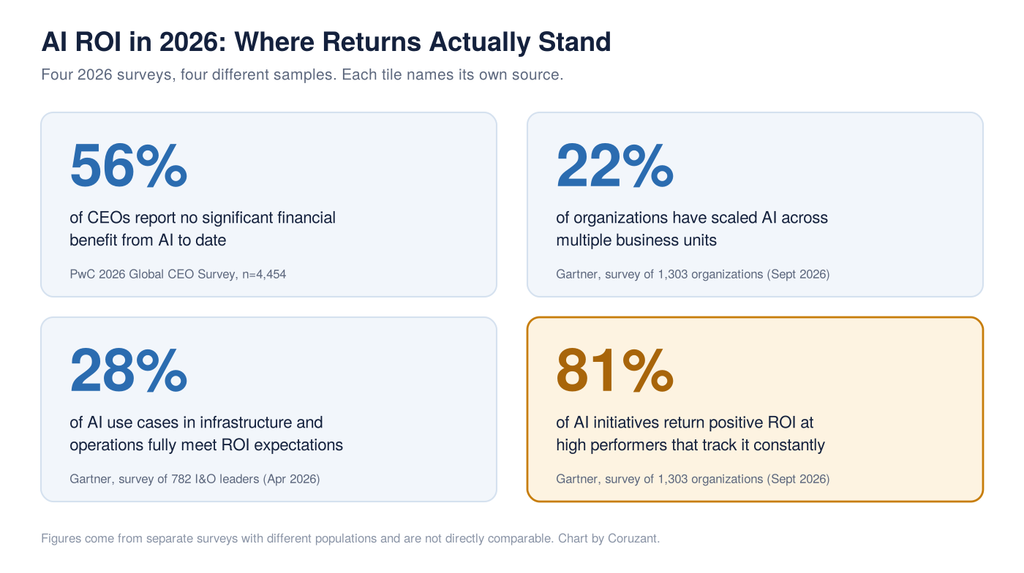
Read together, these surveys say the same thing. A minority of companies have figured out how to turn AI into money, and they’re pulling away from everyone else.
Why AI ROI Is So Hard to Prove
The productivity paradox
Start here, because it explains most of the gap. Most AI tools save time. Time saved is not money saved.
If your analysts each get back five hours a week but headcount, overtime, and output stay the same, the P&L doesn’t move. Economists call this the productivity paradox, and it explains a lot of the gap between “our people love it” and “finance can’t find it.” The hours have to go somewhere measurable: more deals closed, contractors not renewed, a backlog cleared, a hire you didn’t need to make.
Spend is scattered across the business
BCG estimates that more than 80% of AI spending now sits outside enterprise IT budgets. Marketing buys one tool, sales buys another, finance runs its own pilot. Nobody owns the full cost, so nobody can report the full return.
Nobody took a baseline
You can’t show improvement without a “before” number. A surprising number of AI projects launch without one, then try to reconstruct it from memory six months later. That rarely survives a CFO’s questions.
Expectations were set too high
Among infrastructure leaders who reported a failed AI initiative, 57% said they expected too much, too fast. A pilot that should take a year gets judged after a quarter, and a fair return gets labeled a failure.
How to Measure AI ROI: A Five-Step Method
You don’t need a consulting engagement for this. You need discipline, and a spreadsheet you actually update.
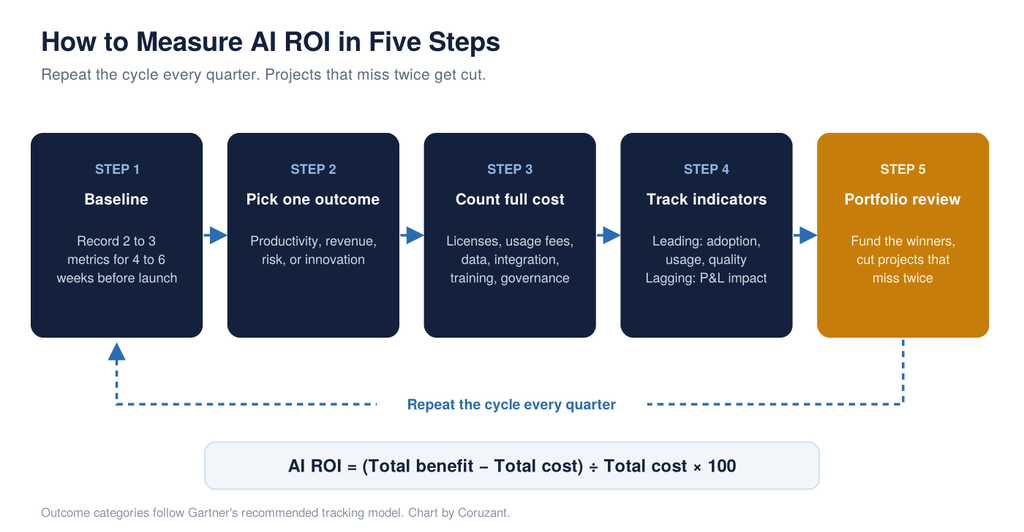
Step 1: Measure the baseline before launch
Pick the two or three metrics the project is supposed to move and record them for at least four to six weeks before go-live. Cycle time, cost per ticket, conversion rate, error rate, revenue per rep. Whatever the business already tracks.
Step 2: Tie every project to one outcome category
Gartner recommends tracking AI spend by outcome: productivity, revenue growth, risk reduction, or innovation. Choose one primary category per project. A tool that claims to do all four usually proves none of them.
| Outcome category | Example metrics |
|---|---|
| Productivity | Hours saved, cost per transaction, output per employee |
| Revenue growth | Conversion rate, deal size, upsell rate, time to close |
| Risk reduction | Fraud losses, compliance findings, error rates |
| Innovation | New products launched, time to market, new revenue lines |
Step 3: Count the full cost
Add up licenses and usage fees, integration, data work, training, governance, and the internal hours your own team spends. Then add a buffer. The next section lists the costs that most often go missing.
Step 4: Track leading and lagging indicators
Lagging indicators, such as revenue, margin, and cost savings, take months to show up. Leading indicators warn you much sooner if a project is drifting: adoption rate, weekly active users, tasks completed with AI, quality scores. If adoption is flat at month two, the revenue impact at month nine won’t save you.
Step 5: Review as a portfolio and cut the losers
Treat AI projects the way an investor treats a portfolio. Review them every quarter, put more money behind the winners, and shut down the ones that miss their milestones twice. Sunk costs are sunk. Keeping a weak pilot alive out of pride is the most expensive habit in enterprise AI.
The Costs Most AI ROI Models Miss
Vendors quote the license. You pay for everything around it.
| Cost | Why it gets missed |
|---|---|
| Usage and inference fees | Billed per token or call, so they grow with adoption and rarely appear in the original business case |
| Data preparation | Cleaning, labeling, and connecting data often takes longer than the AI build itself |
| Integration | Connecting the tool to CRM, ERP, or ticketing systems is usually internal engineering time |
| Training and change management | People need time to learn new workflows, and output dips while they do |
| Governance and compliance | Policies, audits, and new rules such as the EU AI Act’s disclosure duties |
| Monitoring and maintenance | Models drift, prompts break, and vendors change pricing |
| Customization | Fine-tuning or retrieval setups for company-specific knowledge |
Two of these deserve a closer look. Compliance is no longer optional in Europe: if your AI produces customer-facing content, the EU’s Article 50 disclosure rules cover it, and someone has to own that work. Customization costs vary wildly by approach. Lightweight methods such as LoRA fine-tuning can cut the bill sharply compared with training a model from scratch.
Seat-priced platforms need their own math, too. A specialist research tool can cost five figures per user per year, as the AlphaSense review shows, so the return has to be measured per seat, not per company.
A Worked AI ROI Example
Here’s a hypothetical case to show how the numbers behave. Picture a 40-person customer support team rolling out an AI assistant.
Year-one costs:
- Licenses and usage fees: $60,000
- Integration with the ticketing system: $40,000
- Training and change management: $15,000
- Monitoring and ongoing tuning: $25,000
- Total: $140,000
The assistant cuts average handling time by 20%. That’s a productivity win, and on its own it’s worth exactly $0 in hard return, because nobody’s paycheck changed.
Now say the team uses the freed capacity to absorb seasonal volume instead of hiring four contract agents ($110,000 avoided) and cuts overtime by $90,000. Total hard benefit: $200,000.
AI ROI = ($200,000 − $140,000) ÷ $140,000 = 43%
Same tool, same time savings. The ROI only appeared once the hours were turned into a decision someone could see on a budget line. That step is where most AI business cases quietly fall apart.
What High Performers Do Differently
The companies getting real returns aren’t using secret models. They’re running a tighter process.
Gartner found that high performers, the organizations that constantly track ROI and manage AI as a portfolio, report positive returns on 81% of their AI initiatives. Low performers couldn’t say what return 29% of their projects produced at all.
They also spend more on the boring parts. Gartner’s research shows organizations with successful AI initiatives invest up to four times more, as a share of revenue, in data quality and governance than those with poor outcomes. PwC found the same pattern from the CEO side: companies with strong AI foundations were three times as likely to report meaningful financial returns.
And they measure in the P&L, not in slide decks. BCG’s leaders tie AI impact directly to revenue and cost lines, then redesign whole workflows instead of bolting AI onto old ones.
None of that is glamorous and all of it is repeatable.
Conclusion
AI ROI is measurable. Most companies just haven’t done the measuring. Take a baseline before you launch, tie each project to one outcome, count every cost, and decide in advance where the saved time will go. Without that last step, you’ll have happy users and an empty line in the budget review.
Then run your AI spend like a portfolio. Back the projects that move real numbers, and stop funding the ones that only move sentiment. If you do that every quarter, the next time someone asks what AI returned, you’ll have the answer ready.
Read Next
Planning your next AI investment? These are worth a look:
- Customer Journey Analytics Examples
- What Are Vision-Language-Action (VLA) Models?
- Coruzant AI Coverage
Frequently Asked Questions
AI ROI is the return on investment from an AI initiative, measured as the business gain it produces compared with its total cost. That cost includes licenses, usage fees, data work, integration, training, and governance. A reliable AI ROI figure compares results against a baseline measured before launch.
You calculate AI ROI by subtracting total cost from total benefit, dividing by total cost, and multiplying by 100. The hard part is the inputs. Count only benefits that show up in revenue, cost, or risk figures, and count every cost around the software as well as the bill itself.
A good AI ROI is one that beats what the same money would earn elsewhere in your business, after every cost is counted. There’s no universal benchmark, because returns vary by use case and industry. Set a target per project before launch and judge it against that.
AI ROI often takes longer than teams expect. Leading indicators such as adoption should move within weeks, while revenue and cost impact can take several quarters or more. Gartner found that 57% of failed infrastructure AI projects collapsed because leaders expected results too fast.
Most AI projects fail to show ROI because they lack a baseline, ignore hidden costs, or never turn time saved into a measurable business outcome. Scattered ownership makes it worse, with BCG estimating that over 80% of AI spending now sits outside IT budgets.