

AlphaSense sells AI research to the people who read earnings transcripts for a living, and its timing is good: 69% of middle-market financial services firms already use generative AI in their operations (Source: RSM Middle Market AI Survey 2026). Most of those firms have a ChatGPT login somewhere. Far fewer pay five figures a seat for a specialist research platform, and that gap is what this review is about.
You’ll get an idea of what AlphaSense does, what buyers say they pay for it (the company won’t tell you), where it disappoints, and which tools to look at if the quote makes you wince.
About this review: Coruzant covers AI, fintech, and the tools executives use to make decisions. AlphaSense is one of the fastest-growing AI research platforms in finance, with search interest roughly doubling over the past two years, so it belongs in that coverage. This review draws on public reporting, buyer-reported pricing data, verified user reviews, and AlphaSense’s own product documentation. AlphaSense did not sponsor or review this article.
Key Takeaways
- AlphaSense runs AI search over 500 million+ licensed business documents.
- No public pricing. Buyer data puts the median contract near $17,500.
- The Tegus expert transcripts are the main reason to pay the premium.
- Budget for a learning curve and for expert call add-ons.
- Hebbia, 9fin, and Bloomberg Terminal each beat it at one specific job.
Table of contents
What Is AlphaSense?
AlphaSense is a market intelligence platform. You ask a research question in normal language, and it answers from filings, earnings call transcripts, broker research, expert interviews, news, and (on the top tier) your company’s own files, with a citation on every claim.
Jack Kokko and Raj Neervannan started it in 2011. The company sits in Hudson Yards, New York, with Kokko as CEO and Neervannan as CTO.
The last two years have been big ones. In June 2026 AlphaSense raised $350 million at a $7.5 billion valuation, almost double the $4 billion it was valued at in 2024. Vitruvian Partners, Accenture Ventures, and J.P. Morgan Asset Management led the round. Annual recurring revenue passed $600 million in Q1 2026, and the customer count is above 7,000 enterprises.
Much of what you see in the product was bought rather than built. AlphaSense acquired Sentieo, the modeling company Canalyst, the filings tool BamSEC, and in June 2024 the expert transcript library Tegus, for $930 million. Plenty of comparison pages still list Tegus as a competitor, which has been wrong since mid-2024.
How AlphaSense Works
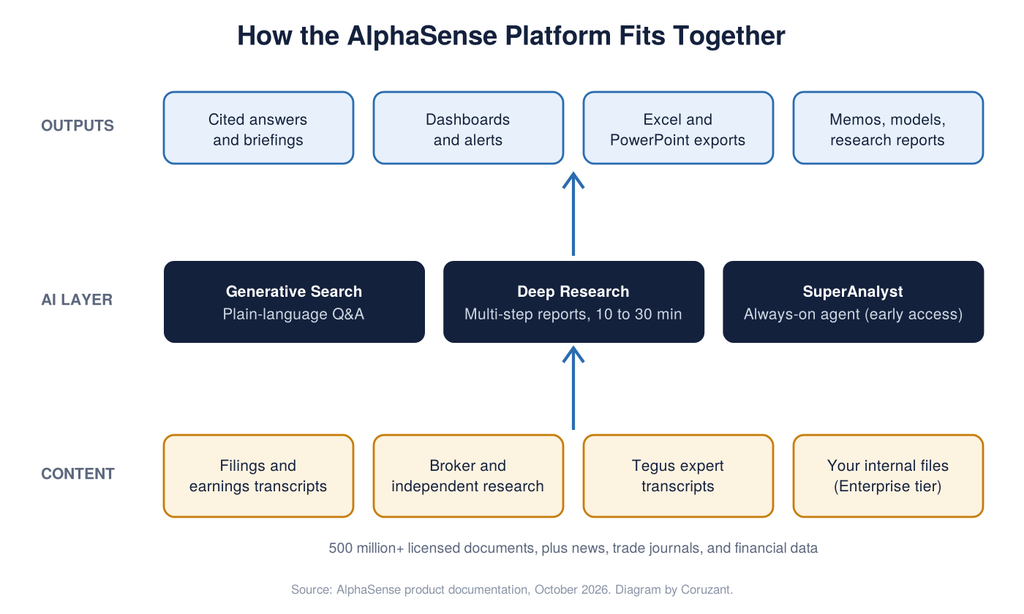
The content does most of the work here. AlphaSense licenses and indexes more than 500 million documents: company filings and transcripts, sell-side research from the banks, independent research, trade journals, news, and the Tegus interviews. Enterprise customers can plug in their shared drives too, so old memos and pitch decks become searchable alongside everything else.
Three AI tools sit on top of that library. Generative Search handles quick questions. Deep Research runs longer investigations and writes them up. SuperAnalyst, the newest, keeps watching a topic after you’ve closed the tab.
What comes out the other end is summaries, briefings, tables, dashboards, alerts, and exports to Excel and PowerPoint. Each answer links to the exact passage it came from. If an AI tool has ever handed you a made-up revenue figure, you’ll click those links more than anything else on the page.
Key AlphaSense Features
Generative Search
You’ll use this one daily. Type “What did management say about pricing pressure on the last two calls?” and you get a short written answer with inline citations. It handles finance vocabulary well. “Guidance” means guidance, and it knows the difference between gross and operating margin.
Deep Research
Deep Research came out in June 2025. It plans its own research path, runs dozens of searches, shows why it picked each source, and writes a structured report. Expect 10 to 30 minutes per question. Use it for an M&A screen or a full industry study, never for a quick fact check.
SuperAnalyst
AlphaSense announced SuperAnalyst in June 2026. It’s an agent that monitors filings, earnings, and transcripts around the clock, remembers project history between sessions, and drafts briefs, memos, models, and slides. It can also find experts and run AI-led expert calls. At launch it was early access for selected enterprise customers only, so ask whether your quote includes it before you count on it.
Expert Insights
This is the Tegus library: interview transcripts with former executives, customers, and competitors of the companies you track. On a private company with almost no public disclosure, these transcripts are often the only detailed view you’ll find anywhere. Live expert calls exist too, billed on top.
Enterprise Intelligence
The top tier connects your internal content to the same AI search, adds private cloud hosting, and opens API uploads. Firms with strict IT and compliance teams tend to end up here.
Financial Data and Monitoring
Fundamentals, screening, comps, transaction data, and the Canalyst models live next to the documents. Dashboards and alerts flag new mentions of a company, theme, or competitor, and there’s a mobile app for the alerts.
AlphaSense Pricing
AlphaSense publishes no prices. Every plan is an annual subscription quoted through sales. There’s no monthly option.
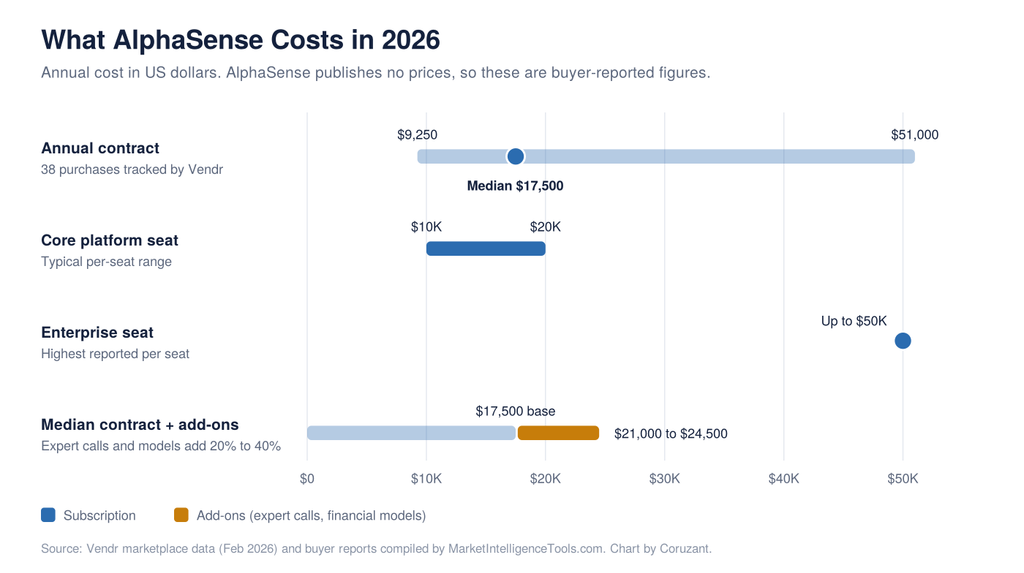
Buyer data fills the gap. Vendr tracked 38 AlphaSense purchases (updated February 2026) and found a median annual contract of $17,500, with deals ranging from $9,250 to $51,000. Seats on the core platform usually cost $10,000 to $20,000 a year. Enterprise seats have been reported as high as $50,000.
| Pricing factor | What to expect |
|---|---|
| Public price list | None, quote only |
| Median annual contract | About $17,500 (Vendr, Feb 2026) |
| Observed contract range | $9,250 to $51,000 per year |
| Billing | Annual subscription, no monthly option |
| Packages | Market Intelligence, Enterprise Intelligence |
| Priced separately | Expert calls, Canalyst financial models |
| Renewal | Auto-renews; reported escalators of 3% to 5% |
Market Intelligence is the standard package: company documents, broker and independent research, expert transcripts, and news. Enterprise Intelligence adds internal document search, private cloud hosting, and API access.
The add-ons are where budgets slip. Expert calls come as prepaid credits or per-call fees, and Canalyst models are quoted separately. Heavy users report these extras adding 20% to 40% on top of the contract.
What Else You Should Know
You can push on price. Seat rates drop at volume thresholds, and buyers on two- or three-year terms report 10% to 20% off. Two things I’d do before signing: ask for the next volume tier’s per-seat rate even if you’re a seat or two short, and put the cancellation deadline in your calendar the day you sign. Contracts auto-renew unless you give notice 60 to 90 days ahead, and that window is easy to miss.
The website has a free sign-up and lets you request a trial. AlphaSense doesn’t publish how long the trial runs or what’s in it, so check with your rep, especially if you want to test the newer agents.
Who AlphaSense Is For
Hedge funds, private equity firms, and investment banks get the most out of it. Their analysts already read transcripts and broker notes every day, and expert interviews feed straight into investment calls.
Corporate strategy, competitive intelligence, and business development teams at large companies come next. Consulting firms use it to get up to speed on an unfamiliar industry in the first week of a project.
For a founder doing occasional market sizing, or a small marketing team, I’d pass. At $10,000 a seat and up, a general AI assistant plus a couple of bought reports covers that need for a fraction of the money.
AlphaSense Pros and Cons
AlphaSense rates 4.6 out of 5 on G2 across 366 reviews, and the reviewers tend to praise and complain about the same handful of things.
Pros
- Filings, transcripts, broker research, and expert calls all sit behind one search bar.
- Every AI answer cites the source passage, which compliance teams appreciate.
- Broker research and expert transcripts are licensed content you can’t get from the open web.
- Reviewers keep mentioning hours saved during earnings season.
Cons
- Five-figure, quote-only pricing shuts out small teams.
- Advanced search syntax and alert setup take a while to learn.
- Some reviewers report stale or incomplete financial data, and some brokers block their reports from AI analysis.
- Deep Research is slow, and outputs are mostly text with limited visuals.
- Expert calls and models can push the real bill well past the first quote.
AlphaSense Alternatives
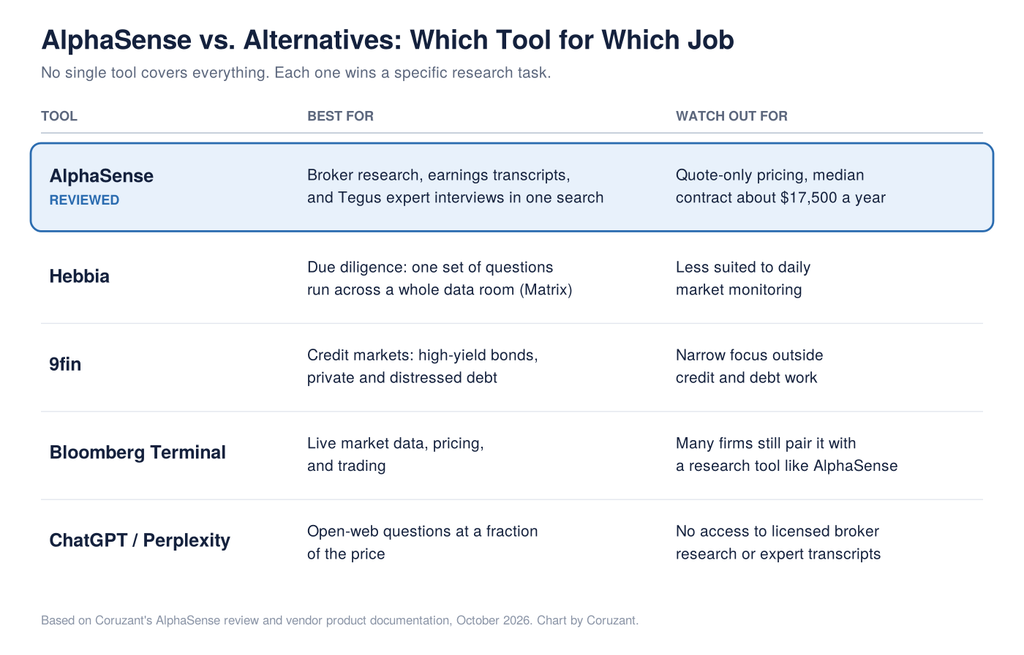
Nothing replaces AlphaSense across the board. A few tools beat it at one job each.
Hebbia is the nearest AI-native rival. Its Matrix view runs one set of questions across hundreds of documents at once, which suits due diligence on a data room better than daily market monitoring.
9fin is built for credit markets, from high-yield bonds to private and distressed debt. If your desk lives in bond documents and loan terms, it goes deeper there.
Bloomberg Terminal is still the default for live market data, pricing, and trading. Plenty of firms keep both: Bloomberg for markets, AlphaSense for research.
ChatGPT and Perplexity, with their deep research modes, cost a fraction of the price and handle open-web questions fine. They can’t see licensed broker research or expert transcripts, and that content is most of what an AlphaSense contract buys.
For more reviews of tools like these, see the Coruzant AI section and the fintech coverage hub.
Is AlphaSense Worth It?
For a team that reads transcripts, broker notes, and expert interviews every week, yes. The citations hold up, nobody else has this content library in one place, and the agent features are improving fast.
For occasional research, I doubt the numbers add up. Get a quote, price the add-ons properly, and run a two-week trial next to Hebbia or a general AI tool before you agree to a multi-year term. Then look at which one your analysts actually kept opening.
Read Next
Comparing AI tools for your team? Start here:
- Best AI Meeting Note Taker in 2026: 5 Tools Reviewed, Tested and Ranked
- The Digital Executive Podcast
- Coruzant Analytics Coverage
Frequently Asked Questions
AlphaSense is an AI market intelligence platform that searches more than 500 million business documents, including filings, earnings transcripts, broker research, and expert interviews. It answers research questions in plain language and cites a source for each point. Analysts, investors, and corporate strategy teams are its main users.
AlphaSense pricing is quoted per customer on an annual contract and isn’t published. Vendr’s buyer data puts the median annual contract at about $17,500, with deals from roughly $9,250 to $51,000. Expert calls and financial models cost extra.
AlphaSense offers a free sign-up and trial requests on its website. It doesn’t publish the trial length or which features are included. Ask a sales rep before you start testing.
AlphaSense bought Tegus in June 2024 for $930 million. The Tegus expert transcript library now runs inside AlphaSense as Tegus Expert Insights. Comparisons that list Tegus as a separate competitor are out of date.
AlphaSense and Bloomberg Terminal do different jobs. AlphaSense is stronger for research across documents and expert interviews, and Bloomberg leads on live market data and trading. Many investment firms pay for both.