


Open-weight models now handle 34% of enterprise AI token usage, up from 23% a year ago (Source: Enterprise Technology Research). That’s a lot of companies building on models they can download, run, and modify. Fewer of them could tell you whether those models are actually open source. Most aren’t.
The two terms get used as if they mean the same thing. They don’t, and the gap matters the moment your legal team reads the license or your engineers try to retrain a model from scratch. This guide explains what each term means, where the line sits, which licenses to watch, and how to decide what your business should build on.
Key Takeaways
- Open-weight models share trained weights but usually not training data.
- Open-source AI also requires training code and detailed data information.
- Licenses range from fully permissive to restrictive custom terms.
- Open-weight models trail the closed frontier by roughly four months.
- Read the license before you build, not after you ship.
Table of contents
- Key Takeaways
- What Is an Open-Weight Model?
- What Makes an AI Model Open Source?
- Why Everyone Calls Open-Weight Models “Open Source”
- Open-Weight vs. Open-Source: Side by Side
- Read the License Before You Build
- Why Businesses Choose Open-Weight Models
- The Trade-offs Nobody Puts in the Pitch
- How to Choose: Open-Weight, Open-Source, or Closed
- Conclusion
- Read Next
- Frequently Asked Questions
What Is an Open-Weight Model?
An open-weight model is an AI model whose trained parameters, the weights, are published for anyone to download. You can run it on your own hardware, fine-tune it on your own data, and deploy it without calling someone else’s API.
What you usually don’t get is everything that produced those weights. The training dataset stays private. The full training code often does too. You get the finished product, not the recipe.
The closest software comparison is a compiled program. You can run it, and with the right skills you can adjust its behavior, but you can’t rebuild it from source because you don’t have the source.
Most of the well-known “open” models sit in this category: Meta’s Llama family, Google’s Gemma, Mistral’s large models, DeepSeek, Qwen, and OpenAI’s gpt-oss.
What Makes an AI Model Open Source?
Open source has a formal definition. The Open Source Initiative, the body that has stewarded the term for software since 1998, published the Open Source AI Definition 1.0 in October 2024.
It requires four freedoms: you can use the system for any purpose, study how it works, modify it, and share it. To make modification realistic, the definition says you need three things:
- Data information: enough detail about the training data for a skilled person to build a substantially equivalent system
- Code: the complete source used to train and run the model, including data processing
- Parameters: the weights themselves
Weights alone cover one of the three. That’s why the OSI has publicly said Llama is not open source, despite Meta’s marketing.
Only a small group of models clears the full bar. Ai2’s OLMo family is the usual example: it ships weights, training data, training code, and evaluation tools together.
Why Everyone Calls Open-Weight Models “Open Source”
Partly habit, partly marketing. For decades, “open source” meant you could see and change the code. When labs started publishing model weights, the label came along for the ride, because weights felt like the code of an AI system.
They aren’t, quite. In traditional software, the source code is the whole thing you need to rebuild a program. In machine learning, the weights are an output. The real ingredients are the data, the training code, and enormous amounts of compute. Publishing weights without the data is closer to releasing a finished binary than releasing source.
There’s also a commercial reason the loose label sticks. “Open source” carries goodwill with developers and regulators. A company that releases weights under restrictive terms still gets to borrow some of that goodwill. That’s why the OSI pushed back so hard, and why you’ll now see careful labs say “open-weight” on purpose.
Open-Weight vs. Open-Source: Side by Side
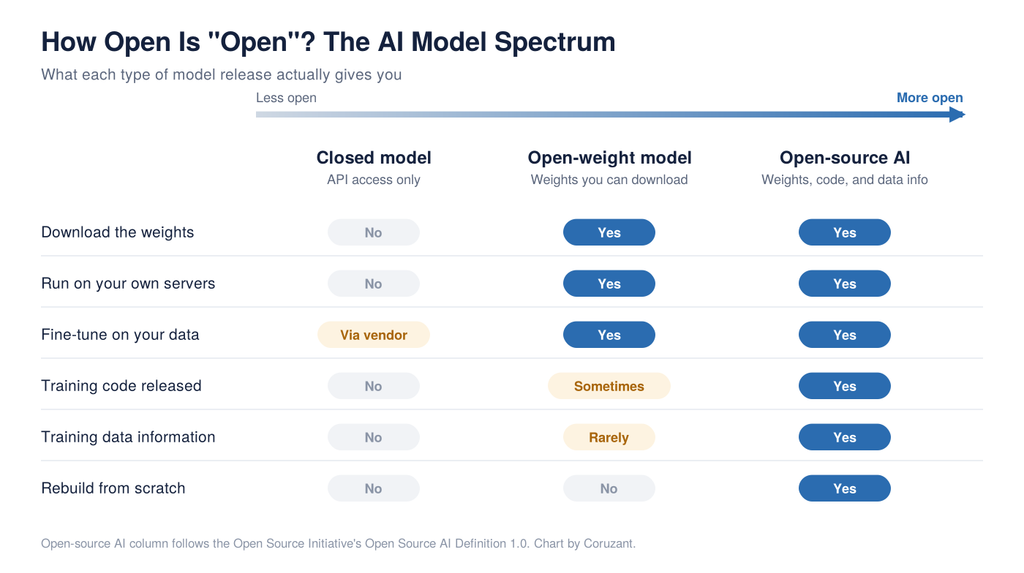
| Closed model | Open-weight model | Open-source AI | |
|---|---|---|---|
| Download the weights | No | Yes | Yes |
| Run on your own servers | No | Yes | Yes |
| Fine-tune on your data | Limited, via vendor | Yes | Yes |
| Training code released | No | Sometimes partial | Yes |
| Training data information | No | Rarely | Yes |
| Rebuild from scratch | No | No | Yes |
| License freedom | Vendor terms | Varies widely | Must meet OSI freedoms |
For most companies, the middle column is the one that matters day to day. Running a model on your own infrastructure and fine-tuning it covers what nearly every enterprise team needs. Full rebuildability matters most to researchers, auditors, and anyone who has to prove exactly what went into a model.
Read the License Before You Build
This is where “open” gets expensive if you skim. Open-weight licenses fall into three rough groups.
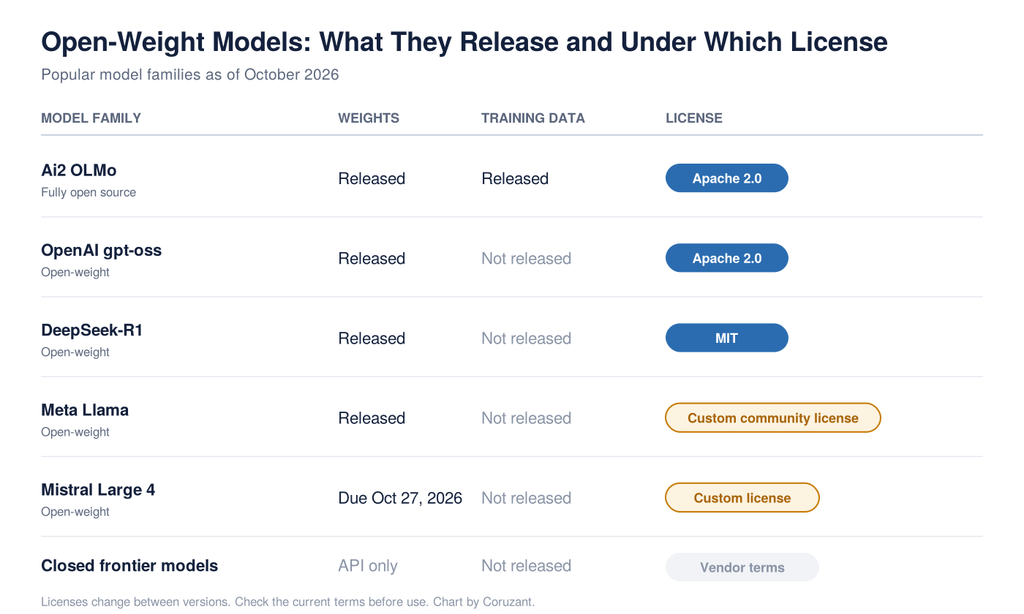
Permissive licenses such as Apache 2.0 and MIT let you use, modify, and sell products built on the model with few strings attached. OpenAI’s gpt-oss models ship under Apache 2.0. DeepSeek-R1 uses MIT.
Custom community licenses let you use the weights commercially, with conditions. Meta’s Llama license, for example, requires a separate agreement for companies above 700 million monthly active users and attaches an acceptable use policy. Google’s Gemma terms carry their own prohibited-use rules.
Restricted licenses limit use to research or non-commercial work, which rules them out for most products.
Licenses also change between versions, which catches teams off guard. Mistral released Large 3 under Apache 2.0. Its new Large 4, a model of roughly one trillion parameters, is expected to ship under a custom license instead, with weights promised by the end of October 2026. As of mid-October, Mistral’s own model page still listed no license at all. Same company, same product line, and nobody outside Mistral knows the rules yet.
A quick license checklist
Before anyone on your team downloads a model for production, get answers to these:
- Is commercial use allowed, and are there revenue or user-count thresholds?
- Is there an acceptable use policy, and does your use case fall inside it?
- Can you distribute fine-tuned versions, or only use them internally?
- Do you have to credit the model or name it in your product?
- Can you use the model’s outputs to train other models?
- What happens to your rights if the license changes in a future version?
If the answers aren’t clear from the license text, treat that as an answer too. Ambiguity in a model license tends to get resolved in the licensor’s favor.
Why Businesses Choose Open-Weight Models
The ETR numbers show the shift is real. Respondents expect open-weight models to reach 41% of their token usage within the next 12 months. The reasons are practical.
Control over data. Running a model inside your own cloud or data center means prompts and documents never leave your environment. For banks, insurers, and healthcare firms, that’s often the deciding factor.
Cost at scale. API pricing is easy to start with and painful at volume. Once usage is steady and high, hosting your own model can cost less per token, though you take on the infrastructure bill.
Customization. You can adapt the model to your domain, terminology, and tone. Methods such as LoRA fine-tuning make this affordable without retraining the whole model.
No surprise deprecations. A downloaded model doesn’t disappear when a vendor retires an API version. You decide when to upgrade.
The Trade-offs Nobody Puts in the Pitch
Open-weight models come with real costs, and I’d rather you hear them here than in month three.
Performance lag. Epoch AI found that since January 2026 the best open-weight models have trailed the closed frontier by about four months on average. For many business tasks that gap doesn’t matter. For the hardest reasoning and coding work, it can.
You run it, you own it. Hosting means GPUs, monitoring, scaling, security patches, and someone on call. That’s a team, not a checkbox.
License risk. A custom license can restrict use cases, require attribution, or change on the next release. Your legal team needs to review it like any other vendor contract.
Compliance doesn’t disappear. An open license doesn’t exempt you from regulation. If your system generates content for EU audiences, the AI Act’s Article 50 transparency rules still apply, whatever license the model ships under.
Weights can’t be recalled. Once weights are public, nobody can patch every copy. If a safety issue turns up later, older versions stay in circulation.
How to Choose: Open-Weight, Open-Source, or Closed
Start with what you actually need, not with the label.
Choose a closed model if you need the strongest possible performance today, have low or unpredictable volume, and don’t have an infrastructure team.
Choose an open-weight model if data has to stay in your environment, your volume is high and steady, or you need to fine-tune on proprietary data. Pick one with a permissive license unless a custom license’s terms clearly fit your use.
Choose fully open-source AI if you need to audit exactly what went into a model, publish reproducible research, or meet a procurement rule that demands full transparency.
Plenty of companies end up running more than one. A closed model handles the hardest tasks, an open-weight model handles high-volume internal work, and the two sit behind the same routing layer.
Conclusion
Open-weight and open source aren’t the same thing. Open-weight gives you the model. Open source gives you the model plus the means to rebuild it. Most of the models businesses call “open” are open-weight, and for most business needs that’s enough, as long as you know what the license allows.
Before your team commits, read the license line by line, check whether it changed from the last version, and budget for the infrastructure you’ll now own. Get those three right, and an open-weight model can give you control and cost savings a closed API can’t.
Read Next
If you’re weighing your next AI build, start with these:
- AI ROI: How to Measure It When Most Companies Still Can’t
- What Are Vision-Language-Action (VLA) Models?
- Coruzant AI Coverage
Frequently Asked Questions
An open-weight model is an AI model whose trained weights are published for anyone to download, run, and fine-tune. The training data and full training code usually stay private. Llama, Gemma, Mistral, DeepSeek, Qwen, and gpt-oss are common examples.
Most open-weight models are not open source under the Open Source Initiative’s definition. Open-source AI requires the weights plus the training code and enough information about the training data to rebuild the model. Open-weight releases typically share only the weights.
Llama is an open-weight model. Meta publishes the weights under a custom community license with usage conditions, but not the training data. The Open Source Initiative has said Llama does not meet its open-source definition.
You can use many open-weight models commercially, but it depends on the license. Apache 2.0 and MIT models allow broad commercial use, while custom licenses may add user caps, acceptable use rules, or attribution requirements. Some licenses ban commercial use entirely.
Open-weight models are close to closed models but still behind at the frontier. Epoch AI estimates the best open-weight models trail leading closed models by about four months on average in 2026. For many everyday business tasks, that gap has little practical effect.