
It is 9:47 on a Thursday night. A real estate buyer finds a three-bedroom apartment she likes and messages three agencies about it. Is it still available? Can she see it this weekend?
One agency replies in 40 seconds. It confirms the apartment is available, offers two Saturday viewing slots, and books one. The other two reply on Friday morning, politely, to a buyer who already has a viewing booked somewhere else.
So, will AI replace real estate agents? Not in this story. Nobody was replaced. The agent who got the viewing still has to show the apartment, read the buyer, and negotiate the deal. What got replaced was the wait.
That distinction is the whole article, and it is a more useful answer than the usual “no, relax” or “yes, panic.”
Key Takeaways
- AI will not replace real estate agents; it takes over repetitive tasks like answering availability questions and booking viewings.
- The most valuable agent tasks, such as negotiation and personal trust, remain human responsibilities that AI cannot replicate.
- Speed to lead is crucial; agents must respond quickly to inquiries, ideally within an hour, to avoid losing potential buyers.
- Real estate technology, like Agentency, should enhance communication and efficiently direct leads to agents when necessary.
- Buyers prioritize agencies that respond promptly over those using AI; effective technology answers questions quickly and connects buyers to agents.
Table of contents
- Will AI Replace Real Estate Agents? Ask the Buyer Who Waited
- What the question gets wrong
- Why the fear is understandable
- The part of the job AI is actually taking
- How Is AI Being Used in Real Estate?
- Where AI in commercial real estate differs
- Speed to Lead: The Metric AI Fixes First
- What the research found
- What fast looks like at 10 p.m.
- Why property leads go cold faster
- What AI Should Never Do in a Property Deal
- Choosing Real Estate Technology That Actually Helps
- What to test before you buy
- Frequently Asked Questions
- What This Comes Down To
Will AI Replace Real Estate Agents? Ask the Buyer Who Waited
The question gets asked a lot. By Ahrefs’ estimates, US searches for it have roughly quadrupled over the last two years. It deserves a straighter answer than it usually gets.
What the question gets wrong
“Will AI replace real estate agents” assumes the job is one thing. It is not. It is a bundle of very different tasks that happen to share a job title.
Some of those tasks need judgment, local knowledge, and a person a buyer can trust with the biggest purchase of their life. Pricing a home. Negotiating an offer. Telling a seller, kindly, that the kitchen is not worth what they think it is. None of that is going anywhere.
Other tasks are repetitive, time-sensitive, and mostly happen when the office is closed. That is the part of the bundle technology is quietly taking apart.
Why the fear is understandable
Agents have heard this before. Online portals were supposed to replace them. So were virtual tours, and before that, the internet itself. Each time, the job changed and the agents who adapted did fine.
The worry this time is that AI can hold a conversation, which feels closer to the actual work. It is a fair concern. It just aims at the wrong part of the conversation.
The part of the job AI is actually taking
Listing questions. Availability checks. Viewing requests. “Is there parking.” “What are the HOA fees.” These arrive at all hours, they repeat endlessly, and they all have answers already written down somewhere in the agency’s own material.
No agent has ever enjoyed answering “is it still available” for the eleventh time on a Sunday evening. That is the work moving to software, and most agents will not miss it. It is also the honest answer to “will AI replace real estate agents”: it replaces a task, not a person.
How Is AI Being Used in Real Estate?
Strip out the hype around AI in real estate and the useful applications today are fairly specific. Here is where it is actually doing work.
Listing and availability questions
The most common use is the least glamorous: answering questions about listings from the agency’s own material. An AI agent that answers listing questions after hours reads the listing pages, brochures, and fee sheets the agency already maintains, and replies from that, with the source attached.
The key word is “own.” A general chatbot will happily guess at an HOA fee. A real estate chatbot trained on the agency’s documents answers with the number that is actually in the listing sheet, or says it does not know.
Area, school, and fee questions
Buyers ask about commute times, nearby schools, parking, pet rules, and what the monthly costs come to. These questions come before the viewing, and they often decide whether the viewing happens at all.
A real estate chatbot can answer them from the agency’s area guides and listing notes, as long as someone wrote those down. If nobody did, the questions it cannot answer become a very useful list of what to add.
Viewing bookings without three forwards
Today, a viewing request often gets forwarded from the inbox to the agent who covers the property, who is out, who forwards it to someone else. A day and a half later, somebody replies.
This is where chatbot automation for real estate earns its keep. The buyer picks a slot in the same conversation where they asked the question, and the agent sees a booked viewing instead of an unread message.
Buyer and tenant qualification before the viewing
Every agent has spent an afternoon at a viewing before discovering the buyer has no financing and a budget well under asking. Qualification questions, asked early and politely, fix that.
Budget range. Timeline. Cash or finance. Something to sell first. A buyer who is already typing will usually answer them, and the agent walks into the viewing knowing who they are meeting.
Where AI in commercial real estate differs
Commercial inquiries tend to be fewer, larger, and more technical: floor areas, lease terms, fit-out allowances. The same principle applies, answer from the documents and hand over early, but the handoff usually comes sooner because the questions get specific fast.
Speed to Lead: The Metric AI Fixes First
If there is one number that explains why this matters, it is response time.
What the research found
In 2011, Harvard Business Review published “The Short Life of Online Sales Leads,” based on an audit of 2,241 US companies that were each sent a test inquiry. Only 37% responded within an hour. 23% never responded at all. The average response time, among those that did reply, was 42 hours.
The same research found that firms that tried to contact a lead within an hour were nearly seven times as likely to qualify it as firms that waited even one hour longer, and more than 60 times as likely as firms that waited a day or more. The study was not about real estate, but anyone who has sold a home will recognize the pattern.
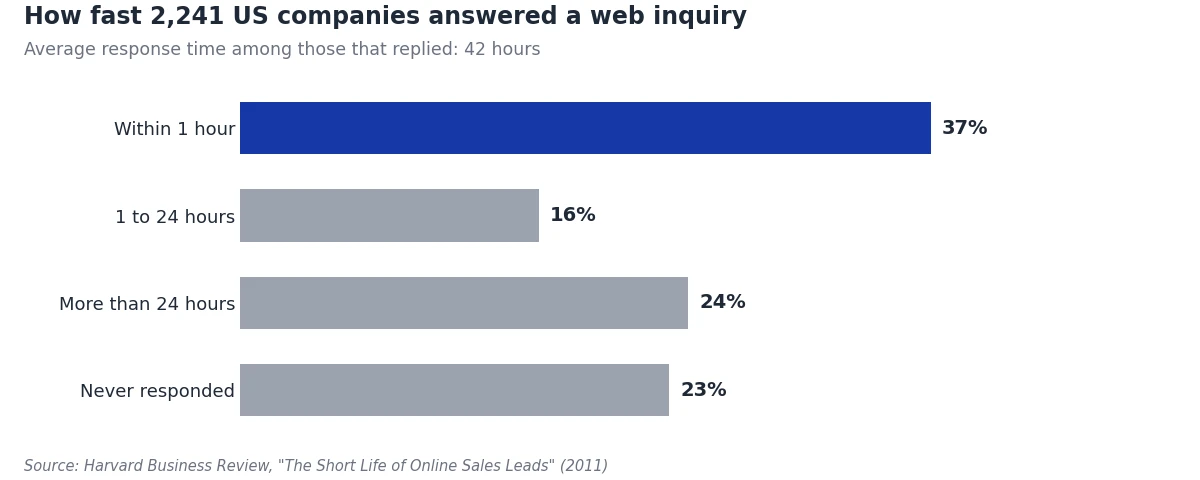
How fast companies answered a web inquiry in the HBR audit. Source: Harvard Business Review (2011).
What fast looks like at 10 p.m.
For most agencies, “fast” at 10 p.m. currently means “first thing tomorrow.” By then, the buyer has often heard from someone else.
An instant reply does not need to close anything. It needs to answer the question, offer a viewing slot, and get the buyer’s name to an agent by morning. That alone changes who gets the first viewing.
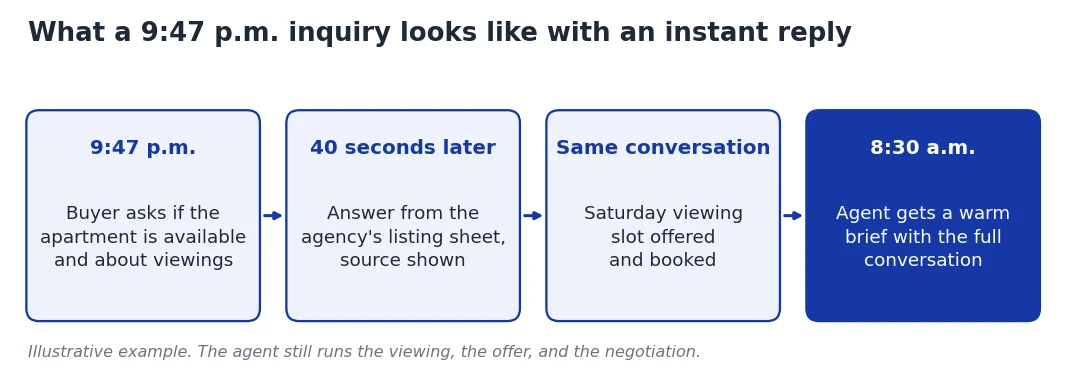
An illustrative after-hours inquiry, from first question to the agent’s morning brief.
Why property leads go cold faster
Real estate has a timing problem most industries do not. People browse listings in the evening and on weekends, which is exactly when offices are closed and agents are, reasonably, off.
So speed to lead in property is not just about working harder. It is about covering the hours when nobody can. That is the gap software fills, and it is why the agents who adopt it tend to see the difference in booked viewings before anything else.
What AI Should Never Do in a Property Deal
Being clear about the limits is what makes the rest of this credible, so here they are.
Offers, negotiation, and mortgage advice stay human
Anything with legal or financial weight belongs with a person. Offers. Counteroffers. Mortgage advice. Contract terms. Anything anyone signs.
An AI tool that wanders into those conversations is creating risk the agency does not need. The time it saves is not worth the one time it gets something wrong.
Decline rather than guess
This is the single most important behavior to look for. When the answer is not in the agency’s material, the system should say so and hand the buyer to a person.
A confident wrong answer about an HOA fee or a lease length is not a small mistake. It is a complaint, and possibly a compliance conversation.
Questions about the neighborhood’s people
Some questions sound simple and are not. In the US, fair housing rules mean agents are careful about how they answer things like “what kind of people live around here,” because the wrong answer can amount to steering.
An AI tool should hand those questions to a person, not improvise an answer. Facts about the property, the fees, and the viewing slots are fine. Characterizing the people in a neighborhood is not.
Choosing Real Estate Technology That Actually Helps
There is no shortage of real estate tools for agents, and the property technology market has plenty of products promising to automate everything. Most agencies need far less than that.
What to test before you buy
Load your real listing documents into any proptech AI tool you are considering. Then ask it three questions: one your documents answer clearly, one they answer vaguely, and one they do not answer at all.
A good tool answers the first with a source, handles the second carefully, and declines the third. If it answers all three with the same confidence, keep looking.
Then check where it lives. Most real estate AI tools look great on a website demo. But buyers message on WhatsApp, Instagram, and text, so the tool has to work there too, from the same set of answers.
Finally, look at the handoff. Real estate workflow automation is only useful if the agent receives the full conversation, with the buyer’s name, the property, and the questions already answered. Anything less just moves the work around.
If you are comparing AI for real estate agents against a simpler AI chatbot for real estate websites, the same three tests apply. The label matters far less than the behavior.
How Agentency Handles Real Estate Lead Response
We build one of these, so it is only fair to run our own platform through the same tests, and to answer “will AI replace real estate agents” from the other side of the table: ours is built to hand buyers to agents, not around them.
It answers from your listings, with the source shown
Agentency answers sales and rental questions from the documents and pages the agency already maintains: crawled listing pages, uploaded PDFs, or pasted text. Every answer shows its source, and the built-in test chat lets you ask the questions your team is tired of before any buyer does.
It books viewings and checks live records
The agent handles viewing-slot booking in the conversation. When it needs a live listing record, a Call Action connects it to an API you already run, and higher risk actions can require explicit confirmation before anything fires.
It qualifies buyers and tenants, then hands over a warm brief
It asks the qualification questions, captures the applicant’s details, and hands the agent a warm brief with the full transcript attached. The agent starts the call already knowing who the buyer is.
It declines when the answer is not in your material
When the retrieval gate finds nothing relevant, the reply is blocked. The agent says it does not know and passes the conversation to a person, rather than guessing.
One agent across the channels buyers use
The same agent answers on the website widget, WhatsApp, Instagram, SMS, and other channels from one knowledge base, and it replies in the buyer’s language. Data is encrypted in transit, each workspace is isolated, and two-factor authentication is available on every plan.
Frequently Asked Questions
What is proptech?
Proptech, short for property technology, covers software and tools used to buy, sell, rent, manage, or market property. It ranges from listing portals and virtual tours to AI agents that answer buyer questions, such as Agentency, which answers from an agency’s own listing material.
Will real estate agents be replaced by AI?
No. AI is taking over the repetitive, after-hours parts of the job, like availability questions and viewing bookings. Pricing, negotiation, and the trust a buyer places in an agent remain human work.
How fast should real estate agents respond to leads?
As fast as possible, and ideally within the hour. Harvard Business Review research found that firms contacting leads within an hour were nearly seven times as likely to qualify them as firms that waited even one hour longer.
Can AI book property viewings?
Yes. An AI agent can offer available slots and book a viewing in the same conversation where the buyer asked about the property. Tools like Agentency handle viewing-slot booking in the conversation and hand the agent a brief with the full transcript.
Read Next
A few related pieces worth your time:
- Agentic Automation Needs People Who Steer AI and Own Results
- How “Big Guy/Little Guy” Collaboration Can Help MLB Go Yard Again
- How Measurable Data is Enabling Skiers to Level Up
What This Comes Down To
Will AI replace real estate agents? The buyer from Thursday night would probably say the question is aimed at the wrong thing.
She did not choose an agency because it had AI. She chose the one that answered. The agent who showed her the apartment on Saturday was a person, doing the part of the job that only a person can do.
Good real estate technology should be measured the same way: does it get the right answer to the buyer before they go elsewhere, and does it hand them to an agent at the right moment? Everything else is detail. So the next time someone asks “will AI replace real estate agents,” the better question is whether your agency answers at 9:47 on a Thursday night.
Agentency is an AI chatbot builder for customer service and sales. Businesses train the Agentency AI agent on their own website, documents, and product catalogue, and it answers customer questions with the source shown. When the answer is not there, it declines and hands off to a person with the full transcript. One agent covers the website, WhatsApp, Instagram, Messenger, Telegram, Slack, and 10+ channels, in the customer’s language, for ecommerce, real estate, restaurants, and support teams.