
AI content disclosure requirements became enforceable across the European Union on 2 August 2026, in a year when chief marketing officers were already putting an average of 15.3% of their budget into AI while overall marketing spend stayed flat at 7.8% of company revenue (Source: Gartner CMO Spend Survey 2026). The money moved first yet the labeling bill arrived second.
Most of the coverage written about this has been aimed at general counsel. That’s a problem because the obligations that bite hardest fall on the people producing campaign assets, running chatbots, and publishing content. If your AI outputs reach anyone in the EU, the rules reach you, regardless of where your company sits.
Key Takeaways
- Article 50 transparency duties have applied since 2 August 2026.
- Most advertising does not qualify for the lighter disclosure treatment.
- AI translations escape marking. AI summaries and rewrites do not.
- Penalties run to 15 million euros or 3% of worldwide turnover.
- Content made before 2 August needs no retroactive label.
Table of contents
- Key Takeaways
- The Four Duties Sitting Inside Article 50
- Why the Advertising Carve-Out Is Smaller Than You Think
- The Editing Exemption and Where It Stops
- The Text Rule Almost Everyone Misreads
- Dates That Still Matter
- What Enforcement Actually Looks Like
- A Practical Sequence for the Next 60 Days
- Conclusion
- Read Next
- Frequently Asked Questions
The Four Duties Sitting Inside Article 50
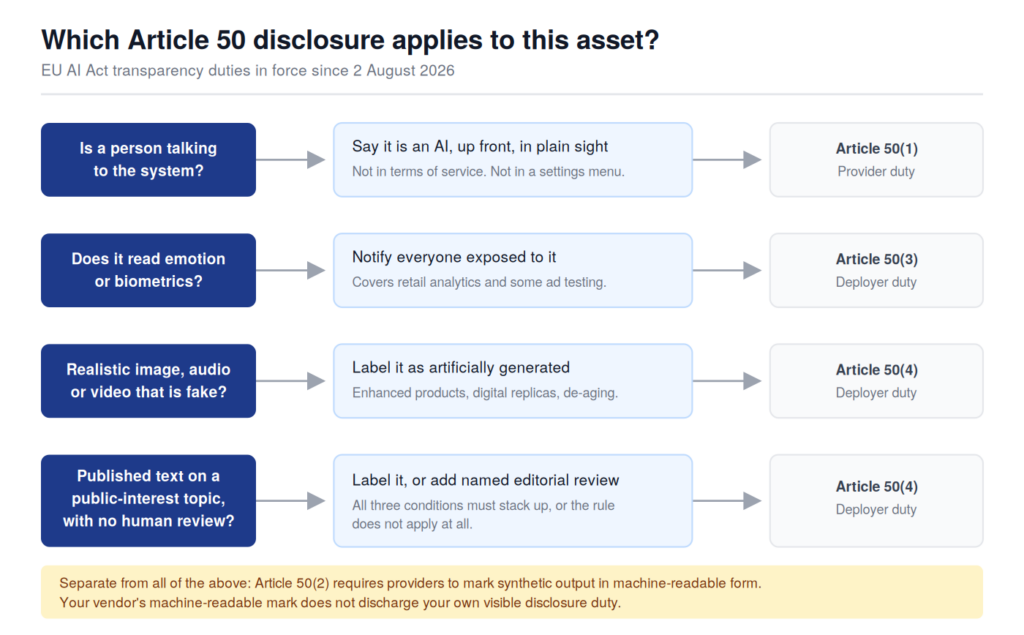
The text of Article 50 of the AI Act splits into four separate obligations, and they do not all land on the same party. Two fall on providers, the companies building and shipping the AI system. Two fall on deployers, which is what your marketing team almost certainly is.
Telling people they are talking to a machine
Any AI system designed to interact directly with people has to make clear that it is an AI, unless that much is already obvious. Chatbots, voice agents, and automated support assistants all count. The final Commission Guidelines are specific about placement: the notice has to be perceivable in practice, delivered at the first interaction at the latest, and not buried in terms of service or a settings menu.
Marking synthetic output so machines can read it
Providers of generative systems must mark synthetic audio, image, video, and text in a machine-readable format so the content is detectable as artificially generated. Watermarking, signed metadata, or both.
Flagging emotion recognition and biometric categorisation
If you run a system that infers emotion or sorts people into biometric categories, you have to tell the people exposed to it. Retail analytics and some ad-testing setups fall inside this without anyone realising.
Labeling deepfakes and certain published text
This is the deployer duty, and it is where marketing lives. Anyone deploying AI to generate or manipulate image, audio, or video content that could pass for real has to disclose it. The same applies to AI-generated text published to inform the public on matters of public interest.
One detail catches teams out constantly. The provider’s machine-readable mark under the second duty does not discharge your visible disclosure duty under the fourth. Two different obligations, two different parties, two different outputs. The Commission’s Article 50 FAQ states plainly that deployers cannot rely on embedded marking to satisfy their own labeling requirement.
Why the Advertising Carve-Out Is Smaller Than You Think
The draft guidelines published in May suggested that creative and artistic content would get a lighter touch. Agencies read that as an advertising exemption and relaxed.
They should not have. When the Commission adopted the final Guidelines on 20 July 2026, the examples told a different story. Advertising can qualify as creative content, but only in narrow circumstances, and most of the advertising examples the Commission worked through did not qualify for the reduced regime. Three specific practices were named as deepfakes requiring disclosure:
- AI-generated marketing content that makes a product look different from reality
- Digital replicas of real people
- De-aging effects applied to actors
Read that first bullet again. Product shots enhanced past what the product actually looks like now carry a labeling duty. Beauty, automotive, food, and fashion teams have been doing exactly this for two years.
There is a further trap for anything that mixes registers. Where content combines informative and creative characteristics, the Guidelines hold that the informative character wins and the standard labeling obligation applies. A product explainer with a stylised treatment is still an explainer.
The Editing Exemption and Where It Stops
Not every touch of AI triggers marking. The final Guidelines widened the standard editing exemption to cover grammar correction, spellchecking, minor stylistic polishing, and, newly, AI-generated translations. Run a campaign through a translation engine for eleven markets and you are outside the marking duty.
Summaries and substantive rewrites did not get the same treatment. Those still require marking. The line the Commission drew sits roughly where meaning starts changing: fix the sentence and you are editing, restate the argument and you are generating. Teams running AI-assisted content pipelines should map their workflow against that boundary now rather than after a complaint. Publications that have already built AI content verification workflows for security reasons will find most of the plumbing is already there.
The Text Rule Almost Everyone Misreads
Article 50(4) covers AI-generated or manipulated text, but only where three conditions stack up together. The text has to be published. It has to inform the public on a matter of public interest. And it has to reach publication without human review or editorial control.
Miss any one of those and the duty does not apply. A product page is not a matter of public interest. An internal memo is not published. And a post that a named editor reviewed, approved, and took responsibility for falls outside the rule entirely, which is the exemption most publishers will rely on.
That last point deserves emphasis because it reverses the intuition. The rule does not punish AI assistance. It punishes unreviewed AI publication. Editorial accountability is the thing being protected, which is roughly the same argument running through the work on provenance and knowledge governance inside enterprises.
Dates That Still Matter
A lot of teams assumed the Digital Omnibus on AI, Regulation (EU) 2026/1744, pushed all of this back. It did not. Published in the Official Journal on 24 July 2026 and in force since 27 July, the Omnibus deferred the high-risk regime to December 2027 and August 2028. Article 50 stayed exactly where it was.
Three dates are worth writing down:
| Date | What applies |
|---|---|
| 2 August 2026 | All four Article 50 duties in force |
| 2 December 2026 | Marking duty reaches generative systems already on the market before August |
| No deadline | Content generated before 2 August needs no retroactive label |
The retroactivity rule has a wrinkle. For images, audio, and video, the date that counts is when the content was generated. For public-interest text, it is the date of publication. Text your team generated in July and scheduled for October is inside the rule.
What Enforcement Actually Looks Like
Breaching Article 50 exposes you to fines of up to 15 million euros or 3% of total worldwide annual turnover, whichever is higher. Smaller companies and startups face the lower of the two rather than the higher. National market surveillance authorities handle enforcement, and they will be working from the Commission’s Guidelines even though those Guidelines are formally non-binding and only the Court of Justice can give an authoritative reading.
The Commission also published a Code of Practice on marking and labelling AI-generated content on 10 June 2026, then assessed it as adequate on 8 July. Signing up is voluntary. It is also currently the only EU-wide recognised route to demonstrating compliance with the marking and labeling obligations, which makes it less optional than the word “voluntary” suggests. The Code asks providers to apply at least two machine-readable techniques rather than one, on the view that no single method is reliable enough on its own.
A Practical Sequence for the Next 60 Days
Start with an inventory. You cannot label what you have not counted, and most organisations underestimate how many AI systems are touching customer-facing output.
Then work through four checks. Does every conversational assistant say it is an AI, up front, in words a person will actually see? Does every generative tool in the stack mark its output in machine-readable form, and have you asked the vendor to confirm that contractually? Do you have a procedure for disclosing deepfakes and unreviewed public-interest text, with someone named as owner? And is any of it written down?
Documentation is the part teams skip and regulators ask for first. The same discipline that leadership teams apply when they fold AI into operating models applies here: the control is only real if somebody owns it and the evidence exists.
One more thing worth doing while you are in there. Map which disclosures sit on which touchpoints, because a label placed at the wrong moment fails the “first exposure” test even when the wording is perfect. Teams that already run customer journey analytics have the map. Most of the work is joining it to the compliance inventory.
Conclusion
Article 50 is narrower than the panic suggests and broader than the shrug suggests. It does not require you to stamp “made with AI” on every asset. It does require you to be honest at four specific moments: when a machine is talking, when output is synthetic, when a system is reading emotions, and when something realistic is fake or something published is unreviewed.
Treat the labeling as a disclosure problem rather than a legal one and you will get to a workable answer faster. Your audience is not confused about whether you use AI. They assume you do. What they cannot tell is which parts, and that gap is exactly what the rule is closing. Getting ahead of it is cheaper than the alternative, and the organisations that built trust into their AI programs early are finding the compliance work mostly amounts to writing down what they already do.
Read Next
A few related pieces worth your time:
- Why Growing Businesses Eventually Need a Digital Marketing Agency
- Digital Strategy coverage
- AI coverage
Frequently Asked Questions
The AI content disclosure requirements sit in Article 50 of the EU AI Act and have applied since 2 August 2026. They cover four situations: telling people when they are interacting with an AI system, marking synthetic output in machine-readable form, notifying people exposed to emotion recognition or biometric categorisation, and labeling deepfakes plus AI-generated text published to inform the public on matters of public interest.
Yes. The AI content disclosure requirements apply wherever the AI system’s output is used in the European Union, not where the company is established. A US or UK business running a chatbot for EU customers, or publishing AI-generated campaign assets that reach EU audiences, is in scope.
No. Standard editing tasks fall outside the marking duty, including grammar correction, spellchecking, minor stylistic polish, and AI-generated translations. Summaries and substantive rewrites still require marking. Visible disclosure is triggered by deepfake content and by unreviewed public-interest text, not by AI assistance in general.
Breaching Article 50 carries fines of up to 15 million euros or 3% of total worldwide annual turnover, whichever is higher, with the lower figure applying to smaller companies and startups. National market surveillance authorities enforce the rules and are expected to follow the Commission’s Guidelines when assessing compliance.
No. Regulation (EU) 2026/1744 deferred the high-risk AI obligations to December 2027 and August 2028, but left Article 50 on its original schedule. The only related concession was a grace period to 2 December 2026 for the machine-readable marking duty, and only for generative systems already on the market before 2 August 2026.