LoRA fine-tuning is now one of the most common ways companies customize AI models without paying to retrain them, and the pressure to spend wisely is real: worldwide AI spending is forecast to reach $2.7 trillion in 2026, up 49.5% on the year before (Source: Gartner, September 2026). Most of that money goes to infrastructure. The part you control is how much compute each model decision burns.
Low-rank adaptation, or LoRA, lets you teach a large model a new skill, style, or domain by training a tiny add-on instead of the whole network. The add-on is often a few megabytes. The model it modifies can be tens of gigabytes. That size gap is what turns fine-tuning from a research-lab expense into a line item a mid-sized team can approve, and it changes how you should think about prompting, RAG, and model ownership.
Key Takeaways
- LoRA trains a small adapter while the original model stays frozen.
- It cuts trainable parameters by orders of magnitude and slashes GPU memory.
- Use it to change behavior or format, not to add fresh facts.
- RAG handles changing knowledge while LoRA handles consistent style and task skill.
- Your adapter is portable IP, but it is tied to one base model.
Table of contents
What Is LoRA?
LoRA is a parameter-efficient fine-tuning method. Instead of updating every weight in a pretrained model, it freezes them and trains a pair of small matrices alongside selected layers. At the end, you have the original model plus a compact adapter that nudges its outputs toward what you want.
Microsoft researchers introduced the technique in 2021. Their original LoRA paper reported that, on GPT-3 175B, it reduced trainable parameters by 10,000 times and GPU memory needs by about three times compared with full fine-tuning, while matching or beating full fine-tuning quality on the models they tested.
Why does this matter to a non-engineer? Because full fine-tuning of a large model was, until recently, something only well-funded labs did. LoRA made it routine. It is now built into standard open-source tooling, and it is what most teams mean when they say they “fine-tuned” an open model for a support assistant that writes in a brand voice or an extraction model that returns clean JSON every time.
How Low-Rank Adaptation Works
A large language model is mostly matrices, huge grids of numbers that transform one layer’s output into the next layer’s input. Fine-tuning traditionally means adjusting all of them.
The low-rank trick
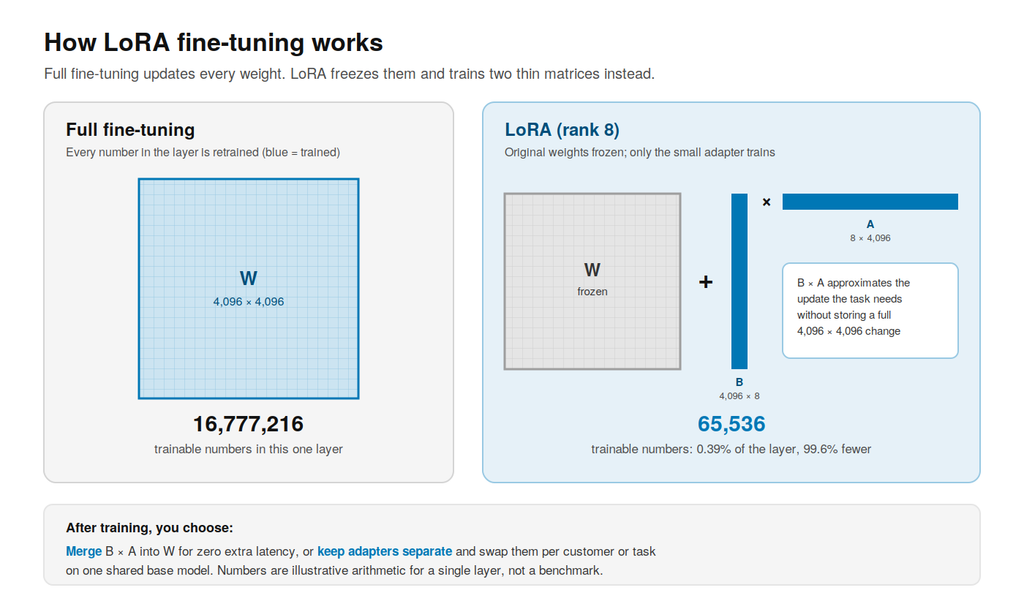
The researchers behind LoRA bet that the change a model needs for a new task is simple, even when the model itself is not. So instead of learning a full update to a 4,096 × 4,096 matrix (about 16.8 million numbers), LoRA learns two thin matrices that multiply together to approximate it. At rank 8, those two matrices hold 65,536 numbers. That is roughly 0.4% of the original.
Rank is the main dial. Low ranks (4 to 16) suit narrow tasks like tone or output format. Higher ranks give the adapter more room for harder specialization, at more cost.
No slowdown at runtime
Once training finishes, the adapter’s small matrices can be merged back into the original weights. The result behaves like a normal model with no extra computation per request. Or you keep adapters separate and swap them in as needed, which opens up a very different serving model covered below.
QLoRA: the budget version
In 2023, University of Washington researchers combined LoRA with 4-bit compression of the frozen base model. QLoRA made it possible to fine-tune a 65-billion-parameter model on a single 48GB GPU while keeping 16-bit fine-tuning performance. For smaller open models, that pushes customization onto a single workstation card.
Why LoRA Changes the Cost Math
Three costs matter when you customize a model: training, storage, and serving. LoRA shrinks all three.
Training. Full fine-tuning with a standard optimizer needs memory for the weights, their gradients, and optimizer state, roughly 16 bytes per parameter before you count anything else. For an 8-billion-parameter model, that is well over 100GB of GPU memory, which means a multi-GPU node. LoRA only computes gradients for the adapter, so the same job often fits on one card.
Storage. A full fine-tuned copy of an 8B model in 16-bit precision is about 16GB. Every variant you make is another 16GB. A typical LoRA adapter for that model is tens of megabytes. Ten customer-specific variants become ten small files and one shared base model.
Serving. This is where the economics really shift. Because adapters are small, one GPU can hold a base model and many adapters at once, routing each request to the right one. Research from Berkeley and Stanford on serving thousands of LoRA adapters showed up to four times higher throughput than earlier approaches, with the number of adapters served growing by several orders of magnitude. In February 2026, AWS engineers published work with the open-source vLLM project on running dozens of fine-tuned variants on shared infrastructure the same way.
Apple uses the same idea at consumer scale. Its 2025 foundation models report describes a developer framework that exposes LoRA adapter fine-tuning for the model running on the device.
The practical upshot: per-customer, per-department, or per-product models stop being a luxury.
Prompting vs. RAG vs. LoRA: Which Do You Need?
LoRA is not always the answer. Most teams should reach for it third, not first.
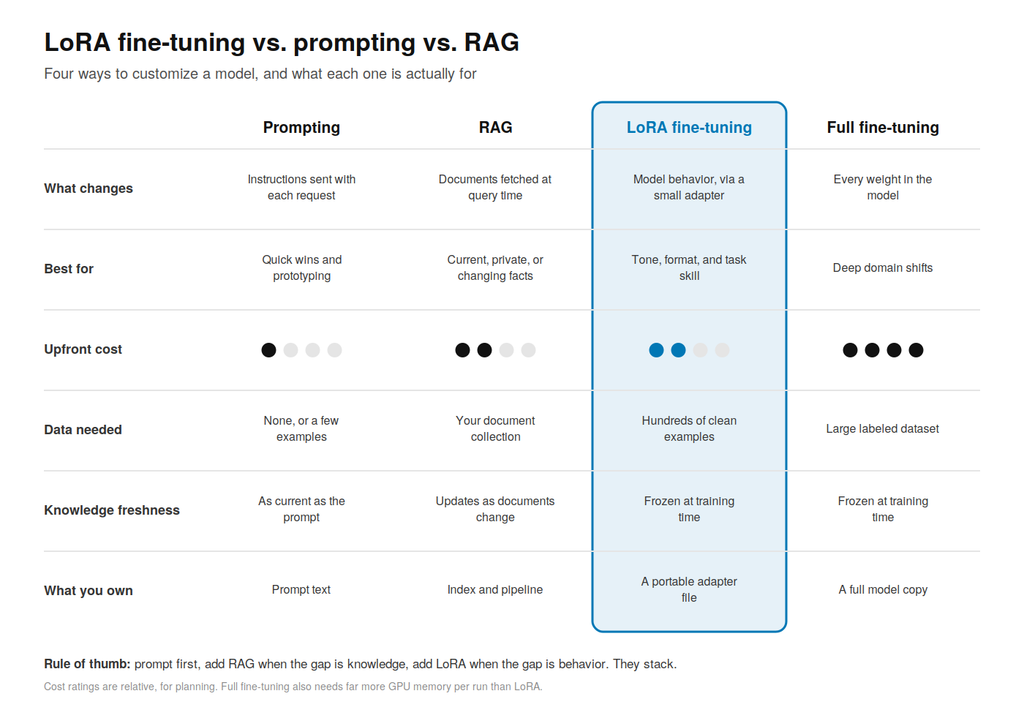
Start with prompting. Clear instructions and a few examples solve more problems than most teams expect, and changing a prompt costs nothing. Good prompt engineering is also how you discover what you actually need the model to do differently. The limit shows up as long, fragile prompts that you repeat on every request and pay for in tokens every time.
Add RAG when the problem is knowledge. Retrieval-augmented generation fetches relevant documents at query time and hands them to the model. Your product catalog changed this morning? RAG sees it. Fine-tuning does not, and retraining an adapter every time a fact changes is a poor trade.
Choose LoRA when the problem is behavior. Consistent tone. A strict output schema. A classification or extraction task the model keeps getting slightly wrong. Domain vocabulary it handles clumsily. These are skills, and skills are what training changes. A useful side effect: once the behavior lives in the adapter, you can delete most of those long instructions from every prompt.
Full fine-tuning is for the rare case where a narrow adapter cannot close the gap, usually deep domain shifts with large, high-quality datasets.
These options stack. A common production pattern pairs a LoRA-tuned model for format and voice with RAG for current facts.
The Ownership Question
For executives, the most underrated feature of LoRA is not cost. It is control.
When you fine-tune through a closed provider’s API, the tuned model usually lives on their platform and runs on their terms. When you apply LoRA to an open-weight model, the adapter is a file you hold. You can run it in your own cloud account, move it between vendors, audit it, and version it like code. For regulated industries, that difference can decide whether a project passes review.
There are strings attached. An adapter is tied to the exact base model it was trained on. When a new version of that model ships, you retrain the adapter. Budget for that, because base models now turn over in months, not years. Check the base model’s license too, since some open-weight licenses restrict commercial use or require attribution.
Ownership also favors smaller models. A well-tuned 3B or 8B model with a task adapter often beats a much larger general model on a narrow job, and it is far cheaper to run. That is the logic behind the shift toward smaller, more efficient AI models.
Where LoRA Falls Short
LoRA is not magic, and a few failure patterns show up again and again.
It is poor at teaching facts. Train an adapter on your policy documents and it may learn to sound like them while still getting details wrong. Use RAG for anything that needs to be accurate and current.
Data quality dominates. A few hundred clean, representative examples usually beat thousands of noisy ones. If your labeled data is inconsistent, the adapter will learn the inconsistency faithfully.
It has limits on hard learning. A 2024 study from Columbia and Databricks researchers found LoRA learned less than full fine-tuning on demanding domains like code and math, though it also forgot less of the base model’s general ability. For most business tasks that trade is a good one. For deep specialization it may not be.
Evaluation is on you. There is no universal benchmark for your task. Build a test set from real cases before training, and compare the adapter against the untuned model with a strong prompt. Sometimes the prompt wins.
How to Get Started With LoRA Fine-Tuning
If you lead the decision, answer five questions before anyone rents a GPU:
- Have you pushed prompting as far as it goes, and documented where it fails?
- Is the gap about behavior (LoRA) or knowledge (RAG)?
- Do you have at least a few hundred high-quality examples of the output you want?
- Which base model will you commit to, and what is its license?
- Who owns retraining when that base model is updated?
If you build, the path is well paved. Hugging Face’s open-source PEFT library is the standard toolkit for LoRA and QLoRA on open models. Managed fine-tuning is also available on the major cloud AI platforms if you would rather not run the infrastructure yourself. Start with a small model, a low rank, and a tight evaluation set, then scale only what the numbers justify.
Conclusion
LoRA turned fine-tuning from an expensive, all-or-nothing retraining job into a small, swappable adapter. Training fits on less hardware, variants cost megabytes instead of gigabytes, and one server can run many customized models at once. That is why it underpins so much practical AI customization today.
For you, the order of operations matters more than the technique. Prompt first. Add RAG when the gap is knowledge. Reach for LoRA when the gap is behavior, and treat the adapter as an asset you own, maintain, and retrain as base models move on.
Read Next
For more on building and governing enterprise AI, start here:
- The Complete Guide to AI Governance Frameworks
- What Is Agentic Orchestration? A Beginner’s Guide
- What Are Vision-Language-Action (VLA) Models? How AI Is Learning to Control Robots
Frequently Asked Questions
LoRA fine-tuning is a method for customizing a pretrained AI model by training small adapter matrices while the original weights stay frozen. The adapter captures the change the model needs for a new task. It uses far less memory and storage than full fine-tuning.
LoRA fine-tuning is not better or worse than RAG since they solve different problems. LoRA changes how a model behaves, such as tone, format, or task skill, whereas RAG supplies current facts at query time, and many production systems use both together.
LoRA fine-tuning often works with a few hundred to a few thousand high-quality examples for narrow tasks. Quality and consistency matter more than volume. Build an evaluation set first so you can tell whether the adapter actually improves on a well-prompted base model.
LoRA trains small adapters on a frozen model stored at normal precision. QLoRA does the same but compresses the frozen model to 4-bit precision during training, which cuts memory further. That lets much larger models be fine-tuned on a single GPU.
A LoRA adapter generally works only with the exact base model it was trained on. When you upgrade to a new model version, you need to retrain the adapter. Plan and budget for that retraining as part of owning a fine-tuned model.