Ship chartering has become increasingly digital. Vessel positions can be tracked on a screen, market information circulates within seconds, freight calculations can be automated, and large volumes of commercial data can be searched almost instantly. These tools have made chartering faster and, when used properly, more precise. They have not, however, removed the need for experienced human judgement.
A chartering decision is rarely a simple match between one cargo and one vessel. It is a commercial commitment shaped by timing, geography, vessel suitability, port limitations, cargo characteristics, contractual wording and the reliability of multiple counterparties.
Technology can organize these inputs and identify patterns. A person must still determine which information is relevant, whether it is reliable and what risks may be hidden behind an apparently attractive result.
Key Takeaways
- Digital tools have accelerated ship chartering by improving data access, but human judgement remains essential for decision-making.
- Algorithms excel with structured data, yet outcomes depend on accurate inputs and market context, highlighting the need for complete cargo information.
- AI can assist in workflows by managing information and supporting document reviews, but it should not replace human judgement in commercial negotiations.
- Effective workflows combine automation with human validation to ensure all operational details and agreements are confirmed before finalizing a fixture.
- Cybersecurity risks also exist in ship chartering, requiring secure communication and diligent data management to prevent financial losses.
Table of contents
Data Has Changed the Speed of Chartering
In the past, brokers and charterers relied heavily on telephone calls, telex messages, manually prepared position lists and personal market intelligence. Today, automatic identification system data, digital vessel databases, electronic documentation and specialized communication platforms allow users to assemble a market picture much more quickly.
A charterer can review recent vessel movements, compare technical particulars and estimate voyage duration before sending the first enquiry. A shipowner can circulate a vessel position to a much wider market. Brokers can manage several ship chartering negotiations simultaneously and maintain a clearer record of offers, counteroffers and outstanding subjects.
This acceleration has real value. It reduces routine work, improves access to information and gives smaller organizations capabilities that once required large teams.
Speed can nevertheless create a false sense of certainty. A system may display a vessel close to the loading area without revealing that it is committed to another cargo, awaiting repairs, restricted by draft or unsuitable for the proposed shipment. Digital visibility is not the same as commercial availability in ship chartering
The vessel’s reported position is only one part of the decision. Its open date, previous employment, technical condition, trading restrictions and the owner’s commercial intentions must also be established.
Algorithms Work Best with Structured Information
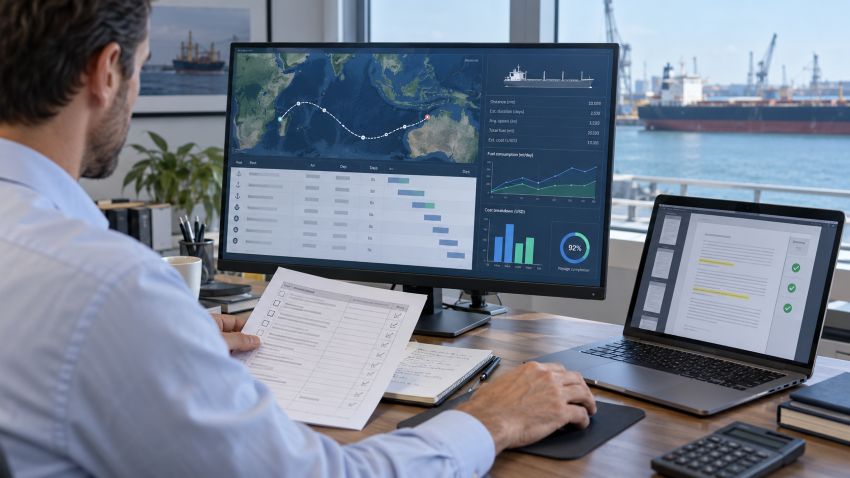
Digital tools perform well when the question is clearly defined and the underlying data are structured.
Voyage-estimation software can calculate distances, sailing time, bunker consumption, port time and expected voyage revenue. Vessel databases can filter ships according to deadweight, dimensions, cranes, flag, age or classification. Document-management systems can identify missing fields and maintain version control. Artificial intelligence can summarize correspondence, extract clauses and highlight inconsistencies for further review in the ship chartering process.
These capabilities reduce avoidable errors, but every output depends on its inputs and assumptions.
A voyage estimate may be mathematically correct but commercially misleading if the loading rate is unrealistic, the bunker price is outdated or expected port congestion has been ignored. A vessel search may identify technically similar ships while overlooking hold condition, crane outreach, cargo history or the owner’s willingness to trade to a particular port.
Good digital practice therefore begins with disciplined cargo information. Quantity and tolerance, stowage factor, dimensions, packing, readiness, loading and discharge rates, port restrictions and special handling requirements must be described accurately.
Incomplete information does not become reliable merely because it has been processed by sophisticated software.
Human Judgement Interprets the Market
Freight markets are influenced by behaviour as much as by data.
Two vessels with similar specifications and positions may produce very different negotiations. One owner may require immediate confirmation because another cargo is available. Another may accept a lower freight rate to reach a preferred geographical position. A charterer may value schedule reliability more highly than the lowest headline freight.
These motivations are not always visible in a database.
Experienced judgement becomes particularly important when different sources of information conflict. An automatic position report may differ from a broker’s update. A vessel’s technical description may appear suitable, while the terminal advises that its crane configuration cannot be accommodated. A recently reported freight fixture may look like a useful market benchmark even though its cargo terms, laycan, commission structure or port conditions were materially different.
The professional task is to test the available information, understand why discrepancies exist and determine which assumptions can safely support a binding commercial decision.
That requires market context, operational knowledge and direct communication with owners, charterers, agents and terminals.
AI Can Assist Decisions but Should Not Make Them
Artificial intelligence is becoming useful in ship chartering workflows, particularly for information retrieval and document review.
It can compare charter-party drafts, organize long correspondence chains, prepare checklists and identify clauses that deserve attention. It can help users model alternative voyage scenarios or detect information missing from a freight enquiry.
The limitation is that commercial negotiations frequently contain ambiguity.
Individual terms may have established meanings within a particular trade, while a small change in wording can alter the allocation of cost or risk. Messages may contain provisional positions, conditional statements or informal language that cannot be interpreted safely without understanding the wider negotiation history.
An AI-generated summary may look convincing while omitting precisely the qualification that matters. It may also treat an outdated vessel description, an unconfirmed loading rate or a preliminary commercial proposal as an established fact.
AI output should therefore be treated as analytical assistance rather than commercial authority. The person responsible for the fixture must verify the source material, examine the commercial logic and ensure that the final recap reflects what the parties actually agreed.
Accountability for a fixture cannot be delegated to a model.
Combining Automation with Verification

An effective technology-enabled workflow separates routine processing from commercial judgement.
Software can collect and structure cargo data, identify possible vessels, calculate preliminary voyage economics and preserve negotiation records. The broker or ship chartering manager can then validate the shortlist, check operational feasibility, test market assumptions and communicate with the relevant parties.
Before a vessel is fixed, several questions still require direct confirmation:
- Is the cargo genuinely ready within the proposed laycan?
- Can the vessel reach and operate at both berths?
- Are its holds, cranes and certificates acceptable?
- Do the stated loading and discharge rates reflect actual terminal performance?
- Are freight payment, laytime, demurrage and documentation terms clearly understood?
- Have all commercial subjects been resolved?
Technology makes these checks easier to organize, but it does not make them optional.
A disciplined digital record is valuable only when it supports a disciplined commercial process. Automated calculations and searchable correspondence cannot compensate for an unsuitable vessel, unrealistic port assumptions or an ambiguous fixture recap.
Cybersecurity Is Also a Ship Chartering Risk
Digitalization introduces risks that are not strictly operational.
Ship chartering teams exchange bank details, contracts, vessel documents and commercially sensitive information electronically. Fraudulent payment instructions, compromised email accounts and altered attachments can result in immediate financial losses.
Changes to payment details should be verified through an independent communication channel. Access to commercial documents should be controlled, and authority for approving payments or final contractual terms should be clearly defined.
Data quality deserves similar attention.
Duplicate vessel records, outdated particulars and copied cargo descriptions can circulate for years. Users should identify the source and date of critical information instead of assuming that frequently repeated data must be correct.
A transparent audit trail helps distinguish verified facts from estimates, preliminary indications and unconfirmed statements. It also makes it easier to reconstruct the negotiation if a disagreement develops later.
Technology Should Improve the Decision
The strongest ship chartering organizations will not choose between technology and people. They will use technology to improve the quality, consistency and speed of human decisions.
Routine calculations should be automated where appropriate. Information should be structured, searchable and traceable. AI should help professionals review larger volumes of material and focus attention on exceptions, inconsistencies and commercial risks.
The final decision must remain with someone who understands vessels, cargoes, ports, contracts and market behavior.
The consequences of a poor fixture are not limited to an inaccurate freight estimate. They can include delays, deadfreight, demurrage, cargo damage, contractual disputes and lost commercial relationships.
Digital tools can show more of the market than any individual could monitor alone. Human judgement determines what that picture means.
In modern ship chartering, the real competitive advantage comes from combining both.