



Automation looks simple in a product demo. A robot performs the same task repeatedly and appears to deliver perfect results. Bringing that technology into a working business is a different challenge, and robotic welding is no different.
Robotic welding demonstrates what successful automation requires. Manufacturers must balance equipment capabilities, employee expertise, production demands, and quality standards before deciding which tasks to automate.
Research into industrial robotics and welding practices reveals a consistent lesson: automation delivers the most value when businesses improve the processes around the technology.
For executives investing in artificial intelligence, robotics, and digital transformation, the manufacturing floor offers lessons beyond welding.
Key Takeaways
- Successful automation requires balancing technology, employee expertise, and process improvements.
- Start with repeatable work instead of focusing solely on the most impressive automation technology.
- Involve skilled employees in automation to redesign roles rather than eliminate jobs.
- Measure quality and rework, not just production speed, to assess automation performance effectively.
- Follow a leadership playbook: choose a repeatable workflow, involve employees, pilot automation, and expand based on reliable improvements.
Table of contents
Start With Repeatable Work, Not the Most Impressive Technology
One automation mistake is starting with the technology instead of the problem.
A manufacturer might purchase a robotic welding system expecting productivity gains. Yet the equipment can struggle if incoming parts require constant repositioning or programming adjustments.
Robotic welding works best when tasks follow predictable patterns. Parts with consistent shapes, reliable positioning, and repeatable weld locations provide a stronger starting point than customized assemblies.
Preparation matters just as much as welding.
Consider a fabrication workflow where flat sheets move through cutting, metal forming, and welding before becoming finished assemblies. Each stage affects the next.
If a formed bracket arrives with an inconsistent bend angle, a robotic welder may struggle to achieve proper alignment. The robot can repeat its programmed movements perfectly while producing an unacceptable result.
This highlights an important principle: a repeatable process is not necessarily a correct process.
The same problem appears in business software.
A company automating customer service responses without organizing its knowledge base may deliver incorrect answers faster. An accounting team automating invoice processing without standardized data could increase errors.
Technology leaders should identify processes with three characteristics before automating them:
- Consistency: Inputs follow predictable formats or specifications.
- Clear rules: Successful results can be defined and measured.
- Manageable exceptions: Unusual situations can be routed to qualified employees.
Starting with these tasks allows businesses to test automation before expanding into complex applications.
Keep Skilled Employees at the Center of Automation
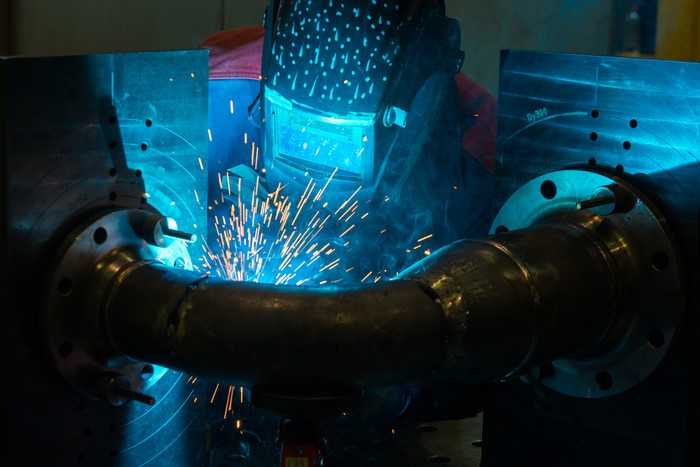
Robotic welding changes how skilled workers contribute to production. It does not eliminate the need for welding knowledge.
Experienced welders understand material behavior, joint preparation, equipment settings, and signs of poor weld quality.
A robot can execute a programmed weld path, but someone must verify the setup and recognize changing conditions.
The American Welding Society reinforces these responsibilities through its Certified Robotic Arc Welding program, which covers skills needed to operate, program, and support automated welding systems.
This offers a lesson for executives considering AI-driven workflows.
Strong automation strategies often redesign employee responsibilities rather than simply removing people from the process.
In welding operations, experienced employees can shift toward programming, equipment setup, inspection, troubleshooting, and handling complex assemblies.
Similar opportunities exist across industries.
In customer service, automated systems handle routine inquiries while representatives resolve unusual complaints. In finance, software processes standardized transactions while analysts investigate exceptions. In logistics, automated scheduling tools manage predictable shipments while coordinators address disruptions.
Successful adoption depends on giving employees meaningful roles in these workflows.
Workers need training on system limitations, procedures for reporting problems, and authority to stop automated operations when necessary.
Leaders should involve frontline employees before selecting automation tools. Their practical knowledge often reveals problems that performance dashboards miss.
A machine operator might recognize that a fixture regularly needs adjustment. A customer service representative may know which requests require judgment.
These details can determine whether an automation project succeeds.
Measure Rework and Quality, Not Just Production Speed
Speed is an easy automation benefit to demonstrate.
A robotic welding cell may complete repetitive operations at a consistent pace. That makes cycle time attractive for managers evaluating investments.
Yet faster production offers limited value if it generates defective parts.
Manufacturers must consider weld quality, inspection results, material waste, downtime, and rework when evaluating automation performance.
The distinction between repeatability and accuracy is important.
The National Institute of Standards and Technology explains that industrial robots can repeatedly return to the same programmed location without necessarily reaching the correct location.
A system can be highly consistent and still make the same mistake every cycle.
That lesson applies to enterprise automation.
An AI-powered document system might process thousands of records hourly, but speed means little if employees spend additional time correcting errors.
Technology leaders need measurements that capture the full cost of acceptable results.
A practical automation scorecard should include:
- First-pass yield: Outputs meeting requirements without correction.
- Rework rate: Work requiring additional attention.
- Cycle time: Time needed to complete each operation.
- Exception frequency: How often human intervention becomes necessary.
- Total operating cost: Equipment, software, maintenance, labor, and correction expenses.
Tracking these measures before and after implementation helps distinguish genuine improvements from impressive-looking activity.
If a new process saves ten minutes during production but adds twenty minutes of inspection and correction, efficiency has declined.
The goal is dependable output with fewer unnecessary steps.
Read Next
A few related pieces worth your time:
- Smart Cities: How Large-Scale LED Displays Support Urban Communication
- Smart Packaging: Using QR Codes, NFC, and IoT to Fight Counterfeiting
- Smart Tech Automated Warehousing Boosts Energy Efficiency
The Leadership Playbook for Automation That Actually Works
Robotic welding demonstrates why successful automation is an operational challenge supported by technology.
Executives can apply its lessons through a straightforward framework.
First, select a repeatable workflow with measurable quality requirements. Document its performance before introducing automation.
Next, involve experienced employees in process design. Identify decisions requiring human judgment and establish procedures for handling exceptions.
Then, introduce automation through a controlled pilot. Measure throughput, quality, rework, and employee intervention rather than focusing exclusively on speed.
Finally, expand only after the pilot demonstrates reliable improvements across the complete workflow.
This approach encourages better investment decisions. Organizations can select technology suited to their operating conditions.
The biggest lesson from the shop floor is simple: automation works best when reliable processes, capable technology, and skilled people improve together.
For technology leaders, that mindset can turn automation into a sustainable operational advantage.