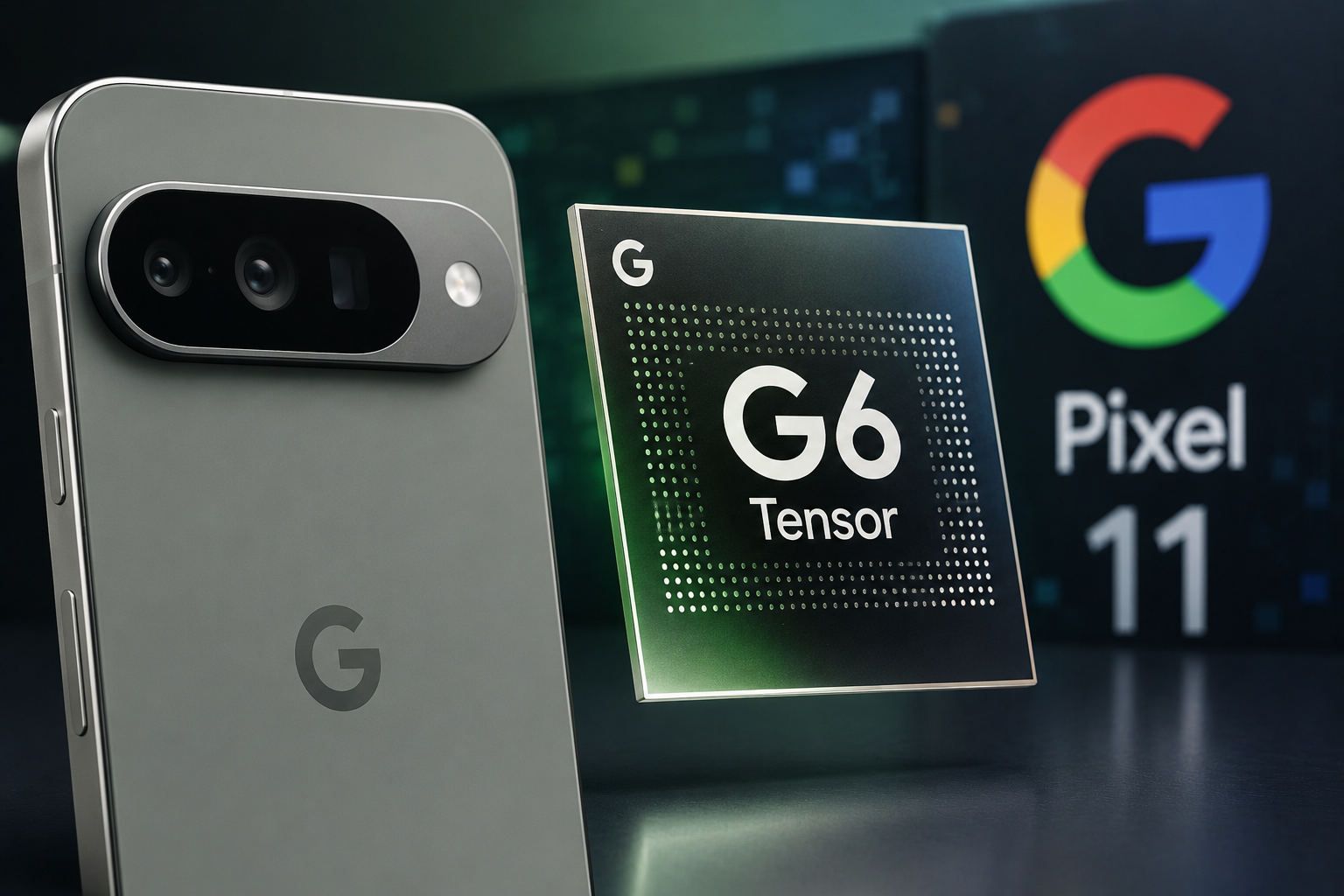
Google has cleared up one of the biggest questions hanging over its new flagship. The Tensor G6 chip inside the Google Pixel 11 is not built on a 2nm process. It uses TSMC’s 3nm process instead.
The correction came from Peng Yu-chun, Google’s VP of Hardware, in an interview with Taiwan’s Central News Agency. He said the chip powering the whole Google Pixel 11 line runs on TSMC’s enhanced 3nm node. Android Headlines and 9to5Google both picked up the comments this week.
That matters because the pre-launch story was very different.
What the Google Pixel 11 leaks got wrong
For months, reports claimed Google had jumped the queue at TSMC. The story went that the Tensor G6 would be the first phone chip on TSMC’s 2nm process, beating Apple to it. Apple is usually first in line for new nodes.
Google never made that claim in public. The 2nm figure came from leaks and from reporting built on those leaks. Google also did not list a process node in its launch materials for the Pixel 11 Pro or any other model.
So this is not a company walking back its own words. It is an executive correcting the record after the record went wrong. The confusion ran deep enough that 9to5Google issued a correction to its own headline on the story.
What Google actually claims for the Tensor G6
Google has been specific about performance, even while staying quiet on the node. The company says the Tensor G6 delivers:
- 25% faster web browsing
- 15% quicker app launches
- 50% more compute from the TPU, the part of the chip that handles AI work
- Support for a new on-device Gemini Nano model
- An upgraded image signal processor, which speeds up Night Sight and extends digital zoom
- A new Titan M3 security chip built around post-quantum cryptography standards
Android Authority reports that the TPU can run up to 3.5 times faster than before in some workloads. That TPU gain is the clearest hardware story in this generation. Most of the rest is refinement.
Why the node question mattered
Smaller process nodes usually mean better power efficiency. Efficiency was widely expected to be Google’s main goal this year. Dropping from 2nm to 3nm changes the ceiling on what buyers can expect from battery life and sustained performance.
The timing did not help. Days before launch, a Geekbench listing for the Google Pixel 11 Pro XL appeared, raising concerns. PhoneArena noted that the chip uses one Arm C1-Ultra core at 4.11 GHz, four C1-Pro cores at 3.38 GHz, and two C1-Pro cores at 2.65 GHz. That is one core fewer than the Tensor G5.
Tom’s Guide covered the same listing and later corrected its own figures on how far the chip trailed rival silicon. Benchmark listings can be faked, so treat any single score with care. Still, anyone cross-shopping the iPhone 17 Pro should know that raw CPU speed has never been where Pixel competes.
Full Google Pixel 11 Pro specs are now public, but independent testing is not yet available. No credible Pixel 11 Pro review has been published yet. Anyone waiting on a Google Pixel 11 Pro review should get one within days of its retail availability.
Pricing and the wider lineup
The Google Pixel 11 price starts at $899 for 256GB. Google has dropped the 128GB tier across the range this year, so the entry model now carries double the old base storage.
The Google Pixel 11 Pro is reported to be priced at $1,099 for the 256 GB model. The Pixel 11 Pro Fold sits at the top at $1,899, and Google says its back panel is close to impossible to crack. The Google Pixel 11 Pro Fold and the Google Pixel 11 Pro XL both saw price increases across all storage tiers.
Google has pointed to a supplier-driven memory shortage as the pressure behind those increases. Peng also said the team leaned on software and system-level tuning to hold performance up without pushing prices further.
The Pixel 11 Tensor G6 story is not over
The new information gives the Pixel 11 a fresh news angle only days after Google’s launch event.
Before launch, the expectation was that the Tensor G6 would be one of the first major smartphone processors to use TSMC’s 2nm technology. The latest reporting indicates Google instead selected a refined 3nm process.
What remains unclear is why Google ultimately chose that route and how much the decision affects practical performance and efficiency. Google has not publicly presented the Tensor G6 as a 2nm chip in its official Pixel 11 announcement, which focused instead on the processor’s performance and AI capabilities.
That makes independent testing particularly important.
For now, the clearest takeaway is simple: the Google Pixel 11’s Tensor G6 is not the 2nm chip many reports had led buyers to expect. The latest information points to TSMC’s 3nm technology, while Google’s own performance claims suggest the company has still made substantial improvements to its sixth-generation Tensor platform.
Pre-orders opened on August 12 through the Google Store and carriers. All four models ship on August 20. As Pixel 11 reviews and hands-on testing expand, those real results should provide a much better indication of whether Google’s chip strategy has delivered the upgrade users were hoping for.