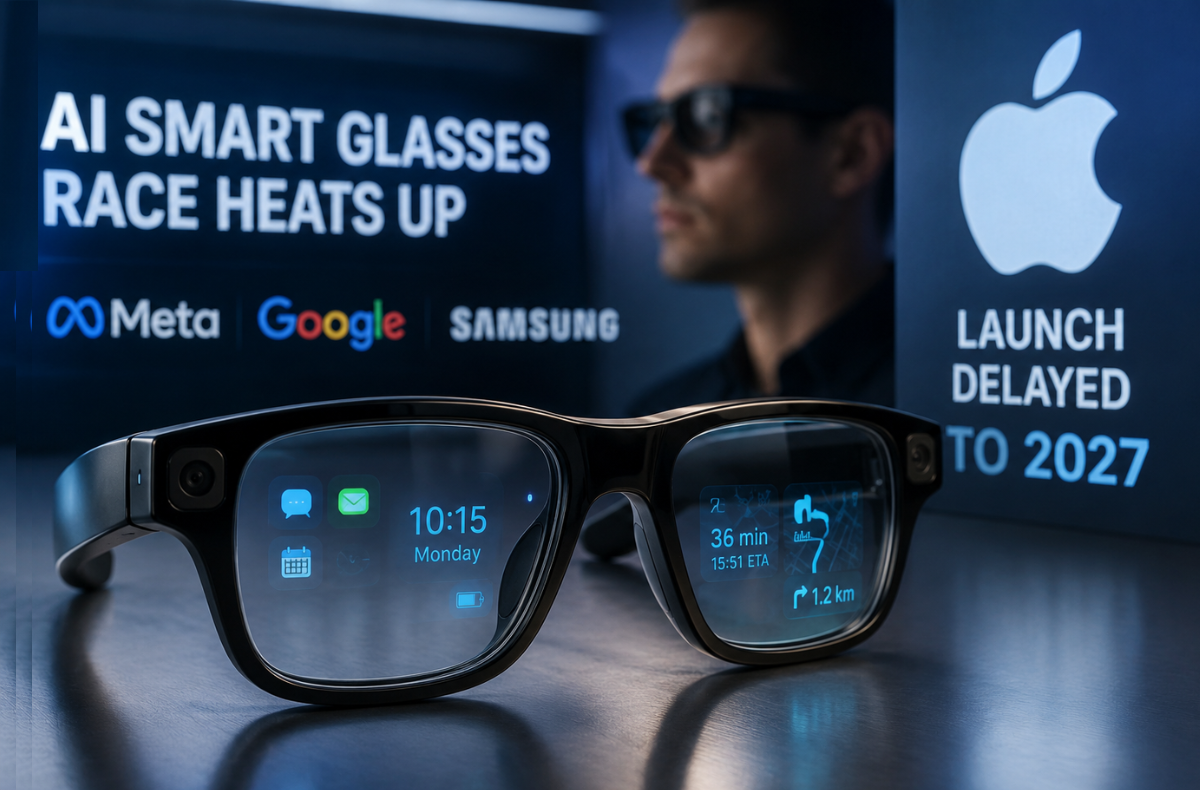
Apple has pushed its first AI smart glasses to 2027, according to Bloomberg’s Mark Gurman and Korean supply-chain reports. The delay hands rivals another full year in a market Apple has still not entered.
The device, codenamed N50, is now expected to be unveiled at WWDC in June 2027. A consumer release is reported for late that year. Earlier reporting had pointed to a late 2026 reveal. This timeline for AI smart glasses makes the competition more intense.
Apple has confirmed none of this. But the timing lands badly. Those following AI smart glasses advancements know they are now the fastest-growing category in consumer hardware.
Privacy Engineering Is the Real Bottleneck
Reporting points to two causes for the slip. One is ordinary engineering refinement. The other is harder. These engineering issues are particularly challenging for AI smart glasses development.
Apple is still deciding what to say about privacy.
Apple’s AI smart glasses are said to carry two camera sensors. One captures photos and video. The second handles computer vision for multimodal AI queries. There is no display. That architecture closely mirrors Meta Ray-Ban.
It also inherits the same problem. A camera on a face records people who never agreed to it.
Apple Intelligence leans on on-device AI processing, which keeps sensitive data off remote servers. That is a genuine engineering advantage. It is not a full answer to the bystander question.
The friction points Apple has to resolve before launch:
- Bystander consent. No industry standard exists for signalling that a wearer is recording.
- Silicon limits. On-device AI processing constrains how much multimodal AI a thin frame can run.
- Venue bans. New York has barred smart glasses from all 1,240 of its courthouses.
- Trust damage. Meta shipped a firmware update that disables the camera when the capture light is tampered with. The Financial Times later reported that a Meta prototype may not light the indicator at all.
Apple sells privacy as a product feature. Shipping AI-enabled smart glasses with a live camera into that backlash is a marketing problem before it is a hardware one.
Meta Extends Its Lead While Android XR Moves In
The delay creates a vacuum, and two companies are already filling it. This market gap is particularly notable in the sphere of AI-powered smart glasses.
Meta held 69.2% of the AI smart glasses market in the first quarter of 2026, per IDC. Display-less glasses shipped 2.25 million units in that quarter alone, up 167% year over year. IDC forecasts roughly 13.6 million units for the full year.
Meta launched a $299 entry model in June 2026. Multimodal AI shipped on it from day one, making it a popular choice among smart glasses with AI features.
Google is moving next. It revealed Gemini-powered eyewear at I/O in May, built on Android XR with Samsung, Warby Parker, and Gentle Monster. A fall 2026 launch is confirmed, and the glasses work with iPhone. Samsung smart glasses are expected to follow under the same alliance.
Wearable tech trends have already turned. VR headset shipments fell sharply through 2025 while lightweight glasses surged, with AI smart glasses driving much of this growth.
For enterprise IT, the takeaway is blunt. Face-worn cameras reach corporate networks this fall, whatever Apple does. The governance gap mirrors the one already opening around autonomous AI agents and mobile device verification. Meeting-room policy, visitor screening and recording rules need updating now.
Waiting for Apple to define the category is no longer a viable strategy as AI smart glasses adoption accelerates for consumers and enterprise.