The most valuable FinOps use cases have shifted from trimming idle servers to governing AI workloads, and the reason is arithmetic: worldwide AI spending is forecast to reach $2.59 trillion in 2026, a 47% jump year over year (Source: Gartner). That money effectively spreads across model APIs, GPU capacity, vector databases, data pipelines, and SaaS tools that quietly added AI features and repriced themselves.
Most finance teams inherited a cost model built for predictable infrastructure. Tokens broke it. A single agentic workflow can call six services, retry three times, and produce a bill nobody can trace back to a product decision. The use cases below are where FinOps practices are actually earning their budget right now, spanning classic cloud discipline and the newer AI cost problems layered on top.
Key Takeaways
- FinOps now covers AI, SaaS, licensing, and private cloud, not just public cloud.
- Cost allocation is the foundation; unit economics is what executives actually ask for.
- Token-level tracking matters more than GPU-hour tracking for agent workloads.
- Anomaly alerts only work when they route to the engineer who caused them.
- Shift-left guardrails prevent more spend than month-end reviews recover.
1. Cost Allocation and Showback
Nothing else on this list works until spend maps to an owner. Allocation takes raw billing data from AWS, Azure, GCP, and SaaS invoices, then attaches it to teams, products, environments, and customers using tags, account structure, and allocation keys for shared costs.
The hard part is the untagged remainder. Shared clusters, data transfer, support fees, and platform services rarely carry clean ownership, and in most enterprises that unallocated slice runs well into double-digit percentages. Teams close the gap with allocation rules that split shared spend proportionally rather than dumping it into an overhead bucket where it becomes invisible.
FOCUS, the open billing specification maintained by the FinOps Foundation, has made this less painful by standardizing field names across providers. The 1.4 release in June 2026 added invoice reconciliation datasets, which matters more than it sounds: verifying that what a provider billed matches what you actually consumed used to be a manual quarterly exercise.
2. Anomaly Detection With Owner Routing
Every cost platform detects spikes. Few route them usefully.
A daily baseline flags a subaccount running 340% above trend. That alert is worthless in a shared Slack channel where it competes with deploy notifications. It becomes valuable when it lands with the engineer who merged the change, carries the top cost movers, names the new services that appeared, and links to the deploy that preceded the spike.
Speed is the whole point. A misconfigured retry loop caught on day two costs a rounding error. The same loop caught at invoice time costs a quarter’s savings target.
3. Commitment and Discount Management
Reserved Instances, Savings Plans, and Committed Use Discounts trade flexibility for a lower rate. Managing them well means tracking two numbers continuously: coverage, meaning how much eligible usage sits under a commitment, and utilization, meaning how much of what you bought you actually consumed.
Both drift. Workloads migrate, instance families get deprecated, and a team refactors to serverless while a three-year commitment keeps billing for compute nobody runs. Mature practices plan purchases around application roadmaps and renewal windows instead of rolling twelve-month averages, and they revisit coverage monthly rather than at renewal.
4. Rightsizing and Idle Resource Cleanup
The oldest use case, still the one with the fastest payback. Oversized instances, orphaned volumes, unattached IPs, dev environments running through weekends, and databases provisioned for a launch that never scaled.
What has changed is the tolerance for blunt recommendations. Early rightsizing tools optimized on CPU alone and broke latency-sensitive services, which taught engineering teams to ignore the recommendations entirely. Current practice tunes against memory, I/O, and latency budgets, and treats an SLA breach as a failed optimization regardless of what it saved.
5. Kubernetes and Container Cost Attribution
Containers made infrastructure efficient and costs opaque at the same time. A node shows up on the bill. The eleven namespaces sharing it do not.
Attribution tooling splits node cost across namespaces, workloads, and labels based on actual resource consumption, which finally lets you answer whether the recommendation service or the search service is driving cluster growth. Non-production clusters running overnight are a recurring find here, as are persistent volumes and snapshots accumulating for years because nobody wants to be the person who deleted something. If you are working through this, these Kubernetes cost optimization strategies cover the practical moves in depth.
6. Unit Economics
Cost visibility tells you that you spent $840,000 on infrastructure last month. Unit economics tells you that you spent $2.14 per active customer, up from $1.87, because a new feature triples database reads for enterprise accounts.
This is the use case executives ask for and the one most tooling supports weakest. It requires joining billing data to business metrics that live somewhere else entirely, usually a data warehouse. The payoff is that pricing, packaging, and margin conversations stop being guesswork. Product teams can see which features carry negative margin at current pricing, and gross margin forecasts stop depending on a spreadsheet someone maintains by hand.
7. Token-Level AI Cost Tracking
Model API spend behaves nothing like compute spend. It scales with prompt length, context size, retry behavior, and how many tool calls an agent decides to make, none of which appear on a provider invoice in a form finance can read.
Teams instrument at the application layer instead: tokens in and out, model version, cache hit rate, agent steps, tool invocations, and the business transaction that triggered the whole chain. That telemetry answers the question a provider bill cannot, which is why spend changed rather than how much it was. Gartner’s July 2026 forecast for AI models and platforms put 2026 end-user spending at $64 billion, up 63% year over year, with the analyst commentary pointing directly at rising scrutiny of usage efficiency and cost control.
Prompt caching, model routing, and context trimming all reduce cost meaningfully. None of them can be justified without token-level data first.
8. GPU and Reserved AI Capacity Planning
Reserved GPU capacity is expensive, scarce, and easy to waste. Utilization on dedicated AI infrastructure runs low at many organizations because training jobs are bursty and inference demand is uneven across the day.
The planning work looks familiar to anyone who managed compute commitments: forecast demand, size the reservation against a realistic utilization assumption, and build a queue that keeps expensive silicon busy between scheduled jobs. What is unfamiliar is the volatility. Model releases can obsolete a capacity plan in a quarter.
9. Forecasting and Budget Variance
Forecasting used to mean extrapolating a trend line. With AI in the mix, that approach fails predictably, because a single production launch can double a monthly bill without any change to the underlying trend.
Better forecasts pull from three inputs: historical usage, the engineering release calendar, and committed capacity. Variance then gets reviewed as a signal rather than a scolding. A team consistently under forecast might be sandbagging; a team consistently over might be absorbing demand nobody planned for. Both are worth knowing before the quarter closes.
10. SaaS and Licensing Spend
FinOps expanded well past infrastructure. According to the FinOps Foundation’s 2026 practitioner survey, 90% of respondents now manage SaaS spend or plan to, alongside licensing, private cloud, and data center environments.
The driver is straightforward. SaaS vendors added AI features and moved to consumption pricing, so tools that used to cost a flat per-seat fee now carry variable usage charges that behave like cloud bills. Seat reclamation, license tier audits, and shadow IT discovery all sit here, and the savings tend to be less technically interesting and more immediately bankable than infrastructure work.
11. Shift-Left Cost Guardrails
The last use case is preventive. Cost estimates in pull requests, tagging enforced before deploy, budget policies that block a provisioning request instead of flagging it afterward, and token cost estimates surfaced in the IDE while a developer is still choosing a model.
Engineers make the decisions that determine the bill, usually weeks before finance sees it. Putting a number in front of them at that moment changes behavior in a way that a month-end review never will. Organizations running this well treat cost as a design constraint alongside latency and reliability, which is also the shift that turns FinOps from a reporting function into an engineering practice. The same logic applies to AI in DevOps workflows, where automation and cost awareness reinforce each other.
Conclusion
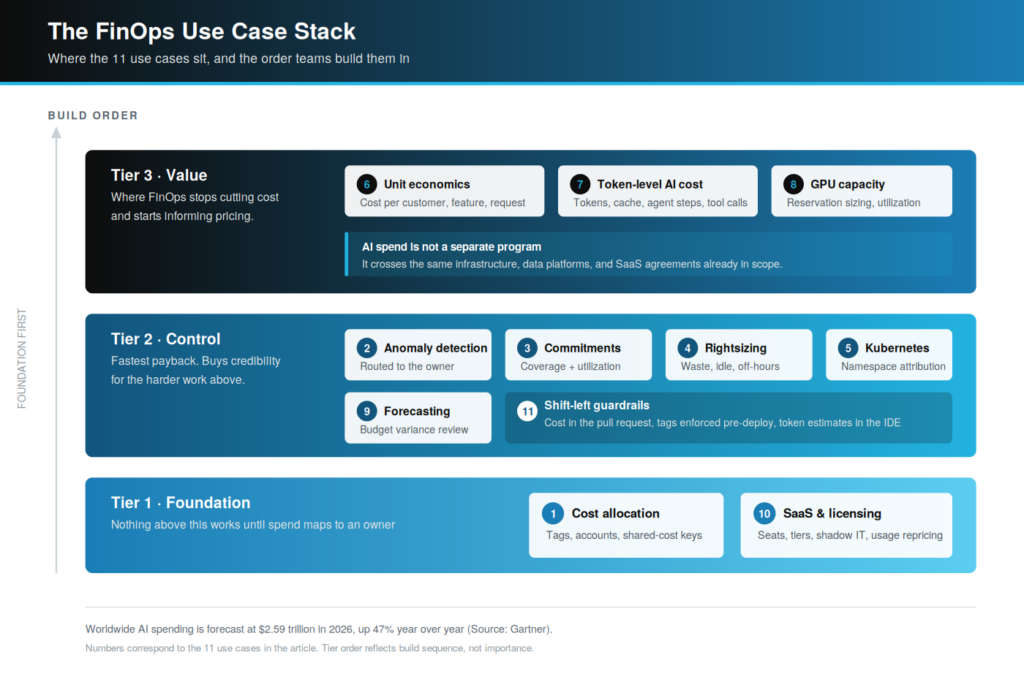
If you are building a FinOps practice from scratch, sequence matters more than tooling. Allocation comes first, because every other use case depends on knowing who owns what. Anomaly detection and rightsizing deliver the fastest visible wins and buy credibility for the harder work. Unit economics and token-level AI tracking come next, and they are where the practice stops being a cost-cutting exercise and starts informing pricing and product strategy.
The trap worth avoiding is treating AI spend as a separate program with separate tooling. It crosses the same infrastructure, data platforms, and SaaS agreements you already manage, and splitting it out guarantees that nobody sees the full picture.
Fold it into the existing practice, instrument at the application layer, and give engineering teams the cost signal early enough to act on it. Underestimating the total cost of cloud architecture decisions remains one of the more expensive mistakes in enterprise IT.
Read Next
More on cloud economics and enterprise cost strategy:
- Kubernetes Cost Optimization Strategies for Teams
- The Cloud’s Hidden Bottleneck: Why Lack of Talent is the Real Threat
- Understanding AWS Serverless Pricing
Frequently Asked Questions
The most common FinOps use cases are cost allocation, anomaly detection, commitment management, rightsizing, and forecasting. These five cover the foundational work of mapping spend to owners and reducing waste. Newer use cases center on AI workloads, including token-level cost tracking and GPU capacity planning.
FinOps use cases apply to AI spending through the same principles of allocation, optimization, and forecasting, but at a different granularity. AI costs track to tokens, model versions, and agent steps rather than instance hours. That requires application-level telemetry, because provider invoices alone cannot explain why spend changed.
Rightsizing and idle resource cleanup deliver results fastest, often within a single billing cycle. Anomaly detection follows closely, since catching a runaway workload early prevents costs that are difficult to recover afterward. Unit economics takes longer to implement but has the largest strategic payoff.
FinOps use cases do not require a dedicated platform at small scale, where native provider tools and a well-maintained tagging strategy can cover allocation and basic anomaly alerts. Dedicated platforms become necessary once spend spans multiple clouds, Kubernetes, SaaS, and AI providers. The breaking point is usually shared cost allocation, which native billing consoles handle poorly.
FinOps use cases are owned jointly by engineering, finance, and product rather than a single department. Engineering controls the decisions that create cost, finance controls budgets and forecasts, and product decides what the spend is meant to achieve. Practices that assign ownership to finance alone tend to produce reports nobody acts on.