
In the hyper-competitive digital economy, shopify speed optimization has become essential because latent infrastructure is the ultimate silent killer of conversions. As enterprise brands scale operations, the frictionless nature of modern SaaS environments often masks a compounding layer of technical debt. What begins as a nimble storefront can quickly degrade into a bloated, script-heavy experience as applications, tracking pixels, and custom code accumulate.
The core of this infrastructure depends entirely on your foundational codebase. Selecting highly optimized, premium Shopify themes is the critical first step to preventing baseline performance degradation.
For Chief Technology Officers (CTOs) and E-commerce Directors, shopify speed optimization is no longer a minor maintenance chore to delegate. It is a core boardroom decision that directly dictates:
- Customer Acquisition Cost (CAC)
- Return on Ad Spend (ROAS)
- Organic search visibility
To truly improve shopify site speed, leadership must look beyond superficial fixes and treat performance as a core engineering discipline.
Key Takeaways
- Shopify speed optimization is critical for conversions in a competitive digital economy, as technical debt can degrade performance.
- Leadership must prioritize site speed as it impacts Customer Acquisition Cost, Return on Ad Spend, and organic visibility.
- Themes can become performance bottlenecks due to issues like bloat, script overload, and layout instability.
- True shopify speed optimization involves deeper code-level changes rather than superficial fixes and requires a technical audit.
- Moving to advanced architectures like headless commerce can significantly improve site speed and performance management.
Table of contents
Why Shopify Speed Optimization Matters for Business Growth
When analyzing the modern consumer journey, latency introduces immediate cognitive friction. When a dynamic element hesitates or a product page takes an extra breath to render, consumer trust erodes instantly.
[Latency Spikes] ➔ [Cognitive Friction Rises] ➔ [Cart Abandonment Accelerates]
Data across high-volume enterprise stores indicates clear financial impacts:
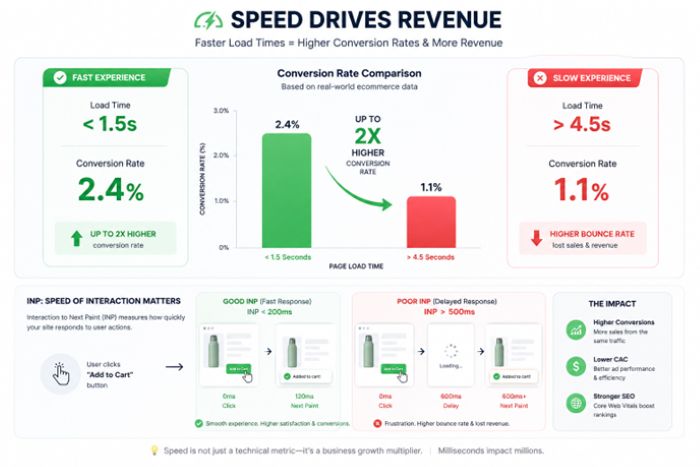
- The 1.5-Second Threshold: Storefronts loading under 1.5 seconds experience up to double the conversion rate of sites taking 4.5 seconds.
- The INP Factor: With Google’s strict focus on Interaction to Next Paint (INP), a system’s responsiveness to user inputs—like variant selectors or checkout clicks—is heavily scrutinized.
To systematically optimize shopify speed, brands cannot rely on automated plugins that add more weight to the DOM. Instead, a comprehensive blueprint for shopify performance optimization must be executed at the application and asset layer.
How Themes Can Become Hidden Performance Bottlenecks
While marketing teams frequently select layouts based on visual design, enterprise engineering requires analyzing underlying code efficiency.
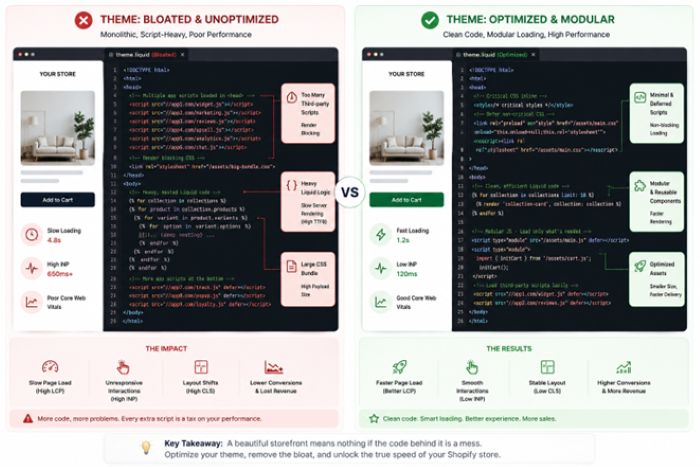
A poorly architected theme acts as a bottleneck that no downstream application can fix, typically driven by three technical liabilities:
1. Theme Bloat and Inefficient Liquid Rendering
Custom or feature-heavy commercial themes often suffer from inefficient Liquid logic. Executing deep, nested loops to fetch variant details or complex metafields without strict pagination causes massive server-side rendering delays. This manifests directly as a high Time to First Byte (TTFB), stalling the browser before the first pixel can render.
2. The App Tax: Script Injection and Performance Overload
The plug-and-play app marketplace is highly convenient, but it remains a primary performance liability. Many apps hardcode their assets directly into the theme’s main layouts (theme.liquid). Every marketing pop-up, loyalty program, or review widget injects external JavaScript that blocks the main thread, leading to high Time to Interactive (TTI) and poor INP scores.
3. Layout Instability and Core Web Vitals Issues
Pre-built themes that do not enforce explicit layout dimensions cause severe visual instability during the page load sequence. To properly optimize page speed on shopify, developers must refactor the theme template to support critical CSS extraction and responsive image constraints.
How to Reach Shopify Speed Optimization Through Better Theme Architecture
True optimization bypasses superficial “speed booster apps”—which ironically add more tracking scripts—and focuses on code-level engineering within the theme framework.
| Optimization Layer | Advanced Techniques | Business & UX Impact |
| Theme Refactoring | Prune redundant app fragments; streamline Liquid loops & optimize GraphQL queries. | Minimizes TTFB; speeds up backend execution. |
| Script Governance | Defer non-critical JS; move heavy tracking pixels (Meta, Google) server-side via GTM. | Lowers Main-Thread work; improves INP. |
| Asset Delivery | Enforce WebP/AVIF formats; dynamic conditional loading via native theme image filters. | Drastically reduces payload; accelerates LCP. |
For organizations investigating how to optimize shopify store speed, the process requires a deep technical theme audit. By applying structural shopify website speed optimization strategies—such as breaking down heavy monolithic CSS/JS bundles into modular, page-specific assets—enterprises can maintain high-fidelity brand experiences without compromising on technical execution.
When Store Growth Requires More Advanced Architecture
High-volume enterprise brands eventually hit a performance ceiling with monolithic Liquid layouts. Complex backend operations will inevitably throttle the user experience. At this stage, the ultimate scale solution is transitioning toward composable, headless commerce.
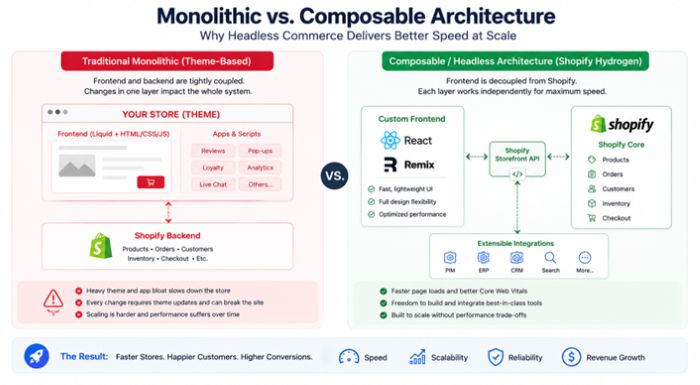
Decoupling the frontend presentation layer from the core database offers definitive advantages:
- Total Budget Control: Developers gain absolute governance over performance and asset execution budgets.
- Framework Power: Utilizing Shopify Hydrogen (React/Remix) isolates the frontend from third-party script interference.
- Global Speed: This architecture delivers sub-second global page loads and immune-level protection against Core Web Vitals degradation.
Building Long-Term Performance with Optimized Theme Systems
Maintaining an ultra-fast storefront is an ongoing culture of operational excellence. Codes naturally degrade as marketing teams deploy tracking pixels and design teams update store sections. Codebase health requires automated performance guardrails to survive.
Navigating this delicate intersection of rich commercial features and raw technical speed requires specialized engineering. For scaling enterprises looking to systematically eliminate technical debt without entering long, expensive custom development cycles, choosing an engineered-for-speed theme ecosystem is a vital strategic move. Rather than relying on rigid, unoptimized templates, brands require commercial layouts that natively bridge design elegance with clean code infrastructure.
This product-first philosophy is exactly how specialized technology creators solve the latency equation. For instance, specialized providers such as NextSky approach Shopify themes as performance systems rather than visual templates, focusing on cleaner architecture and conversion-oriented storefront design.
By utilizing these high-speed systems, brands eliminate the typical tradeoffs between rich visual branding and core speed metrics, backed by streamlined ecosystem support that keeps modifications aligned with optimal performance.
Investing in a premium architecture ensures your storefront is fine-tuned for ultimate scaling. By deploying optimized code environments, enterprise brands can unlock hidden revenue potential, lower drop-off rates, and maximize advertising efficiency.
Ultimately, shopify speed optimization is a foundational feature. In the modern digital economy, the fastest infrastructure doesn’t just capture organic search visibility—it captures the market.