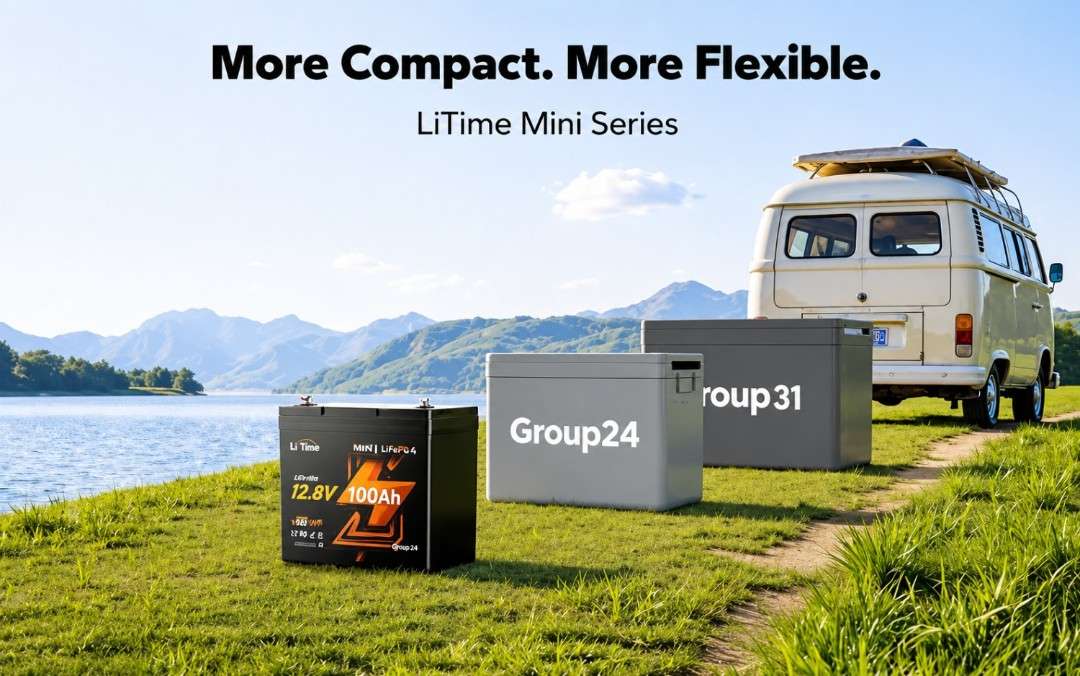
As power demand continues to grow across RVs, camper vans, and overland travel, and as space utilization becomes increasingly important, battery design is placing greater emphasis on energy density, weight efficiency, and intelligent power management. Across the industry, RV power systems are gradually shifting from bulky lead-acid battery banks to more compact, high-energy-density lithium solutions that deliver more usable power within the same or even smaller installation space, while supporting smarter energy monitoring and system integration.
LiTime, a global lithium battery supplier focused on RV, marine, and off-grid applications, is supporting this transition through its Mini Series lithium batteries. Rather than simply increasing capacity through larger battery sizes, the Mini Series reflects a broader shift toward compact architecture, intelligent battery management, and system-level optimization.
Table of contents
Compact Architecture: The Mini Series Design Approach
LiTime began developing compact, high-energy-density battery designs in 2021 and introduced its 12V 100Ah lithium battery with mini format in 2022. According to the company, this marked an early effort in the industry to achieve 100Ah capacity in a footprint smaller than traditional Group 24 battery dimensions.
Since then, LiTime has expanded its compact lineup across Group 27, Group 24, Mini, and Xtra Mini configurations. These designs make it easier for users to upgrade from lead-acid systems or older lithium setups without making major changes to existing compartments or power system layouts.
Compared with a traditional 12V 100Ah Group 31 battery footprint, LiTime’s Xtra Mini design reduces volume by approximately 46% while increasing volumetric energy density by about 85%. The same compact design logic has also been applied to higher-capacity models, including 12V 165Ah, 12V 200Ah, and 12V 320Ah Mini batteries.
For example, LiTime’s 12V 320Ah Mini battery measures approximately 14.49 × 7.44 × 10.04 inches. Compared with a common 12V 300Ah LiFePO4 battery on the market, it reduces volume by about 31% while offering an additional 20Ah of capacity. Compared with lead-acid systems, the Mini Series can also reduce weight by more than 60% and volume by around 50%, making it well-suited for RVs, vans, boats, and other space-limited applications.
System-Level Optimization Beyond Battery Cells
Achieving higher energy density depends on both cell performance and system optimization. LiTime Mini Series batteries use higher-energy-density EV-grade LiFePO4 cells designed to increase energy storage per unit of volume while supporting long-cycle applications. According to LiTime, these cells can deliver up to 4,000 cycles at 100% depth of discharge and up to 6,000 cycles at 80% depth of discharge.
Quality consistency is also built into the system design. Each cell is assigned an independent traceability ID and undergoes more than 80 quality tests, helping improve stability and consistency in RV, marine, and off-grid environments.
Beyond the cells themselves, compact battery performance also depends on internal architecture. LiTime uses flexible cell arrangements to improve space utilization inside the battery housing, allowing more usable energy to be stored within a limited volume. The batteries also integrate LiTime’s self-developed Battery Management System (BMS), which functions as the battery’s control layer, helping monitor and manage charging, discharging, temperature conditions, performance data, and safety-related protections in real time.
By coordinating cell selection, structural layout, BMS intelligence, and quality management, the Mini Series makes compact, efficient, high-energy-density battery architecture more practical for space-constrained applications.
Smarter Power for Modern Outdoor Living
Today, RVs, camper vans, boats, and off-grid systems are supporting more daily-use and work-related power needs. From remote work, entertainment devices, refrigeration, and communication systems to lighting and longer off-grid stays, these applications not only require stable power within limited space but also place higher demands on installation flexibility, battery status visibility, connected monitoring, and low-temperature performance.
In RVs and camper vans, the LiTime Mini Series fits under seats, inside storage compartments, and in other previously unused spaces, saving valuable room and increasing installation flexibility. Marine and fishing applications, these smaller batteries simplify layout design and reduce onboard weight. In off-grid systems, their higher energy density extends runtime even when installation space remains limited.
Smart features are also becoming part of the modern RV battery experience. Many LiTime Mini Series models support Bluetooth monitoring, allowing users to access real-time battery diagnostics, performance metrics, and system status through a mobile device.
For low-temperature environments, LiTime has developed LiHeat™ dual-mode self-heating models.
Reshaping the Mobile Power Experience
The future of RV power is not only about replacing lead-acid batteries with lithium alternatives. It is also about rethinking how energy systems are designed, monitored, and managed for mobile applications. As power needs become more complex, battery systems need to strike a better balance between capacity, size, weight, safety, connectivity, and management efficiency.
“The traditional ‘bigger is better’ mindset does not work well in space-constrained RVs and camper van builds,” said a LiTime spokesperson. “With the Mini Series, we aim to pack more usable capacity into standard or smaller footprints, so users do not have to choose between battery size and living space and can enjoy a freer, more efficient outdoor power experience.”