Price is the only lever on Amazon that you can change a thousand times a day without touching your listing, your ads, or your inventory. It is also the one most sellers still manage by hand, a spreadsheet export on Monday, a panic edit when someone drops 40 cents on Thursday. That gap is why an amazon repricer tool has stopped being a “nice to have” for FBA sellers and become part of the core operating stack, alongside inventory forecasting and PPC management.
This guide covers what pricing automation actually controls in 2026, how the main approaches differ, and the tactics that separate sellers who protect margin from sellers who simply race each other to the floor.
Key Takeaways
- Price management on Amazon is crucial, and manual strategies fail as competition and costs fluctuate.
- Automation tools like an amazon repricer tool improve margin protection and enhance competitive pricing strategies.
- Effective automation involves setting floors and ceilings on prices, managing various fulfillment types, and utilizing data-driven tactics.
- When implementing pricing automation, prioritize accurate cost data and gradually expand your strategy to avoid losses.
- In 2026, successful pricing automation focuses on recovering margins through smart upward pricing, not just reacting to competitors.
Table of contents
Why manual pricing breaks at scale
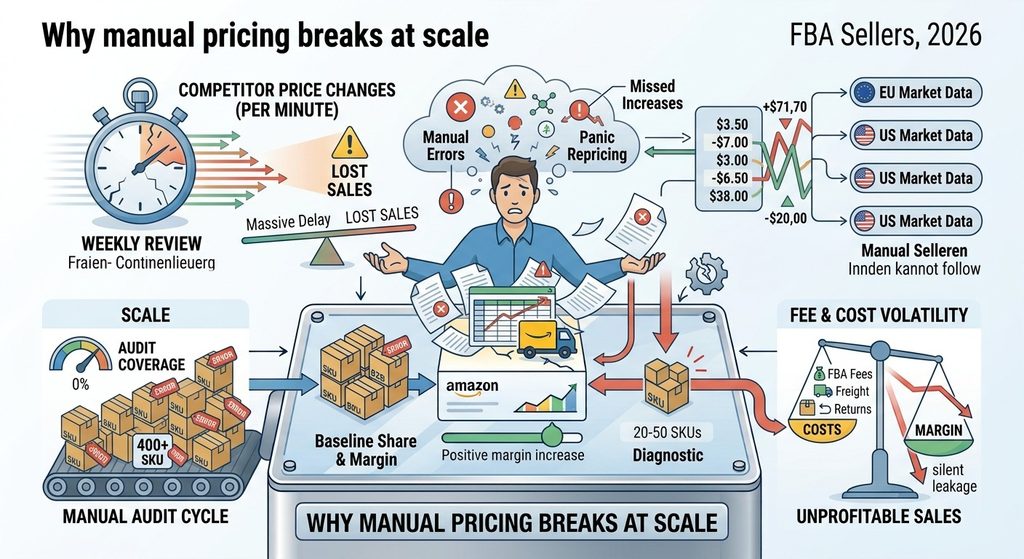
Three pressures converged over the last two years.
The Featured Offer still decides the sale. Estimates of how much Amazon revenue flows through the Featured Offer cluster between 80% and 90%, depending on the category and who is counting. Whatever the exact number, the offer that loses the box loses most of its conversion, and eligibility can flip several times an hour on a contested ASIN.
Margins are thinner than the manual review cycle. With a Professional plan at $39.99 per month, referral fees running roughly 8–15% in most categories (and up to 45% in a few), plus FBA fulfillment, storage, and ad spend, the distance between a healthy SKU and a loss-making one is often two or three percentage points. A price you set on Monday can be underwater by Wednesday after a fee change or a returns spike.
Everyone else is automated. If four of the six offers on your ASIN reprice every ten minutes and you reprice weekly, you are not competing on price — you are handing over the Featured Offer for six and a half days out of seven.
What pricing automation actually controls
Sellers often assume repricing means “software that lowers my price.” A modern system controls considerably more than that, and the upward moves usually matter more than the downward ones.
It sets hard floors and ceilings the price can never cross, which is the only real protection against a race to the bottom. It runs Featured Offer targeting, detecting who currently holds the box and reacting within minutes. It handles upward repricing — climbing while you still hold the box, which is where most recovered margin actually comes from. It applies inventory-aware rules that slow discounting when stock cover gets thin, and fulfillment-aware logic that prices differently against FBA, FBM, and Seller Fulfilled Prime offers instead of treating them as equal. It manages B2B and quantity tiers separately from consumer pricing, since business buyers order in noticeably larger baskets. And it supports time and event control, so Prime Day, Q4, and ordinary weekday traffic can each run a different strategy.
Of those seven levers, only two involve going lower.
Choosing an approach
There are broadly three ways to automate, and the honest answer is that many catalogs need a combination.
Simple rule-based repricing is the entry point: if a competing offer is lower, undercut it by a fixed amount or percentage. It is cheap, transparent, and adequate for a small catalog with predictable competition. Its weakness shows up as the catalog grows — rules multiply, exceptions pile up, and someone has to maintain the whole structure by hand.
Algorithmic or AI-driven repricing works from an outcome rather than an instruction. Instead of “always undercut by five cents,” the engine optimizes for holding the Featured Offer at the highest sustainable price, learning from how competing offers actually behave. It reacts faster on contested ASINs and, critically, pushes the price back up the moment pressure eases. The trade-off is transparency: it needs clean cost data to behave sensibly, and it demands more trust.
Hybrid setups run algorithmic logic on contested ASINs and simple rules everywhere else. For most mid-sized sellers, this is the realistic end state.
The dividing line is not catalog size — it is how contested your ASINs are. A private label seller with no competing offers needs price testing, not repricing. A wholesaler sharing an ASIN with eleven other sellers needs an engine that reacts in minutes.
One structural shift worth noting: usage-based pricing has become common at the top of the market, billed on how many products are actually optimized rather than a flat licence. That changes the ROI question from “can I afford the subscription” to “what is the cost per optimized SKU versus the margin it recovers.”
Set the pricing floor before you set the strategy
The most common failure in pricing automation is switching on a strategy before the cost data underneath it is correct. A repricer with a wrong floor will execute your losses faster and more reliably than you ever could by hand.
Build the floor from the full landed cost stack, not from COGS plus a guess:
| Cost component | Example (a $29.99 SKU) |
| Product cost (COGS) | $8.40 |
| Inbound freight and prep | $1.10 |
| Referral fee (15%) | $4.50 |
| FBA fulfillment fee | $5.20 |
| Monthly storage, amortized per unit | $0.35 |
| Returns and reimbursement allowance (3%) | $0.90 |
| Ad spend allocation (8% TACOS) | $2.40 |
| Total landed cost | $22.85 |
| Target minimum margin (10%) | $2.29 |
| Correct price floor | $25.14 |
Two rules follow. First, the floor should be recalculated automatically, not typed in once — fees, freight, and return rates all move, and a floor set in January is fiction by August. Systems that derive min and max dynamically from live cost inputs remove an entire category of silent margin leakage. Second, set a ceiling as well. Sellers obsess over the floor and then leave money on the table because nothing tells the system how high it is allowed to climb when competing offers go out of stock.
Seven tactics worth automating in 2026
| Tactic | When to use it | Main risk |
| Win-then-climb | Contested ASINs with 3+ offers | Climbing too fast and losing the box |
| Velocity-based increases | SKUs selling above forecast | Overshooting demand elasticity |
| Inventory-aware throttling | Stock cover under ~30 days | Slowing sales before a restock lands |
| Fulfillment-aware gaps | Mixed FBA and FBM competition | Over-discounting against weaker offers |
| Time and event control | Prime Day, Q4, weekend peaks | Forgetting to switch the rule back |
| Cross-marketplace sync | EU, UK, and NA multi-region sellers | FX and fee differences distorting floors |
| B2B tier automation | Catalogs with business demand | Tiers cannibalizing consumer margin |
Win-then-climb is the backbone. Undercutting is only step one; the value comes from raising the price incrementally while you retain the Featured Offer, until the system finds the ceiling the market will bear. Sellers who automate only the downward half of that cycle typically report Buy Box share gains and margin losses at the same time.
Fulfillment-aware pricing is the most underused. If you are FBA with strong performance metrics, you can often hold the Featured Offer at a higher price than an FBM offer. Logic that treats every competing offer as equivalent throws that advantage away on every cycle.
Inventory-aware throttling matters more in 2026 than it did three years ago, because storage costs and restock limits punish both extremes. Selling out three weeks early at your minimum price is not a win; it is a stockout plus a discount.
B2B tiers are the quiet growth area. Business buyers place larger orders, and quantity discounts can be automated separately from consumer pricing — a lever most catalogs never touch.
Guardrails that keep you out of trouble
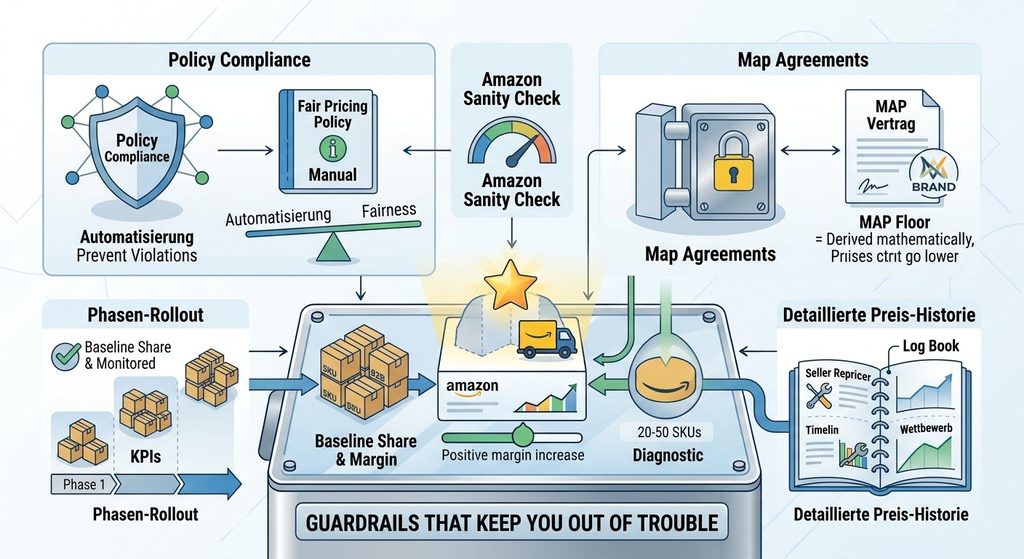
Respect Amazon’s Fair Pricing Policy: automation is not a defence if your pricing triggers a suppressed offer, so ceilings and sanity checks belong in the ruleset rather than in a monthly audit. Where a brand agreement sets a minimum advertised price, treat that floor as contractual, not mathematical. Never launch across the whole catalog at once — start with 20 to 50 SKUs spanning your best and worst performers, run for two weeks, then expand. Log every price change, yours and the competition’s, because detailed price history is what turns a repricer from a black box into a diagnostic tool. And re-audit costs quarterly; fee updates, freight swings, and return-rate drift silently invalidate floors.
A realistic rollout
Spend the first week cleaning cost data — COGS, freight, fees — until landed cost per SKU is accurate. In week two, pilot on a small set of SKUs with floors and ceilings only, and record baseline Featured Offer share and margin. In week three, switch on win-then-climb and inventory rules so upward repricing goes live. In week four, layer on time control, B2B tiers, and marketplace sync, then move to a weekly review rhythm.
Measure four things, not one: Featured Offer share, average selling price, gross margin per unit, and sell-through rate. Automation that lifts Buy Box share while average selling price falls faster is not working — it is just discounting on autopilot.
The bottom line
Pricing automation in 2026 is less about reacting faster than the offer next to you and more about knowing exactly where your floor is, then automating the climb above it. The approach you choose matters far less than the quality of the cost data you feed it and the discipline of the guardrails you set around it. Get those two right, and the software does what it was always supposed to do: recover the margin that manual pricing quietly leaves on the table every single day.