

A decision playbook for CISOs, CIOs, and CTOs covering approval, boundaries, monitoring, and revocation when agents act inside production systems.
AI agent access control is no longer a theoretical problem: 53% of organizations say their AI agents have already exceeded their intended permissions (Source: Cloud Security Alliance). The request usually arrives half-built. A team has an agent that can “help with finance” or “handle CRM updates,” and they want it connected to production systems by the end of the quarter. The security question gets squeezed into one line: approve or deny.
That framing is where the trouble starts. The useful unit of decision is not “which model,” and it is not yes or no. It is this: which agent, acting for whom, may perform which actions, on which systems, under what conditions, with what evidence, and with what way to stop it? Answer those questions and you have an approval you can defend later.
This guide assumes the agent’s business case is already settled. What’s left is how much authority it gets and how you keep that authority bounded once it runs.
Key Takeaways
- A user’s consent is not the agent’s authorization.
- Give every agent its own identity, separate from human accounts.
- Approve specific actions, not broad system access.
- Log tool calls and system operations, not just conversations.
- Map and test revocation system by system.
Why “the human approved it” is not authorization
The most common shortcut is treating a user’s click as the agent’s permission. Someone approves, the agent inherits their access, and the reasoning stops there.
Keep three things apart:
- Identity is which agent or workload is acting.
- Delegation is whose authority it operates under.
- Authorization is whether this specific operation is permitted in the current context.
A person asking an agent to do something does not mean the agent should carry that person’s full access into every system it touches. NIST makes the same separation in its design tenets for agent identity management, published on October 27, 2026. The ten tenets call for agents with their own verifiable identities, tied to a specific workload and approved configuration, managed on a lifecycle distinct from human users. They also favor short-lived access over standing credentials.
NIST presents them as an initial set and a design direction, not a binding standard. You don’t need to wait for the standard, though. Established identity and access practice can enforce the separation today.
Why does it matter? Because a well-meaning agent can still do damage. OWASP’s Top 10 for Agentic Applications lists goal hijacking, tool misuse, and identity and privilege abuse among the leading risks. An attacker who redirects an agent’s goal works entirely inside the access you granted. So the real question is how far that access reaches.
Who approves an agent’s access
Agent approval is a cross-functional call. Business, IT, security, and the owners of the affected systems and data should agree on scope together, which is why GenAI keeps reshaping the CIO and CISO relationship. The ownership questions are the same ones that apply to any production AI system: a named business owner, a named technical owner, and a written record. Those are covered in detail in this guide to AI deployment approval.
Agents add one item to that record: the agent’s own identity and its operator. If you can’t say which identity the agent will act under, the request isn’t ready.
Set access boundaries action by action
Vague scope is where privilege creep begins. “Access to CRM” and “can help with finance” can’t be approved, because neither says what the agent may actually do.
Approve explicit actions on explicit resources, and split the verbs:
- Read
- Create
- Update
- Delete
- Approve
- Send or execute
A read-only lookup carries one level of risk. Updating a record carries another. Approving a transaction, deleting data, or sending something outside the company is a different category again. Put the consequential verbs behind extra controls, such as human confirmation or a second approval path. Never let one grant cover all six because it was easier to provision.
Prefer narrow, task-specific tools to broad administrative credentials. An agent that checks order status does not need an admin API key.
Watch what happens downstream too. When authority passes to sub-agents or other services, scope should shrink at each hop, never grow. Here’s a simple test: if a downstream call can do more than the agent that triggered it, something is misconfigured.
Standing access is the other quiet risk. An agent holding live credentials around the clock is a bigger target than one that requests scoped, expiring access for a single task. Use just-in-time grants wherever your stack supports them.
Where the agent reaches your systems matters
Agents don’t touch systems in the abstract. They go through specific routes, and each route has its own authorization and logging behavior.
The Model Context Protocol is one common route, exposing tools and data sources to an agent. Model Context Protocol security is its own surface, with risks around credential handling and untrusted integrations. Treat MCP as one path, not as a synonym for agent security. The same bounded-scope rules apply to every connector, API, and framework along the way.
Browser-based agents face a different set of problems: prompt injection from web pages, extension exposure, and token handling inside the browser. The browser agent security risk breakdown covers that category. Match each route to its own controls rather than assuming one boundary covers all of them.
Tier the risk and start small
Government guidance now points the same way. Careful Adoption of Agentic AI Services, the joint guide from CISA, the NSA, and partner agencies in Australia, Canada, New Zealand, and the UK, names expanded attack surface, privilege creep, behavioral misalignment, and unclear event records as core risks. Its advice is plain: begin with low-risk, nonsensitive use cases, avoid broad access to sensitive data and critical systems, and expand autonomy only as controls mature.
That turns a binary decision into a staged one. Start where exposure is contained. Confirm you can see and control what the agent does. Then widen it.
Use these factors to set the tier:
| Factor | Lower risk | Higher risk |
|---|---|---|
| Data sensitivity | Public or internal reference data | Regulated, financial, or personal data |
| Action impact | Read-only lookup | Writes, deletions, approvals, external sends |
| Reversibility | Easily undone | Hard or impossible to reverse |
| Autonomy | Human confirms each consequential step | Fully autonomous execution |
| Connected systems | One system, scoped interface | Many systems, broad credentials |
| Logging and recovery | Clear action logs, tested rollback | Sparse logs, no rollback plan |
An agent that lands in the right-hand column across several rows shouldn’t get the same lightweight approval as one in the left. Let the tier decide how much control and review it needs before production.
Log what the agent did, not what it said
A transcript of the agent’s messages is not an audit trail. It tells you what the agent said, not what it changed.
Agent logs should let an investigator connect four things:
- the agent identity that acted
- the delegated authority it acted under
- the tool or system it invoked
- the outcome
Log tool calls and system operations as first-class events. Then protect the logs from the thing they record. NIST’s tenets call for tamper-evident, append-only evidence kept on logging infrastructure independent of the agent, and the reasoning is simple. A compromised agent that can edit its own logs can erase its tracks.
Logging also needs a live counterpart. Monitor for out-of-scope or unusual activity, and keep a way to step in while the agent is running. NIST frames runtime containment as a design goal. Don’t assume every product you buy already does it.
Revoke access per system, and test it
Agents need revocation built into the lifecycle, not saved for emergencies. Access should end when:
- the task is complete
- the accountable owner leaves or changes role
- the business purpose changes
- behavior looks anomalous
Be honest about the mechanics. Enterprise applications, APIs, and agent frameworks each handle authorization and logging their own way, and one delegation chain can run through several of them. There’s no reliable evidence that a single kill switch revokes an agent’s access everywhere at once. NIST is still working on interoperable identity and authorization, including an NCCoE project whose first implementation use case is AI agents in the software development lifecycle. Until that work matures, list every system the agent can reach, document how its credentials are pulled in each one, and rehearse it before launch.
The decision path in one view
Run every new agent request through these gates in order:
- Identity assigned? The agent has its own identity, not a borrowed human or shared account.
- Scope explicit? Specific actions on specific resources, with read, write, approve, and send kept separate.
- Risk tier set? The factor table decides how much control applies.
- Evidence in place? Logs tie each action to identity, authority, tool, and outcome, and the agent can’t alter them.
- Revocation tested? You know how access is pulled in each connected system.
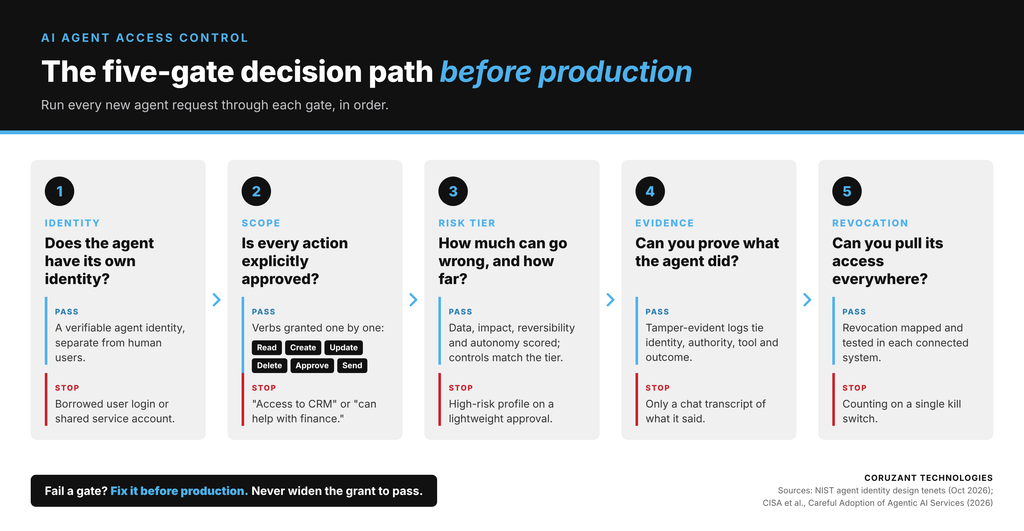
A request that fails a gate has work to finish before production. Widening the grant so it passes is not the fix.
Conclusion
Good AI agent access control comes down to refusing the easy shortcut. The agent gets its own identity, its permissions are written as specific actions, its tool calls are logged where it can’t tamper with them, and its access ends system by system when the job does. None of that requires a finished standard. It requires deciding these things before launch instead of during an incident.
Start with your lowest-risk candidate, run it through the five gates, and treat whatever you learn about logging and revocation as the template for the agents that follow. Expand autonomy only when you can show what the agent touched and how you’d stop it.
Read Next
If you’re working through the decisions around this one, these are useful next reads:
- The Complete Guide to AI Governance Frameworks
- What Is Agentic Orchestration? A Beginner’s Guide
- Human-in-Loop Testing in Agentic AI Systems
If you’re setting agent boundaries for the first time, episodes of The Digital Executive feature CISOs, CIOs, and CTOs working through the same access and accountability questions in their own organizations.
Frequently Asked Questions
AI agent access control builds on traditional IAM rather than replacing it. What changes is that the agent gets its own verifiable identity, its delegated authority stays narrower than the human who triggered it, and its tool calls are logged as first-class events. Established IAM and workload-identity practices carry most of the load while agent-specific standards develop.
AI agent access control contains prompt injection, it doesn’t eliminate it. OWASP treats goal hijacking and tool misuse as standing risks, so assume an agent can be steered. NIST’s tenets recommend keeping the system that decides what an agent may do separate from the model deciding what it tries, because guardrails inside the model aren’t enough on their own. Narrow scope, layered authorization, and monitoring limit what a hijacked agent can reach.
Not reliably, at least not yet. Applications, APIs, and agent frameworks differ in how they authorize and log activity, and NIST’s interoperability work is still in progress. Plan access and revocation per system rather than counting on a single control point.
That depends on your sector, your jurisdiction, and the data and actions involved, and a general guide can’t settle it. Confirm the obligations for your specific use case with your compliance team before granting an agent access to regulated data.
Start with a low-risk, nonsensitive workflow with read-only or easily reversible actions, which is what CISA and its partners recommend. Use it to prove that your logs tie each action to an identity and that revocation actually works. Move to higher-risk tiers only after that.