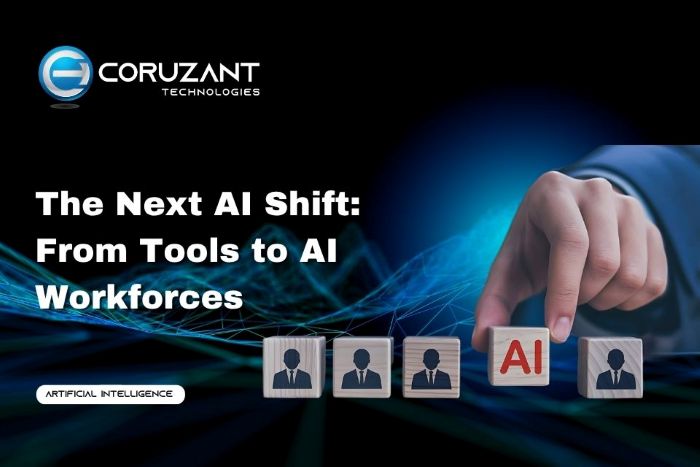
Artificial Intelligence is evolving at an extraordinary pace. In just a few years, businesses have embraced AI-powered chatbots, content generation, customer support automation, predictive analytics, and intelligent search. While these technologies are already transforming how organizations operate, I believe they represent only the beginning of a much larger shift to AI workforces.
Based on more than two decades of helping businesses improve digital operations, sales, and customer experience, Paul Ryazanov believes the next stage of AI adoption will not be defined by individual AI applications. Instead, businesses will begin building coordinated AI workforces that work alongside employees across every department. This vision is reflected in the development of Comerix, an AI Relationship Intelligence Platform designed to help organizations preserve knowledge, strengthen customer relationships, and build AI-powered sales and support teams.
The question is no longer whether companies should adopt Artificial Intelligence. The real question is how AI becomes part of everyday business operations.
Key Takeaways
- Artificial Intelligence is evolving rapidly, leading to AI-powered tools that fundamentally change business operations.
- Instead of isolated applications, businesses need coordinated AI teams that work together across departments for efficiency.
- AI can significantly enhance sales and customer engagement by understanding specific business processes and needs.
- Incorporating organizational knowledge into AI systems offers a competitive advantage that surpasses just adopting advanced technology.
- Successful businesses will blend human expertise with AI capabilities, creating a collaborative workforce for long-term growth.
Table of contents
Businesses Don’t Need More AI Tools
The rapid growth of Artificial Intelligence has created an explosion of specialized software.
Today, organisations use one application to write marketing content, another to summarise meetings, another to answer customer enquiries, and another to analyse data. While each tool solves an individual problem, they often create fragmented workflows that require employees to move constantly between different systems.
This approach is not sustainable.
As businesses continue investing in AI, success will depend less on the number of AI applications they purchase and more on how effectively those systems work together.
Rather than deploying isolated tools, organizations will increasingly build connected AI environments where multiple specialised agents collaborate, share business knowledge, and support employees through a unified platform. This approach is already influencing how platforms such as Comerix are being designed, where AI workforces work together rather than operating as disconnected assistants.
Every Business Depends on Sales
Artificial Intelligence is often associated with ecommerce, but the opportunity extends far beyond online retail.
Every business depends on attracting customers, answering questions, qualifying opportunities, and building long-term relationships.
A dental practice schedules consultations.
A law firm qualifies enquiries.
A manufacturer develops distributor relationships.
An accounting firm nurtures prospects.
A retailer converts visitors into buyers.
Although the industries differ, the underlying sales journey remains remarkably similar.
Businesses must engage customers, understand their needs, provide accurate information, follow up consistently, and deliver exceptional service throughout the customer lifecycle with or without AI workforces.
This is where Artificial Intelligence can generate measurable commercial value.
From Individual Assistants to AI Teams
Today’s AI solutions typically perform individual tasks.
Tomorrow’s organisations will deploy specialized AI workforces responsible for different business functions.
One AI agent may qualify new enquiries before assigning them to the appropriate salesperson.
Another may provide instant customer support using company knowledge and historical conversations.
Another may analyze customer behaviour to identify sales opportunities or recommend personalized marketing campaigns.
Others may prepare quotations, manage appointments, update CRM records, or automate operational processes.
Working together, these specialised agents create an AI workforce that supports employees rather than replacing them. According to Paul Ryazanov, the long-term opportunity is not to replace people with AI, but to enable every employee to work alongside multiple intelligent digital colleagues that continuously learn from the organization.
Business Knowledge Is the Real Competitive Advantage to AI workforces
Many organisations believe selecting the most advanced language model is the key to successful AI implementation.
In reality, the model is only one component.
Artificial Intelligence becomes significantly more valuable when it understands how a business actually operates.
Products, pricing, customer history, documentation, internal policies, workflows, previous conversations, and operational procedures all provide the context required for AI to make meaningful decisions.
Businesses that invest in organising and connecting this knowledge will gain a far greater advantage than those simply adopting the latest AI technology. This philosophy sits at the heart of Comerix, where organizational knowledge is treated as a strategic asset that powers AI-driven customer service, sales, and operational decision-making.
Human Expertise Remains Essential
Artificial Intelligence excels at speed, consistency, and processing large volumes of information.
People excel at empathy, creativity, negotiation, leadership, and strategic decision-making.
The future of business is unlikely to be fully autonomous.
Instead, successful organisations will combine the strengths of both.
AI will reduce repetitive administrative work, while employees focus on solving complex problems, building relationships, and creating new opportunities for growth.
Preparing for the Next Phase of AI workforces
Every major technology shift has changed how businesses operate.
The internet connected companies with global markets.
Cloud computing transformed software delivery.
Mobile technology reshaped customer expectations.
Artificial Intelligence is now transforming how work itself is performed.
The organizations that gain the greatest advantage over the coming decade will not necessarily be those that purchase the most AI software. They will be those that successfully integrate AI into their customer journeys, operational processes, and decision-making.
The future belongs to businesses where human expertise and intelligent AI systems work together as one coordinated team. As Paul Ryazanov continues to explore this evolution through his work with Comerix, the focus remains clear: helping businesses preserve organizational knowledge, strengthen customer relationships, and create AI workforces that deliver measurable commercial outcomes rather than simply adding another software tool.