Agentic orchestration is the practice of coordinating multiple AI agents so they work together on tasks too complex for any single agent, and it has become the defining architecture question in enterprise AI, where only 11% of organizations have agentic systems actively running in production despite widespread piloting (Source: Deloitte). That gap between experimentation and deployment is not a model problem. It is a coordination problem.
You have probably seen what a single AI agent can do. It answers a question, drafts a document, maybe books a meeting. Useful, but limited. Ask that same agent to research a market, write a report, validate the numbers, and format the output, and it starts dropping threads. The context window fills up. Errors compound.
Agentic orchestration solves this by splitting the work across specialized agents and putting a coordinator in charge, the same way a project manager runs a team instead of doing every job alone.
Key Takeaways
- Agentic orchestration coordinates multiple specialized AI agents under one controlling layer.
- An orchestrator agent assigns tasks, manages state, and merges results from sub-agents.
- Single agents fail on complex work because context and error rates compound.
- Common patterns include orchestrator-worker, sequential pipelines, and hierarchical agent teams.
- Start small: one orchestrator, two or three specialist agents, one measurable workflow.
The Definition, in Plain Terms
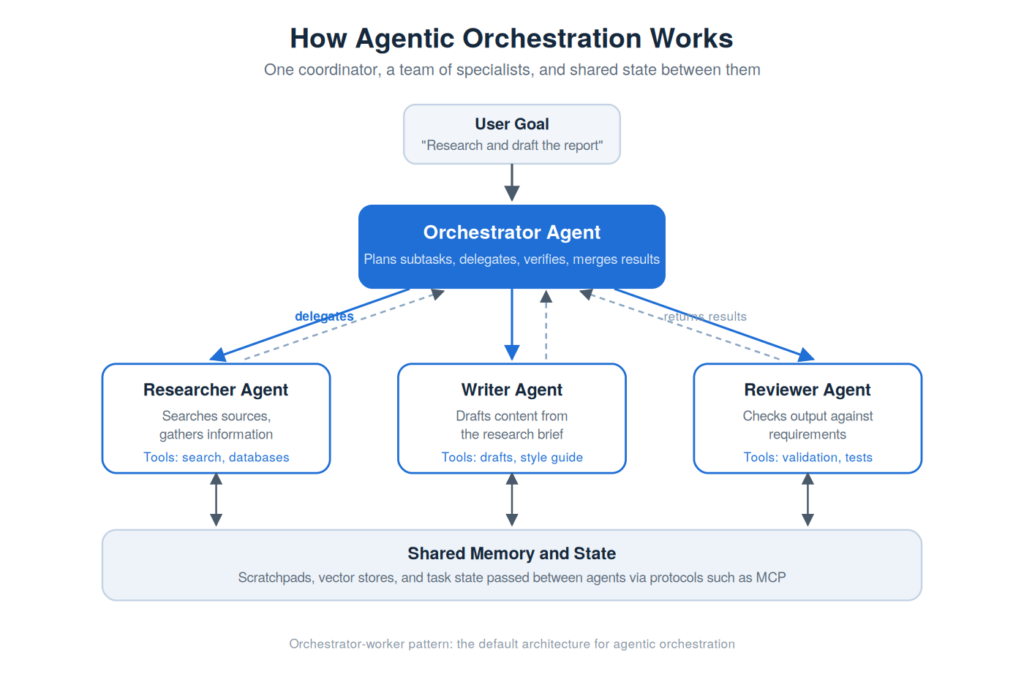
Strip away the jargon and agentic orchestration is task delegation for software. One agent, usually called the orchestrator or supervisor, receives a goal. It breaks that goal into subtasks, hands each subtask to a specialist agent, monitors progress, and assembles the pieces into a finished result.
Each specialist does one thing well. A researcher agent gathers information. A coder agent writes and tests functions. An analyst agent checks the output against requirements. None of them needs to understand the whole job. The orchestrator does.
This mirrors a shift the software industry has been through before. Monolithic applications gave way to microservices because one giant program could not scale or fail gracefully. Single do-everything agents are hitting the same wall, and orchestrated agent teams are the response.
Why Single Agents Break Down
A lone agent carries every instruction, every retrieved document, and every intermediate result in one context window. On a short task that works fine. On a long one, three things go wrong.
First, context overflows. The agent forgets constraints stated early in the task or loses track of partial results. Second, errors stack. If an agent is 95% reliable per step, a 20-step workflow succeeds barely a third of the time. Third, one agent cannot parallelize. It works through subtasks in sequence even when they could run at the same time.
Orchestration attacks all three. Each sub-agent gets a clean, focused context. The orchestrator can verify outputs between steps, catching mistakes before they propagate. And independent subtasks run in parallel, which cuts total completion time on research-heavy or multi-source work.
There is a fourth reason that matters if you run a business rather than a lab. Governance. When agents touch customer data or spend money, you want checkpoints. An orchestration layer gives you a natural place to insert human approval, logging, and policy enforcement without rewriting every agent.
How Agentic Orchestration Works
Under the hood, an orchestrated system has four moving parts. You will see the same anatomy across frameworks such as LangGraph, CrewAI, Microsoft’s AutoGen, and Google’s Agent Development Kit.
The Orchestrator
The orchestrator is itself an agent, typically backed by a capable reasoning model. It plans the task graph, decides which specialist handles what, sets the order of operations, and judges when the overall goal is complete. In some designs it also handles retries and escalation, rerouting a failed subtask to a different agent or flagging it for a human.
Specialist Agents
Specialists are narrow by design. Each one gets a role definition, a limited toolset, and a scoped context. A retrieval agent might only have search and database access. A writer agent might only have the draft and the style guide. Narrow scope keeps each agent reliable and makes failures easy to trace. How these agents perceive their tools and environment is a discipline of its own, and Coruzant’s breakdown of agent experience and reasoning covers it in depth.
Shared Memory and State
Agents need a way to pass results around without stuffing everything into one context window. Orchestrated systems use shared memory: a scratchpad, a vector store, or a structured state object that persists across steps and sessions. Practitioners have started calling this coordination fabric an agent harness, the infrastructure that manages tool execution, memory, and state so the agents themselves stay simple.
Communication Protocols
When agents come from different vendors or run on different platforms, they need a common language. The Model Context Protocol (MCP) has emerged as the leading standard for connecting agents to tools and data sources, and agent-to-agent protocols are following close behind. This is what makes cross-platform orchestration realistic instead of a walled-garden exercise.
Common Orchestration Patterns
You do not need to invent an architecture. A handful of patterns cover most real deployments, and each one trades something for something else.
| Pattern | How It Works | Best For | Main Trade-Off |
|---|---|---|---|
| Orchestrator-worker | One supervisor delegates to parallel workers, then merges results | Research, analysis, content pipelines with independent subtasks | Supervisor becomes a bottleneck on very large jobs |
| Sequential pipeline | Agents run in fixed order, each transforming the last output | Intake, enrichment, and decision flows in regulated settings | No parallelism, so slower on long chains |
| Hierarchical teams | Orchestrators nested inside orchestrators, each running a worker pool | Genuinely large, multi-department workloads | Highest cost and hardest to debug |
| Evaluator loop | A critic agent reviews and rejects output until quality clears a bar | Accuracy-sensitive work such as code, legal, and finance | Slower and pricier per completed task |
Where Orchestration Pays Off Today
The pattern is showing up in production across a familiar set of functions. Customer operations lead the way: an orchestrator routes an incoming issue to a triage agent, a knowledge agent, and a resolution agent, escalating to a human only when confidence drops. This goes well beyond what a scripted bot could do, a shift Coruzant has tracked in its look at why chatbots are giving way to agents.
Software development is the other proven ground. Teams pair a planning agent with coding, testing, and review agents, compressing work that used to take days into hours. Verifiable domains like code adapt fastest because the orchestrator can actually check whether a subtask succeeded.
Beyond those two, finance teams orchestrate transaction monitoring and reporting agents, supply chain groups coordinate forecasting and logistics agents, and marketing teams run research, drafting, and distribution agents as a pipeline. The common thread: multi-step work with clear handoffs and checkable outputs. Browse Coruzant’s AI coverage for current deployment stories across these sectors.
The Honest Challenges
Orchestration is not free. Every agent call costs tokens, and a hierarchical system can burn ten times the compute of a single agent on the same task. Treat cost as an architectural concern from day one, not a bill you discover later.
Debugging gets harder too. When a five-agent workflow produces a wrong answer, tracing which agent went off the rails requires proper logging and observability, tooling many teams have not built yet.
Security deserves its own paragraph. Each agent with tool access is an attack surface, and coordinated agents can amplify a compromise. Sandboxed execution, least-privilege tool grants, and audit trails are the baseline controls, and regulators are paying attention as agentic deployments scale.
Finally, do not orchestrate what should be a workflow. If a task is deterministic, a plain automation script beats an agent team on cost, speed, and reliability. Orchestration earns its keep on tasks that need judgment at multiple steps.
How to Get Started
Start with one workflow you can measure. Pick something with real business value, clear success criteria, and tolerable failure modes. Internal research summaries, ticket triage, and draft-and-review content pipelines are common first wins.
Then build the smallest thing that works. One orchestrator, two or three specialists, shared memory, and logging on every handoff. Run it against a baseline: the same task done by a single agent, or by a person. If the orchestrated version is not clearly better on quality, speed, or cost, simplify before you scale.
Choose your framework based on your stack and your team. Python-centric teams gravitate to LangGraph or CrewAI. Microsoft shops lean on AutoGen and Copilot Studio. If you expect to mix vendors, prioritize MCP support so your agents and tools stay portable. And decide early where humans sit in the loop. The strongest production systems combine autonomous execution with human judgment at the decision points that carry risk.
Conclusion
Agentic orchestration is what turns impressive AI demos into dependable systems. The core idea fits in a sentence: give complex work to a coordinated team of narrow agents instead of one overloaded generalist. The mechanics, an orchestrator, specialists, shared state, and a common protocol, are within reach of any team that can already build with LLM APIs.
Your best move is a small, measured pilot. Pick one workflow, wire up a minimal agent team, instrument everything, and compare it honestly against the status quo. You will learn more from two weeks of running a real orchestrated system than from two months of reading about them.
Read Next
Keep exploring how AI agents are reshaping enterprise operations:
- How AI Agents Transform the Customer Journey at Every Stage
- Top Custom AI Agent Development Companies in USA
- Top AI Agent Development Companies: Choosing the Right Partner
Frequently Asked Questions
Agentic orchestration is the coordination of multiple AI agents by a supervising orchestrator agent that breaks a complex goal into subtasks, assigns each to a specialist agent, and merges the results. It replaces the single do-everything agent with a managed team, which improves reliability, enables parallel work, and creates natural checkpoints for human oversight.
Agentic orchestration differs from workflow automation in who makes the decisions. Traditional automation follows fixed, predefined rules, while orchestrated agents reason about each step and adapt when conditions change. Use automation for deterministic tasks and orchestration for work that requires judgment at multiple points.
Agentic orchestration tools include open-source frameworks such as LangGraph, CrewAI, and AutoGen, plus platform offerings like Google’s Agent Development Kit and Microsoft Copilot Studio. Most modern stacks also rely on the Model Context Protocol (MCP) to connect agents with tools and data in a portable, vendor-neutral way.
Agentic orchestration matters because single agents fail on long, multi-step business processes. Orchestrated systems keep each agent’s context focused, verify outputs between steps, and give organizations a control layer for governance, auditing, and human approval, which is what regulated enterprises need before trusting agents in production.
Agentic orchestration can cost several times more than a single agent because every sub-agent call consumes tokens. Costs stay manageable when you match model size to task difficulty, cache repeated context, and reserve multi-agent designs for work that genuinely needs them. Measure cost per completed task, not cost per call.