Agentic AI systems are no longer a roadmap item. They are woven into the product pipelines, internal tooling, and customer-facing services right now. However, as organizations race to deploy agentic AI in different environments, a more disciplined view is beginning to prevail, i.e., one can’t afford to take humans out of the loop. Not yet! Maybe not ever!
This blog discusses how Human-in-the-Loop (HITL) testing is a design principle that spans the entire lifecycle and is not just a QA afterthought.
Key Takeaways
- Agentic AI systems require a Human-in-the-Loop (HITL) approach to prevent unpredictable behavior, context misinterpretation, and ethical blind spots.
- HITL is not just QA; it is a governance architecture that ensures ongoing evaluation throughout the AI lifecycle.
- Designing for HITL intervention involves establishing approval checkpoints and audit trails, ensuring human oversight in critical decision points.
- AI hallucination poses serious risks, especially in QA processes, making human reviewers essential for validating outcomes and improving AI models.
- Regulatory compliance is becoming critical; organizations must embed HITL to meet evolving AI governance standards.
Table of contents
- The Illusion of Full Autonomy
- AI Systems Governance: The Skeleton Every Agentic System Needs
- Approval AI Systems Checkpoints: Designing for Human in the Loop Intervention
- AI Hallucination in QA: A Specific and Serious Problem
- Auditability in AI Systems: If You Cannot Trace It, You Cannot Trust It!
- Explicability: Closing the Black Box
- Regulatory Concerns: The Compliance Clock Is Ticking
- Read Next
- Conclusion
The Illusion of Full Autonomy
Agentic AI systems represent a genuine leap in capability. Nevertheless, a full autonomy is risky for a simple reason: agents make mistakes in ways that compound, and ambiguous scenarios often require human judgment to resolve edge cases before they affect outcomes.
- Unpredictable behaviour: Agents respond dynamically to new inputs, which can lead to unintended decisions
- Context misinterpretation: Without human involvement, AI may misinterpret the subject matter at hand
- Error propagation: One mistake in multi-step workflows can cascade throughout the system making the result unusable
- Ethical blind spots: AI lacks human values unless explicitly programmed, leading to potentially harmful outcomes, so human oversight should act as a fail-safe in high-stakes decision making
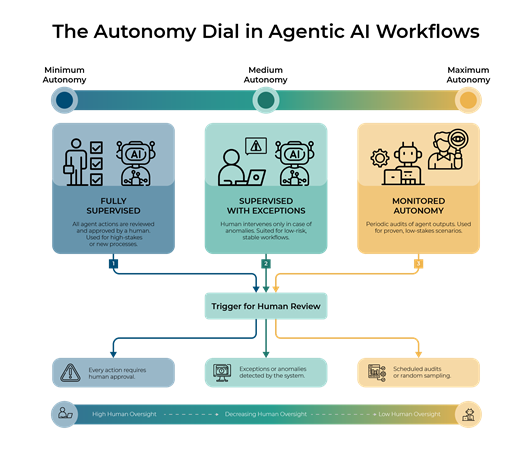
The autonomy provided to the agents must be treated as a dial, rather than a switch, with autonomy tiers defined as per the workflow:
- Fully supervised: Agents need to be reviewed, and every action should be approved; suited for new or high-stakes processes
- Supervised with exceptions: Agents need intervention only in case of anomalies; suitable for stable, low-risk workflows
- Monitored autonomy: Agents need to be periodically audited, usually only a sample of outputs; ideal for proven, low-stakes scenarios
Thus, each agent’s capability needs to be mapped to a tier during design, and not post-incident.
AI Systems Governance: The Skeleton Every Agentic System Needs
Human-in-the-loop (HITL) testing isn’t just a quality assurance mechanism; it’s a governance architecture, with ongoing evaluation built into how AI systems are assessed over time. Most governance discussions around AI stop at policy documents. In practice, governance needs to be embedded into the design and workflow.
This would mean:
- During requirements: Define the ‘minimum viable human touchpoint’ for each agent capability
- During design: Architect agent workflows with explicit pause-and-review states
- During sprint planning: Assign ownership for HITL review tasks the same way code reviews are assigned
- During release: Gate production deployment on HITL test coverage, while recognizing that HITL integrates human oversight and validation across automated development cycles, not only at launch
- Post-release: Establish a review cadence, as agent behaviour drifts as models update, upstream data changes, or usage patterns shift
Additionally, an effective governance framework will include:
- Policy enforcement – Aligning systems with organizational and regulatory policies, including regulatory requirements, compliance requirements, and regulatory compliance
- Risk management – Manual validation steps at critical decision points to protect fairness and sensitive data, with AI governance including protocols to mitigate bias and privacy risks
- Accountability structures – Clear ownership for AI decisions and outcomes
Increasingly, business leaders treat how to use AI responsibly as a governance issue, and 80% of business leaders see AI ethics as a major roadblock.
Approval AI Systems Checkpoints: Designing for Human in the Loop Intervention
One of the most practical implementations of HITL testing is the approval checkpoint: a defined moment in an agent’s workflow where execution pauses and a human performs a review of the next action proposed before it proceeds.
Not every step warrants a pause, though review steps add latency and cost to workflows, so checkpoints should be targeted; that would negate the efficiency gains of automation, but high-stakes actions absolutely do. Thoughtfully placed checkpoints serve a dual purpose. They create a feedback loop that uses human feedback to improve models and reduce bias before errors propagate. In this sense, HITL testing is not merely a safety mechanism, it is a continuous improvement engine.
Some high-leverage checkpoint locations include:
- Before any write-operation to a production system
- Before generating customer-facing content at scale
- Before executing code in a live environment
- At the handoff between agent sub-tasks, especially when context is summarized or compressed
- When confidence scores fall below a defined threshold, allowing HITL systems to route uncertain outputs for human approval
AI Hallucination in QA: A Specific and Serious Problem
AI hallucination is a known challenge. In agentic AI systems used for quality assurance, it becomes a particularly dangerous liability. Consider an agent that generates test cases, validates test results, or summarizes coverage reports, where automated checks can still miss qualitative issues that require human evaluations. If that agent hallucinates, say, a test is passed when it should not have been, or fabricates a finding that was not in the data, the downstream consequences can be severe.
Hallucination in QA creates three specific risks:
- False-green builds – Agents confirm that test suites passed when they did not, pushing the defective code toward production.
- Coverage inflation – Agents report higher test coverage than what really exists, giving engineering leadership a distorted picture of the product health.
- Audit fabrication – In regulated environments, the agents may generate compliance artifacts that describe checks that were never performed
Human reviewers in the QA loop serve as hallucination detectors. They bring the domain expertise, common sense, and the ability to cross-reference claims against the reality in ways that current AI systems simply cannot do reliably. Human input also helps improve ai models and ml models by producing better training data over time. That often includes data labelling, where people review raw data and apply accurate tags or classifications, while active learning lets systems flag uncertain cases for human annotation.
In essence:
- Ground-truth must come from deterministic test runners
- Agent-generated QA summaries cannot be treated as final status
- Cross-verification mechanisms must be implemented
- reinforcement learning from human feedback can improve performance by aligning outputs with human intent and safety guidelines
Auditability in AI Systems: If You Cannot Trace It, You Cannot Trust It!
Any deployment of agentic AI must answer a fundamental question: Can you reconstruct what the agent did, why it did it, and what data it acted on? Unlike traditional systems, in an Agentic system without HITL, there is no way to reconstruct the output.
A complete audit trail for an agentic system will include:
- The exact prompt and context the agent received at each step
- All tool calls made, with inputs, outputs, and timestamps
- Intermediate reasoning states (chain-of-thought logs where available)
- The human interventions that occurred: who reviewed, what they approved or rejected, and when
- The model version and configuration active at the time of execution
HITL testing naturally produces audit trails because human reviewers create records: approvals, rejections, comments, corrections, and every interaction should be logged.
As a part of the best practices:
- Agent audit logs must be built to the same standard as security audit logs, immutable, timestamped, and query-able
- Review tools should enforce structured fields and clear guidelines to reduce inconsistent feedback
- Retention policies must be assigned based on the risk tier of the workflow
- A weekly review of agent decisions to catch failure patterns and auditability issues, including variance from reviewer bias, fatigue-related missed critical errors in repetitive reviews, and patterns in hitl work
Explicability: Closing the Black Box
“Why did an agent take a particular action?” This is one of the persisting problems in AI, and it becomes more acute as systems grow increasingly complex. Human reviewers in the loop, especially domain experts applying human intelligence, help bridge the explicability gap.
Capturing that human reasoning, and feeding it back into the system’s design, is how organizations build the institutional knowledge needed to eventually reduce oversight in lower-risk contexts, while also informing AI development and the broader push for trustworthy ai. Explicability also matters externally. Customers, partners, and regulators increasingly want to know how AI-driven decisions were made.
HITL processes close the explicability gap, creating the explanatory narrative that external audiences require. This in turn would require reviewers to capture their decision rationale in structured fields, not free text, creating a taxonomy that can be tracked, acted on, and even built into agentic outputs. This review layer also supports exploratory testing by surfacing unexpected bugs or design flaws that automated checks may not explain well.
Regulatory Concerns: The Compliance Clock Is Ticking
AI regulation is no longer a distant horizon, across industries and geographies. Many of these agentic deployments would be in the high-risk category of the EU AI Act, requiring human oversight, transparency requirements and conformity assessments. Regulators in the financial services, healthcare and critical infrastructure sectors explicitly require a human review of consequential AI decisions.
Beyond the obvious legal risks, there is a commercial dimension, enterprise buyers are increasingly adding AI governance requirements to procurement contracts. HITL architecture is becoming a sales requirement, not just a compliance requirement. As a result, building in human oversight is an architecture decision that companies need to make while designing.
Read Next
A few related pieces worth your time:
- AI Is Changing the Way Companies Manage Compliance Documentation
- Create a Virtual Host Product Demo With an AI Video Generator
- Reputation Management Is Getting Harder in the Age of AI Search
Conclusion
The organizations that will deploy agentic AI most successfully will not be those that eliminated humans from the process the fastest. Rather, they will be the ones who thoughtfully designed human oversight. Therefore, many enterprises are also investing in platforms, such as eInfochips NomAIzoTM, to orchestrate their agentic ecosystem, enabling scalable human oversight, auditability, and responsible deployment practices. In this context, the human in the loop is not merely a control mechanism; instead, it’s a foundation for a collaborative and responsible intelligence.
Frequently Asked Questions – Human-in-the-Loop Testing
- Who should review agent decisions, and what skills should they have?
Match the reviewer to the decision type. Technical actions need engineers who understand system behaviour. Customer-facing or compliance decisions need domain specialists. That said, reviewers should understand AI limitations, potential failure patterns, etc., and evaluate accordingly.
- How do organizations measure the ROI of Human-in-the-Loop oversight?
The value of HITL is often reflected through risk avoided and fewer incidents. Maintaining a team of human reviewers is more costly than pure automation, but that trade-off should be measured against risk reduction. Pair it with metrics that you can actually track, such as decision accuracy rates, override frequency over time, cost of catching an error at the checkpoint versus after deployment, and review quality metrics, since reviewers can suffer vigilance decay and approve outputs too quickly. Organizations should thus evaluate both risk reduction and operational effectiveness when assessing ROI.
- How should Human-in-the-Loop frameworks evolve when organizations use multiple interacting AI agents?
In multi-agent environments, the review mechanisms should focus on the workflow outcomes, coordination failures, and unintended consequences that may emerge from agent-to-agent collaboration. HITL systems also adapt faster to new patterns because humans can incorporate feedback into workflows as models develop. Building HITL across multiple agents increases integration complexity and requires deliberate workflow design.