Shauna Geraghty Podcast Transcript
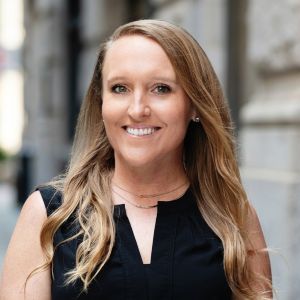
Shauna Geraghty joins host Brian Thomas on The Digital Executive Podcast.
Brian Thomas: Welcome to The Digital Executive. Today’s guest is Shauna Geraghty. As the Senior Vice President, Global Head of People & Talent at Talkdesk, Shauna Geraghty leads the global talent, people, IT, and workplaces functions, and serves as the executive sponsor for the Women in Tech ERG. She’s also a strategic advisor for Stanford University School of Medicine, and is on the customer advisory board of LinkedIn.
Shauna Geraghty the first US employee at Talkdesk, helped build its marketing and talent functions from the ground up. Since 2016, she’s helped scale the company to 1,500-plus employees, and now leads its strategic focus on attracting, retaining, and growing the best and brightest talent. Geraghty has a doctorate in clinical psychology from PGSP, Stanford, and the PhysD Consortium.
Well, good afternoon, Shauna. Welcome to the show.
Shauna Geraghty: Thanks for having me.
Brian Thomas: Absolutely, my friend. I appreciate it. You’re hailing out of New York. At the moment, I am in Kansas City, so I appreciate you taking the time, especially that time in the evening. Shauna, if you don’t mind, jumping right into your backstory here.
You joined Talkdesk as its first US employee in 2012, mid doctorate in clinical psychology with no marketing experience. Your first task was writing the copy for the company’s first website. From there, you built marketing, then talent, and helped scale a company past 1,500 employees, which is an amazing feat.
What made you say yes to a tiny startup mid doctorate, and how do you make sense of that path now?
Shauna Geraghty: Yeah, great question. What drew me to Talkdesk really truly was the opportunity. At the time, I considered it to be a once in a lifetime opportunity to work with ambitious founders and to build something from the ground up.
You know, I was living in Silicon Valley. I didn’t know much at all about SaaS, but I recognized the potential of this company and the people behind it, and I was willing to go all in and bet on both. And today I still consider it to be a once in a lifetime opportunity. I think that the thing that draws me, that drew me to Talkdesk initially and that keeps me here is really the ability to build something from the ground up.
So not to necessarily have the experience, not to necessarily have the playbook but to really use my skills in research and critical thinking and my learning agility to solve big challenges and to build something from the ground up without a playbook, without someone who’s done it before
Brian Thomas: That’s awesome. That’s a really ambitious move, very bold jumping in like that. But it was an opportunity, as you mentioned, to starting something from the ground up, building something that’s really your own. I know you’re a part of it, but that was just amazing. And to, to scale it from that to the size that Talkdesk is now is just simply amazing.
So appreciate the bold move and the backstory. Shawna, HR and IT converging, let’s talk about that. You now lead people, talent, IT, and workplaces together, and you’ve argued that HR and IT are converging into a single decision-making layer. What’s driving that convergence, and why does it make sense for the same leader to own both the human and the technology sides of how work gets done?
Shauna Geraghty: Yeah, it’s a great question. I think that AI is just fundamentally changing the relationship between people and technology and their work. And for the first time ever, you’re seeing the convergence of workforce strategy and tech strategy. They’re starting to become part of that same conversation.
Historically, HR really kind of determined a talent strategy almost in isolation while IT provided the tech, tech kind of strategy infras- infrastructure to support the scaling needs of the organization. That model, in my opinion, doesn’t work anymore, right? You can’t make work- workforce decisions without understanding what AI can automate, what AI might be able to augment or potentially even eliminate, and you certainly can’t make technology investments without understanding how they’ll fundamentally reshape roles and capabilities within the organizations as well as workflows.
So I think that there’s a convergence that’s happening today that we’ll no longer be able to pull apart in the future. So bringing these two functions together really allows us to move from just managing people and technology kind of separate, as separate functions or resources, to truly redesigning how work gets done within an organization
Brian Thomas: That’s amazing. And there’s always been that relationship, I think being in IT for so long and, and working with a lot of my peers in HR, I think it’s amazing that the opportunity to work so closely you being over both of those teams is, is amazing. With AI fundamentally changing how work gets done, as you mentioned, is really gonna pull those teams together.
You have to align, the workforce and that technology are now converging, as you mentioned, and it’s important those two areas are very, very tightly aligned. Shawna, as chair of Talkdesk’s AI steering committee, you focus on how AI and automation can empower employees, grow productivity, and evolve organizational design.
Where are you seeing AI genuinely make your work- workforce better rather than just cutting cost? And how do you help employees see AI as an ally rather than a threat to their jobs?
Shauna Geraghty: I think the biggest opportunity actually is not just reducing costs. It’s fundamentally increasing what people are capable of accomplishing.
So I use the example of recruiting. AI can absolutely handle a lot of the manual, redundant, tactical work that recruiters used to consider to be kind of admin work. And what that allows is for them to free up their resources to be more strategic, to be more proactive to do what they really truly love to do, which is assess talent, advise our leaders on their talent strategy, and building more meaningful candidate relationships.
And so I would extrapolate that same example across all of our functions at Talkdesk. I think that AI is certainly going to change jobs. Some tasks will disappear within those jobs, and new capabilities will emerge in their place. I think that that’s the beauty of that, is understanding where we can focus our investment, focus on driving AI fluency, redesigning these roles around the future possibilities, and allowing our employees to really truly amplify their impact leveraging this tool is incredible.
So we work with our employees to think about that, how, how we can leverage this as a tool to amplify their impact and increase their value, not just solve for cost-cutting measures or, drive ef- efficiency gains, if you will. I think as leaders that’s our responsibility, to create that environment where we can highlight that their capabilities can be amplified and create that path forward for them and the opportunity to do that.
Brian Thomas: Awesome. Thank you. You did highlight some things which we’re seeing today. It might have started with, an autom- automated employee application system, right? But now you’re seeing AI can handle much of the repetitive recruiting tasks and, some people might pause there, but what it actually allows is having recruiters build these more meaningful people relationships, which you talked about.
So that’s awesome. You did mention some tasks will go away. We all know that, and I’m seeing that in my space as well, but there are so many other human-managed tasks that will be created out of this, and I think it’s amazing that we’ll actually get to see humans at their full potential instead of doing some of these repetitive robot-type tasks.
So I appreciate that. And Shauna, the last question of the evening here, you’ve said the role of HR leaders is becoming much broader, that they increasingly need to be business transformation leaders who bring people together, organizational design, and technology to fundamentally rethink how work gets done.
If you look out maybe five, even 10 years out, what does the people function actually look like in an AI-native company, and what should HR leaders be building right now to lead that transformation rather than just react to it?
Shauna Geraghty: I think that the people function will look radically different than it does today about five to 10 years out.
So it, I, I think it, and at the essence, we’ll be moving from managing the workforce to truly architecting how work gets done. And I think that what that means is the people function will be designed around those outcomes. How do we redesign the work so that we can drive more value for the business?
Where can we think about where we can layer AI onto a current process to automate and drive more efficiency and/or completely redesign a process so it brings more value to the business? So those are the types of conversations I believe that HR leaders of the future will be having. In order to prepare for those conversations, I, I really do believe that there are three capabilities that an HR leader of the future must start to develop now.
First is driving their business and tech fluency. We really need to understand deeply how AI can add value, where the limits of that tool or function might be, and what are the economics of our business model, and how does technology and AI transform that? So not just thinking about our employee experience, but how do we drive transformation within our organizations?
The second is really thinking about organizational and workforce architecture. We really need to get better at deconstructing our work down to the, I call it the unit of work, to understand what is that unit of work that that function derives to impact the business, and then redesigning our workflows and sometimes our organizations around that and thinking about what are the future capabilities that we need in order to drive the business outcomes that we’re looking, looking to drive.
And then the third is transformation leadership. Talked about it earlier. Tech, tech alone doesn’t transform a business. It’s changing the behaviors, the incentives, and sometimes the expectations of the leader as well as the organizational culture. Together, those help to transform a business along with technology.
So being able to own that, that, that role of transformation leadership is gonna be so important. And I think that most people leaders who are going to be impactful are going to be the ones that are helping to drive the strategy within the organization, helping to redesign the operating model, and being in the forefront of that change that’s happening within the organization
Brian Thomas: Amazing. Thank you so much. And just to highlight a few things, Shawna, you talked about the future. Five years is gonna be crazy, but I can’t even imagine 10 now with AI. But you talked about that people function will look radically different. We’ll look at things like, how do we really build AI into our processes, into the things that we’re doing with people around the organization?
You talked about the three things HR leaders of the future will talk about, right? The focus on driving the business and tech fluency organizational workforce architecture, as you said, and transformational leadership. Again, changing the behaviors, not necessarily technology, and I really love that.
Yeah. Like I said, I lo- I love being in tech, but most importantly for me, it’s always been about the people, so I appreciate that. And Shawna, it was such a pleasure having you on today, and I look forward to speaking with you real soon.
Shauna Geraghty: Well, thank you so much, Brian. It’s been my pleasure.
Brian Thomas: Bye for now.
Shauna Geraghty Podcast Transcript. Listen to the audio on the guest’s Podcast Page.