Vladi Lepi Podcast Transcript
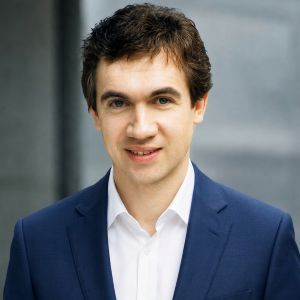
Vladi Lepi joins host Brian Thomas on The Digital Executive Podcast.
Brian Thomas: Welcome to Coruzant Technologies, Home of The Digital Executive Podcast.
Do you work in emerging tech? Working on something innovative? Maybe an entrepreneur? Apply to be a guest at www.coruzant.com/brand.
Welcome to The Digital Executive. Today’s guest is Vladi Lepi. Vladi Lepi is the Founder of SurR.Ai, an art and technology project operating at the intersection of artificial intelligence, mathematics, and blockchain secured systems.
His work focuses on authorship structure and the role of time in defining creative output in the age of AI. Through SurR.Ai, Lepi positions AI not as an autonomous creator, but as a tool within a human-directed system, introducing a framework where digital art is treated as a structured verifiable protocol rather than a standalone image.
Lepi’s latest project, SurR.Ai, the System of Temporal Law, explores how blockchain timestamping can be used to define authorship in AI-generated content. By minting a 62-second audiovisual sequence on Ethereum, the work creates a permanent verifiable point of origin, applying principles of irreversible timestamp systems to the question of ownership in digital media.
Well, good afternoon, Vladi. Welcome to the show.
Vladi Lepi: Hello. Thank you so much. Thank you for inviting.
Brian Thomas: Absolutely, my friend. I appreciate it. You’re hailing in out of New York City. I’m in Kansas City, so we’re just an hour apart. So, I appreciate you jumping on the podcast today. Let’s just jump right into your question here.
Vladi, you’ve spent decades working across cultural production, institutional leadership, and technology-driven systems. What experiences shaped your journey to founding SurR.Ai and exploring the intersection of AI, mathematics, and blockchain?
Vladi Lepi: Yes, it’s probably the, a good question about the background.
I was born in, former Soviet Union in the city Kharkiv, Ukraine, and, my education started with, you know, regular school plus ballet education. I went to ballet school in Kharkiv, and then I moved to the Kyiv, capital of Ukraine, where I, I was a student of the only one, ballet academy in Ukraine.
At that, time, Ukraine was about 50 million people, and the school was only one school to get education as a ballet dancer. So, when I started education there, had subject like history of ballet, history of theater, history of art, musical, literature. So, it was not only ballet education, it was overall art education.
And this background, like, together with the- Later, my, performance, career, gave me some kind of unconscious, background which led me, to found, SurR.Ai. it, it’s kind of activated the background information that I received during the education and led me, uh, perform via visual arts.
And, lately it’s not only visual arts, it’s also sound. So, the latest works that I do, it’s, audiovisual works. but, the main idea why I decided to do digital art, it was concept of NFT. I understood, at some point I, I understood what it is and, now it, it, it was a trigger, you know.
NFT availability of this technology, let me, start producing, first, uh, still images, then videos, and now it’s audiovisual, presentations. sometimes it’s a solo presentation, sometimes it’s like, the artwork that we are talking about, 62 seconds. Uh, so it’s probably one of the longest, presentations that produced so far.
Brian Thomas: That’s amazing. Thank you. And I appreciate the backstory, especially where you came from and what you did. obviously coming from Ukraine, in the arts, area, and of course the ballet school, very competitive, and I think that’s really cool that, you were able to do that work. And as you stated, this background provided an unconscious direction to what you’re doing today now in AI and digital art.
You got into NFTs and you’re doing some really interesting things. Of course, we love talking about the blockchain AI and NFTs here as well on the show, so thank you. And Vladi, there’s a growing debate around whether AI can truly be considered a creator. How do you define the relationship between human intent and machine-generated output?
Vladi Lepi: I do not view AI as a creator. Uh, view it as a high-speed performer that lacks, lacks a script. The relationship is identical to the, uh, relationship between a choreographer and a dancer, for example. A dancer possesses physical capability, but without, scripted dance choreography, there is only motion, no production.
AI can generate endless motion, but it cannot generate intent AI, SurR.Ai, we treat Medium as a generative substrate, while the human artist acts as a conscious knowledge center. By imposing a rigid mathematical structure, like in my 62-second protocol, video that we are talking about, I provide the score the machine must follow.
We aren’t competing with the machine. We are governing it, to ensure the final output is a harmonious blend of human ingenuity and technological innovation. so it means, like, I consider, AI art is a human-made art, and this is, like, a main point of the conversation and main point of the presentation of this art piece, uh, because, I conceived it as a digital art, for the, ABS, uh, competition.
But, but it, it’s grounded in the physical world. And, the concept of phigital, when physical and digital lives together, it’s, also one of the main ideas that I’m trying to deliver to the audiences.
Brian Thomas: Thank you. That’s awesome. I appreciate you unpacking some of that. And I just wanna highlight a couple things, Vladi.
You do not use AI as a creator, as you said, but more of a high-performance, uh, assistant. Yeah. and the analogy you used is, the dancer, right? It’s physical, but without the choreography, it’s really not a true performance. I like how you laid that out for our audience. And what you’re doing really is a, it’s a harmonious blend of human and machine art, and I really love that.
So, thank you for keeping the creators in mind out there. And Vladi, by minting a 62-second audiovisual sequence on Ethereum, you created a permanent point of origin for digital media. How do blockchain secured systems fundamentally change how we think about provenance and intellectual property?
Vladi Lepi: Yes. As I told you, the main point why I decided to start the digital art, it was concept of NFT. And I see NFT, technology as a safety tool, as a, like, a, a lock or, like, a safe. So, um, in my opinion, it’s important what is inside of the lock or safe, not, it’s important to have this technology available, but, uh, the main idea, what you, what kind of file you have inside, and the value is in the file.
So blockchain solves the crisis of what, I call the digital slop, where media is poured into an anonymous reservoir and loses its connection to the creator. By minting on Ethereum, we move from owning the file to securing the intent. In my ballet background, provenance was a lineage passed from master to students.
It’s like a peer-to-peer education. You cannot learn ballet, by watching videos or, reading a book. On the blockchain, provenance is a mathematical and absolute. It creates a permanent libretto that proves at a specific temporal moment a human directed the machine. This, transform, transforms the work from disposable piece of data into individualized entity.
It secures the human signal against the noise of infinite generation, ensuring, that artist’s digital fingerprint remains unchangeable and authentic, authenticated.
Brian Thomas: Thank you. really appreciate that. We’ve probably had 100, folks here on the podcast that are in the Web3 blockchain space. it’s great to hear that we’re leveraging the technology, not just for crypto, but as you know, blockchain brings a lot of, really, security and originality to it.
Obviously, you talked about that. You know, getting to this work, the genesis of your work was getting to this NFT space, and using blockchain, it solves that problem of provenance. It proves the originality of the artist’s work, and I think that’s amazing, and we need more of that so we can continue to promote the creators out there and the unique work that they provide.
So, thank you. And Vladi, the last question I have for you today, as we look ahead, how do you see AI, blockchain, and au- authorship evolving over the next decade? And what role will verifiable systems play in shaping the future of creative ownership?
Vladi Lepi: I, I think the next decade will be, will see a great partition.
On one side will be the AI slop, a flood of an- anonymous, low-value automated content, content. On the other will be verifiable authorship. The artists will evolve into author-governor, valued not for what they ma- uh, make, but for how they direct and audit the machine. A verifiable system like blockchain will become the digital DNA of creative work.
In a world of infinite copies, provenance will be the only true currency. At, SurR.Ai, we are already building this future, treating every creative act as a smart contract. Verifiable systems will ensure that the total art lineage from ancient Greek theater to digital authorship remains a clear, unbroken line of human culture me- memory rather than a pile of machine-generated data.
Brian Thomas: Thank you. And I love your insights. obviously, you talked about the next decade. and you kind of broke it into two. You said there would be a partition of, AI, which obviously is gonna do mass production of output of, you name it, all this art. But the other side of the partition, as you said, was this verifiable authorship.
And at the end of the day, providence, right, will be the true currency and, and that’s gonna hold the value, and I think that was very interesting, so I appreciate your insights.
Vladi Lepi: And- Absolutely …
Brian Thomas: Vladi, it was such a pleasure having you on today, and I look forward to speaking with you real soon.
Vladi Lepi: Thank you so much.
Brian Thomas: Bye for now.
Vladi Lepi Podcast Transcript. Listen to the audio on the guest’s Podcast Page.