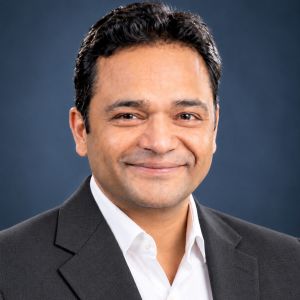
Sachin Gupta Podcast Transcript
Sachin Gupta joins host Brian Thomas on The Digital Executive Podcast.
Brian Thomas: Welcome to The Digital Executive. Today’s guest is Sachin Gupta. Sachin Gupta is an accomplished enterprise technology leader, independent researcher, and digital transformation strategist with over 20 years of experience driving enterprise architecture, large scale technology modernization, and business innovation across global organizations.
He is committed to bridging the gap between technology innovation and real world business outcomes. As a IEEE senior member and active contributor to professional and technology communities, he also serves on the advisory board of the Strategic AI Program at the University of Colorado, Colorado Springs.
Sachin is also passionate about advancing responsible AI adoption, intelligent automation, and next generation enterprise architecture. His research and thought leadership explore how agentic AI, intelligent decision-making systems, and evolving digital operating models can transform enterprise operations and improve global supply chain resilience.
Well, good afternoon, Sachin. Welcome to the show.
Sachin Gupta: Hey, thanks, Brian. It’s great to be here. I’ve enjoyed listening to your podcast, so it is exciting to be on the other side of the microphone today. I really appreciate the invitation.
Brian Thomas: Absolutely, my friend. I appreciate you so much. You’re hailing out of Denver, Colorado.
I’m in Kansas City, so just an hour apart today, which is nice. Sachin, if you don’t mind, I’m gonna jump into your first question here. You’ve spent over 20 years in enterprise technology, from Oracle to Mahindra, Bristlecone, to leading global enterprise technology programs today, while also becoming an IEEE senior member, an independent researcher, and an advisory board member for a university strategic AI program.
What’s the thread connecting that journey, and how did an enterprise architect and ERP specialist end up working on agentic AI and supply chain resilience?
Sachin Gupta: Yeah. The twenty years of my journey span between what technology can do and what technology actually work inside a real business. At Oracle, I helped build ERP supply chain products from inside, so I learned how the software thinks.
As a consultant, I implemented planning system for clients and saw where good software meets messy reality, the data quality, processing people. Leading enterprise technology program today, I own the outcome. Systems have to run every day across region under compliance rules. How I got to agentic AI?
Supply chain are decision problems. When AI moved from predicting to acting, the obvious question for someone with an ERP background was: How do we let AI act inside these systems without breaking them? That’s a question I’m researching on.
Brian Thomas: Amazing. I, I really appreciate that. And of course, with your background, Sachin 20-plus years, obviously enterprise technology in the software space diverse company and roles a- a- across some of the biggest companies.
We… And we mentioned just a few there, but you’re absolutely right. Technology leapfrogs, but this is probably, in our lifetime at least, probably the biggest move and change in advancement in technology with AI. And you talked about that, where it’s moving n- from predicting, now it’s actually acting, and there’s a lot of things that could be happening within our tenets, within our software with these agents, and it’s important we have people like you that are educated in helping us all out.
So thank you. Sachin, next question here. You recently presented AI-enabled supply chain resilience from ERP systems of record to intelligent demand supply orchestration at a AAPSCM Global Procurement Supply Chain AI and Logistics Summit in Dallas recently. What problems were you trying to solve, and what does it mean to move forward from an ERP as a system of record to an AI-driven orchestration?
Sachin Gupta: A supply delay or a demand spike travel through the inventory, freight, pricing, and customer commitment within days. That’s the problem statement I talked about there. Most companies can see far more than they could five years ago, but decision are still made one at a time. You forecast, then plan inventory, then source, then ship, then check the compliance.
Each step looks right its own, and the result is still poor. The classic example, small s-swing in customer demand becomes large swing upstream. That is what we call as a bullwhip effect, and that is one of the key point which we discussed there. Three roles in next big shift which I propose there. One, ERP stays the system of record that stays source of transaction.
Second, AI becomes the system of intelligence. It sense, it reasons, and it recommend. Three, the workflow and agent becomes the system of action. They carry out approved decision. A quick example, a high priority order hits a supply shortage. Instead of someone checking five systems by hand, AI layer look at alternative warehouse, partial shipment, substitute item, and expediting rank the options with the trade-off explained, and a person approves in a minute instead of days.
The tagline which I talked all about that day, the goal isn’t perfect prediction. It is earlier detection and faster coordinated response
Brian Thomas: Amazing. Thank you so much. We talked a little bit about that summit you were at again, and you talked about how companies are certainly advancing, especially the larger companies taking advantage of the technology seeing m-much better forecasting, a lot of data in front of them.
However, those decisions are sometimes still bottlenecked, right? But you talked about three things in this space, is that ERP is still a system of record, the AI is a system of intelligence, and you talked about that workflow where the agent is a system of action, and I thought that was interesting that you broke those out for us.
So I, again, appreciate your insights there. Sachin, you emphasize balancing innovation with governance, architectural discipline, cybersecurity, and measurable value. In a moment where everyone feels pressure to adopt AI as fast as possible, how do you keep that discipline without becoming the person who slows everything down?
And why does governance actually enable innovation rather than block it?
Sachin Gupta: Yes. Governance gets a bad name when it, it’s gate at the end. It works when it is designated in from the start. I use three risk tier autonomy. One, routine reversible decision run automatically end to end. Second, medium risk decision get quick approval.
And third, high impact decision such as cross-border compliance or contract exceptions stays with a named person. My rule of thumb is AI recommends, but human governance where the consequences are material. Measure outcome, not AI activity, decision response time, service levels, override rates, and compliance escapes.
When a leader trusts the guardrails, they say yes faster. Teams without guardrails get stuck in pilots because nobody wants to own the risk
Brian Thomas: Thank you. Appreciate that. You talked about that I thought it was interesting and, and Sachin, I’m also part of IT governance council over the years and, and recently AI governance committee in my role as the chief AI officer. Governance does get a bad rap when it’s used as, dated, right?
But if governance is set up correctly at the beginning, as you talked about it can actually enable innovation here. You talked about the low, medium, and high risk as well. But at the end of the day, AI may recommend things do a lot of that decision presentation, but at the end, at the end of the day, we need to have humans in the loop, and humans need to make those decisions.
So thank you. And Sachin, the last question of the day, if you could share with us, you’ve said the next era won’t be defined simply by adopting AI, but by creating trustworthy, adaptive, and human-centered enterprise systems that enable sustainable innovation and long-term resilience. Could you paint that picture for us maybe five, ten years out?
What does a truly intelligent human-centered enterprise look like, and what do leaders need to start building today just to get there?
Sachin Gupta: Sure. ERP still exists as a trusted record. Around it sits an intelligent layer that senses, reasons, and recommend and govern agency carry out the appropriate actions.
Every AI decision is traceable, what it saw, what it recommend, what it approved. To start with, I would recommend three approaches. Trusted master data, because AI is only as good as it gets the inputs. Second, clear decision ownership and risk tier has to be there. Third, small measurable use cases that can grow, and we go further from there.
The one line to close this answer, the goal isn’t the most automated enterprise. It is most trusty one.
Brian Thomas: Interesting. Thank you for sharing. I really appreciate that. You had so much space in the ERP ex- so much experience in the ERP space, and you talked about ERP still sits as that system of record no matter how advanced it is or how much integration of artificial intelligence is there.
At the end of the day, we wanna make sure that every AI action is logged so that we can either reference that or maybe even sometimes troubleshoot certain things as you talked about. But you, you mentioned having a, a tested master plan, obviously identifying that risk making sure that you have a clear risk plan there.
And of course, you talked about starting with measurable small use– usable use cases where you can build upon from there. So I appreciate the insights. And Sachin, it was such a pleasure having you on today, and I look forward to speaking with you real soon.
Sachin Gupta: Thank you, Brian. I really enjoyed this. People can find my work at sachingupta.net.
Brian-Thomas: Thanks again and bye for now.
Sachin Gupta Podcast Transcript. Listen to the audio on the guest’s Podcast Page.