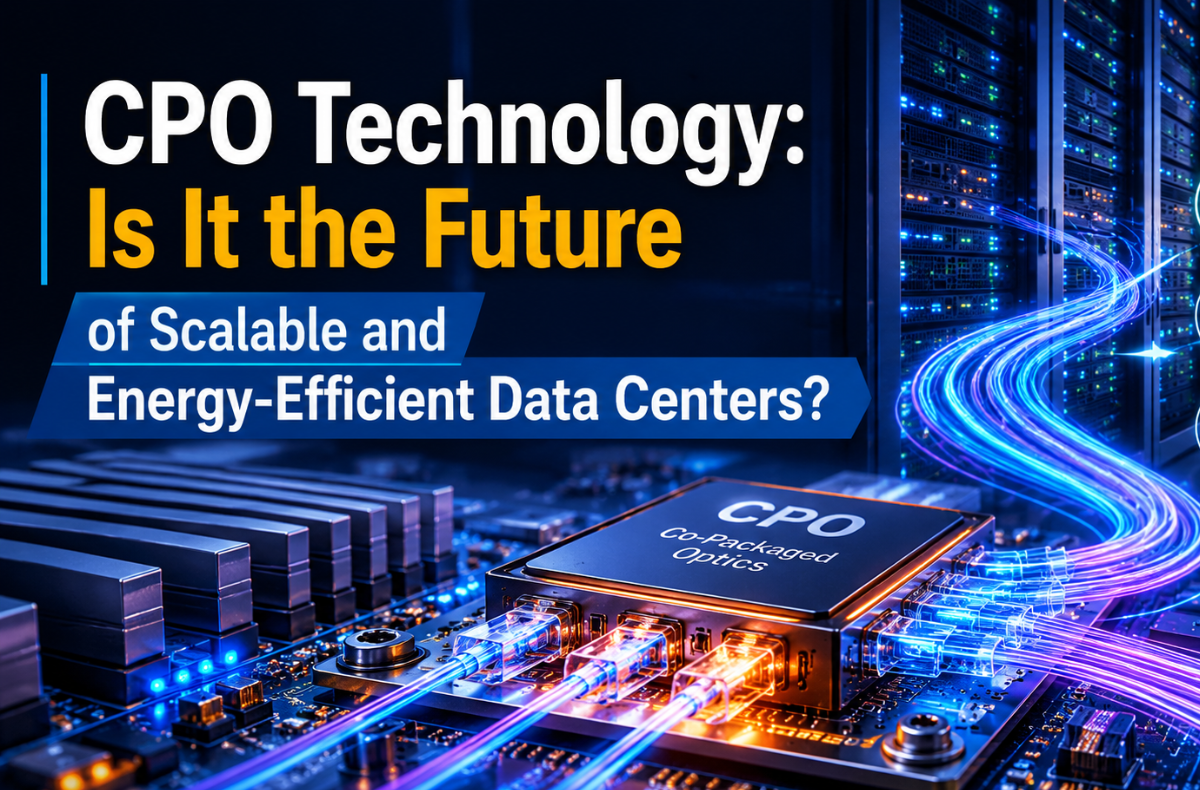
Co-Packaged Optics (CPO) integrates photonic engines directly with switch ASICs to dramatically reduce energy loss and latency. By replacing traditional pluggable optics with CPO technology, data center operators achieve up to 70% lower optical interconnect power consumption and massively increased bandwidth density for demanding AI workloads.
Data centers face an unprecedented challenge. Generative AI clusters require massive bandwidth and low latency, pushing traditional electrical interconnects to their physical limits. Pluggable optical transceivers currently consume approximately 50% of system power in traditional switch systems [Broadcom, 2024]. This creates a severe bottleneck for scalability.
Co-Packaged Optics (CPO) offers a powerful solution. This advanced packaging approach integrates optical transceivers directly next to processing chips. The result is a highly efficient architecture that keeps data in its optical form until it reaches the chip.
By shortening electrical trace lengths to just a few millimeters, CPO technology fundamentally changes how facilities handle massive workloads. Data center operators can now use next-generation optical networking to reduce costs, lower heat, and maintain peak performance.
Key Takeaways
- CPO integrates photonic engines with switch ASICs, dramatically reducing energy loss and latency for data centers.
- This technology allows significant improvements in bandwidth density, making it ideal for demanding AI workloads.
- CPO operates at 5-7 pJ/bit, far more energy-efficient than traditional pluggable optics, which consume 15-20 pJ/bit.
- Major companies like Broadcom and NVIDIA are driving advancements in CPO technology to meet future data center needs.
- Challenges for CPO adoption include complex manufacturing processes and the need for effective thermal management strategies.
Table of Contents
Why is CPO essential for modern data centers?
Traditional electrical traces lose signal quality over short distances. They waste energy and generate excessive heat. A single high-performance compute node can draw up to 35 kilowatts, making data center power efficiency a critical operational priority [SemiEngineering, 2024].
How does CPO solve bandwidth and power bottlenecks?
CPO brings the optical interface directly onto the same substrate as the switch ASIC. This co-packaged optics architecture leverages 3D-IC Packaging and Photonic Integrated Circuits (PICs) to bypass the limitations of legacy copper connections.
Operators see immediate benefits when they choose CPO over pluggable modules. Pluggable transceivers require long electrical paths across a printed circuit board. Co-Packaged Optics eliminates these long, lossy traces. Data leaves the chip optically, drastically lowering Energy Consumption Per Bit.
What are the limits of pluggable optics?
Pluggable Optical Transceivers rely on multiple electrical interfaces. These interfaces cause significant electrical loss, up to 22 dB for 200 gigabit-per-second channels [NVIDIA, 2024]. To compensate, systems require power-hungry digital signal processing (DSP) retimers. CPO reduces this electrical loss to around 4 dB, removing the need for DSPs entirely.

What are the key advantages of co-packaged optics?
Hyperscale data centers require a high-bandwidth data center architecture to support AI training and real-time analytics. CPO delivers on all fronts, providing a scalable path forward.
How does CPO improve energy efficiency?
CPO power consumption reduction is profound. CPO operates at 5-7 pJ/bit, whereas traditional pluggables consume 15-20 pJ/bit [NADDOD, 2024]. This energy-efficient data center networking directly improves a facility’s PUE (power usage effectiveness).
Power Consumption Comparison
| Metric | Pluggable Optics | Co-Packaged Optics (CPO) |
|---|---|---|
| Energy per bit | 15 – 20 pJ/bit | 5 – 7 pJ/bit |
| Electrical Loss | ~22 dB | ~4 dB |
| Total Optical Power | Baseline | Up to 70% reduction |
How does CPO impact bandwidth and latency?
Optical interconnect technology provides unprecedented data rates. Systems using 800G optical interconnect and 1.6T Network Fabrics allow rapid GPU communication. The low-latency AI infrastructure ensures that AI Clusters & Acceleration hardware can process data without network bottlenecks.
By integrating Silicon Photonics Integration directly on the package, CPO increases optical bandwidth density by up to 8x compared to older standards.
Which companies are leading CPO deployment?
Major technology providers actively drive the Optical Interconnect Ecosystem forward. Hyperscale Cloud Architecture depends on these innovations to meet future demands.
What is Broadcom CPO technology delivering?
Broadcom recently introduced Bailly, the industry’s first 51.2 terabits-per-second (Tbps) CPO Ethernet switch. It integrates eight silicon photonics-based 6.4-Tbps optical engines with the Tomahawk 5 switch chip [Broadcom, 2024].
- Efficiency: Delivers 70% improvement in optical interconnect power.
- Density: Provides an 8x improvement in silicon area efficiency.
How does NVIDIA CPO networking scale AI factories?
NVIDIA integrates co-packaged optics directly onto the switch ASIC to power massive AI systems.
- Spectrum-X Photonics: This Ethernet switch, slated for a 2026 CPO deployment, delivers up to 409.6 Tb/s of bandwidth [NVIDIA, 2024].
- Quantum-X Photonics: Leveraging InfiniBand, this platform delivers 5x higher power efficiency and 10x higher resilience than traditional modules.
How do materials improve signal integrity?
Corning actively supports hyperscale data center optics with advanced materials. Their CPO FlexConnect™ fiber provides single-mode, bend-resilient connectivity tailored for short-length configurations. Additionally, using Glass Substrates instead of organic materials improves power delivery and Signal Integrity for dense ASIC Integration.
What challenges face CPO adoption?
While Co-Packaged Optics vs pluggable optics clearly favors CPO for performance, transitioning an entire facility involves specific hurdles.
What are the main CPO scalability challenges?
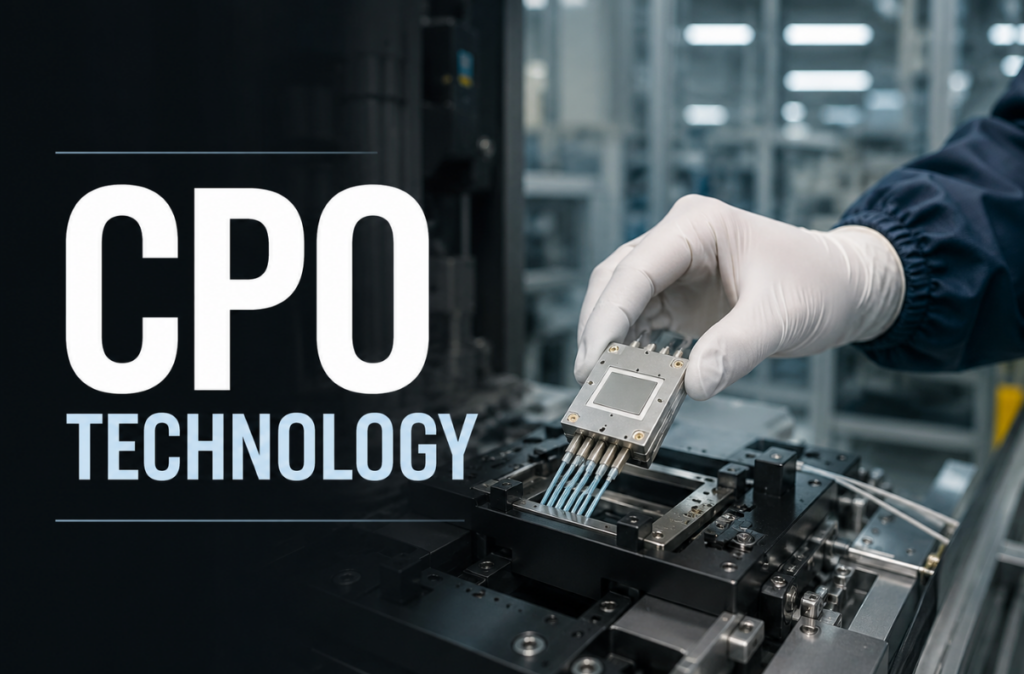
Manufacturing complexities remain a barrier. Photonic chiplet packaging requires precise alignment and advanced assembly techniques. Initial R&D investments are high, and the industry currently lacks unified energy-efficiency standards for these new modules.
How do thermal management strategies work in CPO?
CPO thermal management is critical because dense optical transceiver integration concentrates heat. Operators must implement liquid or microfluidic cooling to maintain Reliability, Availability, and Serviceability (RAS).
Choose External Light Sources (ELS) if field serviceability matters more than absolute peak power savings. ELS allows technicians to replace lasers easily without discarding the entire switch, though it incurs slightly higher coupling losses. Choose on-chip lasers if minimizing footprint is the absolute highest priority.
Preparing for next-generation optical networks
CPO technology for AI data centers is not just a theoretical concept; it is the definitive future of digital infrastructure. As AI networking infrastructure demands continue to explode, CPO switch architecture provides the only sustainable path forward. Data center operators must evaluate their upgrade cycles now to integrate CPO solutions and maintain a competitive edge in power efficiency and compute capability.
FAQs
Co-Packaged Optics (CPO) is an advanced packaging technology that integrates optical engines and electronic switch ASICs onto a single substrate. This Optical Input/Output (OIO) approach reduces the physical distance data must travel electronically, significantly enhancing speed and efficiency.
CPO eliminates long, high-loss copper traces between the switch chip and the front panel. Keeping the electrical path short removes the need for power-hungry digital signal processors, cutting energy use by up to 70%.
CPO provides the massive bandwidth density and ultra-low latency required for synchronizing thousands of GPUs. This allows faster training times and more efficient real-time inference in large-scale AI factories.
Key challenges include complex manufacturing, high initial costs, and difficult thermal management. Additionally, replacing lasers integrated directly into a co-packaged chip requires new maintenance strategies, such as utilizing external light sources.
Early implementations and evaluation kits are currently available. However, broad commercial availability and large-scale deployment of massive platforms, such as 409.6 Tb/s CPO switches, are scheduled for the second half of 2026.