
There is a cost line that almost never appears on a small business financial statement. It is the time a retail associate spends walking to the stockroom for an answer, the task a shift change drops because no one passed it on, and the minute a customer waits while a manager is found. Each event is small, but the events repeat every day, and their total quietly raises the small business operating cost without a single invoice to explain it.
Retevis has spent 16 years building radios for teams rather than consumers, selling into more than 170 countries with over 40 million units delivered and more than 10 million users served, through the official store, online marketplaces and local dealers. A verified buyer at a large distribution center offered a practical view: “We use these in a large distribution center and we can communicate anywhere, including drive-in freezers and coolers.” The useful move for an operator is to treat communication as a cost category, name the parts, and evaluate the tool against them rather than buying on instinct.
Key Takeaways
- Communication gaps in small businesses lead to hidden costs like time lost, rework, waiting, and damaged customer experience.
- Measuring communication inefficiencies helps transform hidden costs into quantifiable data for evaluating ROI.
- Operators should assess communication tools based on reliability, usage barrier, deployment cost, and scenario fit for their workforce.
- License-free radios are cost-effective solutions, minimizing administrative setup costs and eliminating recurring fees while improving communication efficiency.
- Choosing the right radio configuration depends on specific roles, ensuring that the tool fits seamlessly into daily operations.
Table of contents
How communication gaps settle into four costs

The first cost is the time lost to repeated communication. A question asked a second time, a message that never reached the right person, or a call placed from the wrong place all consume working minutes that cannot be billed or recovered. Across a team, these minutes are the most direct drag on communication efficiency.
The second cost is rework at handoffs. When a task moves between shifts, departments or a front desk and a back office, an unclear handoff produces work that has to be redone, from a duplicated order to a maintenance job logged twice. The rework is visible only after the fact, which makes it easy to miss in a busy week.
The third cost is waiting and the opportunity it removes. Staff who cannot get an answer stop the task in front of them and wait, and a customer whose question cannot be answered in the moment may take the purchase elsewhere. The lost sale does not appear as a number, but it is a real operating cost.
The fourth cost is customer experience damage. Slow answers, visible confusion and staff leaving the floor to find help shape how a customer judges the whole business, and that judgment affects repeat visits and referrals in a way no single shift report captures.
Measure the baseline before choosing a tool
A practical first step is to measure the baseline over a normal week. Count the repeat calls and message chases, log handoff errors between shifts, and time a sample of customer waits. The estimate turns a hidden cost into a number, and that number gives the team communication ROI calculation a starting point rather than a guess. The same measure can be repeated after a tool is in place, so the change is judged on evidence.
Four dimensions for evaluating a communication tool
An operator can assess any tool on the same four dimensions. Reliability asks whether the tool works across the real site, including floors, back rooms and outdoor areas. The usage barrier asks how quickly a new or seasonal staff member can use it without training. Deployment cost covers the purchase, any setup or licensing work, and recurring fees. Scenario fit asks whether the tool matches the different roles in the business, from the front desk to the warehouse.
Judged together, these dimensions are how a team measures team communication ROI rather than comparing headline features. A tool that scores well on reliability but carries a monthly fee or a long setup may still lose on total cost, while a simple tool that staff actually use can return more.
Why license-free radios belong on the evaluation list
A license free walkie talkie addresses three of these costs at the structural level. With no license application, the administrative cost of setup falls to zero, and an FRS two way radio works out of the box on the Family Radio Service band, so there is no waiting for approval before deployment. With no monthly fee, the recurring cost stays at zero after the hardware is bought, which changes the multi-year math against a phone plan or a licensed system. Push-to-talk also connects in under a second, which attacks the waiting and repeated-call costs directly.
How the configuration lands by role
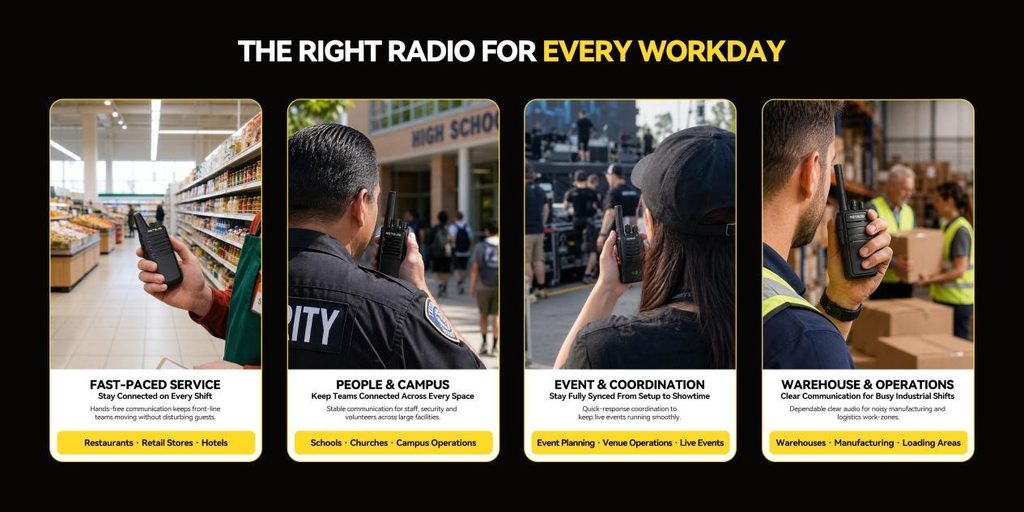
The principle is to match the two way radio for business to the role rather than standardize every unit.
A multi-building school that needs security, administrative and event coverage uses the RT21: a metal body with a longer antenna for penetration, an 1100mAh battery that runs 10 to 12 hours with over 72 hours of standby, and a side emergency alarm.
Frontline retail, restaurant, hotel and warehouse teams use the RT22, a 113g radio with VOX, a shoulder mic and a single-key emergency alarm that charges through USB-C.
Customer-facing front desk and management staff use the B3H, a 15mm thin radio with a hidden screen, a 1620mAh battery that runs 18 hours and holds 49 hours of standby, plus an SOS alarm and channel lock. All three share FRS channels, so they work together as one fleet and expand without replacing existing units.
Read Next
A few related pieces worth your time:
- Pricing Code, Data and IP Before a Shutdown: A Founder’s Guide
- Why Your Global eSignature Rollout Breaks in China
- Manufacturing Automation Roadmap: Do It in Stages, Not All at Once
The operator’s judgment
The hidden cost of communication gaps is real because it compounds in small, repeated pieces rather than one large event. Naming the four costs, scoring a tool on four dimensions, and counting the structural savings of no license and no monthly fee give the decision a clear basis. The right choice is the configuration the team will actually use across its real roles, and that is the standard on which the investment should be judged.