


Here is a failure that recurs across global eSignature deployments. A company standardises on one platform for Europe and North America. The rollout works. Then the China entity comes online and the assumption collapses — not because the product is bad, but because the platform was built against one legal model and mainland China runs on a different one.
This gets misread as a feature gap. It is a category error, and it survives procurement because “eSignature” sounds like one concept with local variations. It is not. In China it is a different instrument entirely, and the difference is not nuance — it is whether the signature produces legal effect at all.
Key Takeaways
- Global eSignature deployments often fail in China due to differing legal frameworks on electronic signatures, leading to misconceptions about their validity.
- China requires only digital signatures recognized by a licensed provider, contrasting with the EU and US approaches that focus on intent and attribution.
- Successful organizations adapt their eSignature solutions by ensuring compliance with local laws, such as integrating regionally qualified signatures and proper certificate management.
- To effectively filter vendors, companies should ask about their ability to handle transactions across different regulatory environments like China, the EU, and the US.
- With tightening regulations in China, it is crucial to understand the compliance requirements before selecting an eSignature platform, rather than retrofitting solutions after rollout.
Table of contents
The distinction that everything turns on

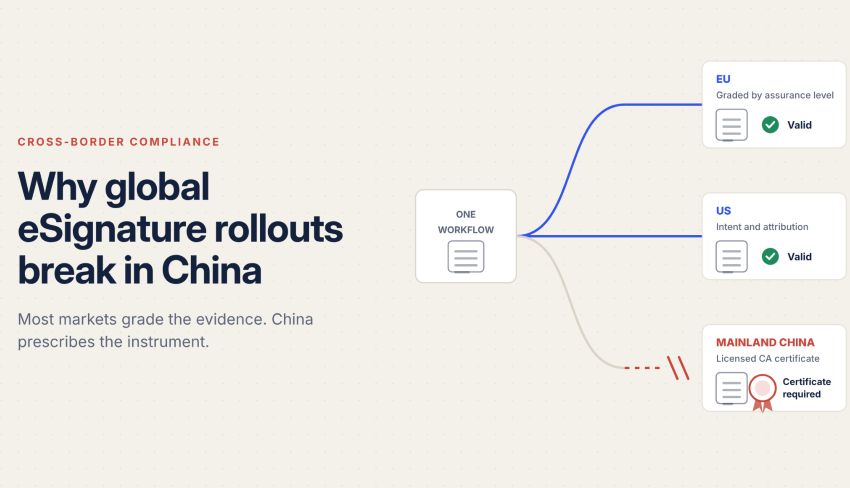
Most of the world regulates eSignature by asking how reliable the evidence is. China regulates it by asking what cryptographic instrument produced it.
Concretely: in the EU, eIDAS (Regulation (EU) No 910/2014) Article 25(1) provides that an electronic signature cannot be denied legal effect solely because it is electronic, and then grades signatures into simple, advanced and qualified tiers by assurance level. A simple signature with a decent audit trail is valid for most commercial documents. In the United States, the ESIGN Act (15 U.S.C. § 7001) and UETA § 7 ask whether the party intended to sign and whether the record can be attributed to them — no certificate, no licensed provider, no tier structure.
Mainland China does something structurally different. The Electronic Signature Law (中华人民共和国电子签名法), adopted 2004-08-28 and effective 2005-04-01, sets out in Article 13 four conditions for a signature to count as “reliable,” and in Article 14 gives a reliable electronic signature the same effect as a handwritten signature or company seal. Those conditions are satisfied in practice through a digital signature carried by a digital certificate issued by a licensed electronic certification service provider — licensed by the Ministry of Industry and Information Technology, which under Articles 16 to 18 must decide on an application within 45 days, with cryptographic use of the CA’s keys separately regulated by the State Cryptography Administration.
The operational consequence is blunt: in mainland China, only digital signatures are recognized as reliable. An audit trail, an intent log, a click-through record — however well engineered — is supporting evidence, not the mechanism that produces legal effect. What that framework demands in practice — the legal basis, the four reliability conditions, the signing sequence, where documents are stored and what it costs — is set out in this guide to electronic signature in China.
That single sentence is where most global rollouts fail, because every Western platform’s architecture assumes evidence is the thing being graded.
Why the distinction is not academic for eSignatures
The practical test is easy to state and uncomfortable to run. Take a signed employment contract or supplier agreement executed on your current platform, and ask what evidence exists that the signature was produced by an instrument your target jurisdiction recognizes.
In the EU and the US, the answer usually points to intent and attribution. You can show that the signer authenticated, saw the document, and clicked. That holds in most cases, and because both frameworks grade or presume validity rather than mandating an instrument, even a simple signature is sufficient for most commercial categories.
In mainland China, the answer has to point to a certificate, and to an issuer whose license can be checked. If it does not, the document is well evidenced and legally unreliable at the same time — a combination that is genuinely hard to explain to a business unit that has been using the platform successfully for two years.
Where it surfaces for eSignatures
Three places, in the order they usually bite.
The contract everyone assumed was signed. A team in Shanghai uses the corporate platform, receives a completed document with a full audit trail, and files it. Eighteen months later the counterparty challenges reliability under Article 13. The audit trail proves what happened on the platform. It does not prove that the signature was carried by a certificate from a licensed provider, because it was not. The evidence is accurate and insufficient.
The integration that cannot be localised. Engineering builds an approval-and-signing flow around one vendor’s API. When the China entity needs a licensed CA in the chain, the vendor has no path to one, and the workaround becomes a parallel manual process — which defeats the reason the rollout existed.
The data-residency collision. Signing data, certificate records and identity verification data face localisation expectations in China, and the cross-border transfer regime in the other direction. A platform whose architecture assumes a single global region cannot be reconfigured into compliance; it has to be re-architected, which is a different budget conversation entirely.
What a workable eSignature architecture looks like
The organisations that get this right stop looking for one platform that satisfies every jurisdiction identically. They accept that the signing layer must be regionally qualified while globally coherent — one workflow, one evidence model, locally valid instruments.
One workflow, region-aware routing. The business process is defined once. What varies is the instrument attached at execution: a QES in the EU where the document category requires it, an advanced or simple signature where it does not, a CA-issued digital certificate on the mainland. Hard-coding a single instrument globally is the design error, and it is usually made in the first architecture review rather than the tenth.
Whether a signature travels across a border at all is a separate judgement from whether it is valid where it was made — governing law, signer location, document type, signature level, identity proofing, data residency and the trust service provider all enter into it. The eight factors are set out in this framework for cross-border eSignature compliance.
An evidence model that survives instrument switching. If the audit trail produced in Frankfurt looks structurally different from the one produced in Shanghai, nobody can compare them in a dispute and the global policy becomes unenforceable in practice.
Certificate lifecycle treated as infrastructure. Certificates expire, get revoked, and their validation material ages out. A rollout that acquires certificates without planning for renewal, revocation checking and long-term validation creates an archive of documents that were valid once and cannot be proven valid later. This is the failure mode with the longest fuse — it typically appears three to five years after go-live, when the first dispute arrives and the issuing CA has rotated its keys.
The licensing structure, who may issue certificates, what the application process demands, and where the cryptography rules sit relative to the licensing rules, is covered in this analysis of China’s e-certification rules for eSignature.
The procurement question that actually filters vendors
Most questionnaires ask “which regions do you support?” That produces marketing answers. Three narrower questions produce useful ones.
Show me the certificate chain on a completed mainland China transaction. Not an integration page — an actual envelope with the issuing CA visible in the evidence record.
Which licensed CA issues it, and what happens when that certificate expires mid-contract-term? The second half of that question separates providers who have operated in China from providers who have integrated with it.
Can the same workflow produce an EU QES, a US ESIGN-compliant signature and a China CA-signed document, with the audit model intact across all three? A vendor that answers the first two and deflects on the third has built for one market and is selling into three.
Why this is urgent rather than theoretical
China has been tightening operational rules around electronic certification through tracks separate from the Electronic Signature Law itself — business-rule requirements on certification service providers with a transition window closing through 2026, and cryptography-use rules under the State Cryptography Administration that took effect on 2026-07-01. Three distinct regulatory lines, three different instruments, and conflating them is its own failure mode.
The direction is toward stricter enforcement of what a certification provider must actually do, not toward relaxation. A rollout built on a platform with no licensed CA in the chain has no path to compliance under any of these tracks, and retrofitting costs far more than selecting for it.
Read Next
A few related pieces worth your time:
- Reddit Login Requirement Is Coming as AI Cuts Search Traffic
- Digital Marketing for Optometrists:Top 6 Strategies for Online Success
- Use Technology-Driven Content Strategies to Enhance Follower Engagement
The honest limitation
None of this means a single global platform is wrong. For a business whose contracts never touch the mainland, the EU and US models are close enough that one platform handles both comfortably, and the complexity of regional instruments is cost without benefit.
The failure is specific: companies standardise globally for administrative convenience, discover the China gap during compliance review rather than procurement, and pay twice — once for the platform, once for the migration. The fix is not a better product. It is asking the right question before the contract is signed, rather than after.