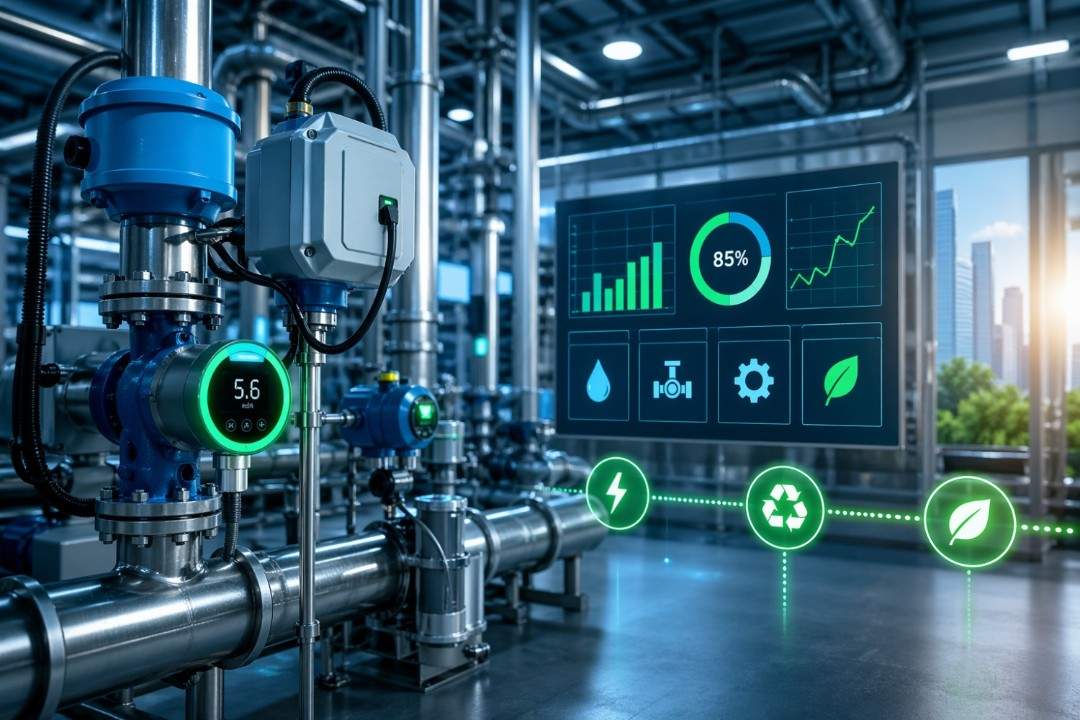
Traditionally, for decades, facility management played with energy-blindness. With building operators and industrial engineers relying on manual readings and organized maintenance, identifying systemic efficiencies was nearly impossible as it all happened in real-time. These systems operated on fixed schedules incorrectly overcompensating to meet peak demands, resulting in massive energy wastage.
This dynamic has fundamentally changed with the paradigm shift toward smart tech and Internet of Things (IoT). Energy usage becomes a far more tangible and controllable metric by embedding interconnected sensors across an entire facility’s infrastructure. Facility managers can now identify precise locations of energy waste through continuous data streams.
Using AI-driven predictive maintenance, it is possible to use algorithms to predict system failures before they happen. It allows to transform facility management from a reactive, manual task to a proactive and very optimized discipline powered by data.
Table of contents
The Hardware Behind the Software: Actuated Valves in Automation
While artificial intelligence and centralized digital dashboards often get all the credit for modern optimization, the physical execution of these strategies relies entirely on precision industrial hardware. Software can identify inefficiencies, but it cannot physically adjust water flow or alter HVAC coolant distribution. Physical hardware acts as the critical “muscles” of the operation.
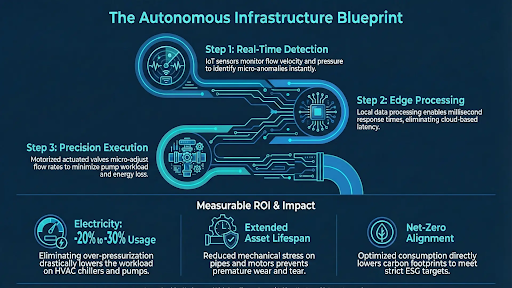
In commercial HVAC, wastewater treatment, and chemical processing systems, the transition from manual regulation to dynamic automation is made possible by high-performance Vincer. These motorized components receive real-time signals from a central IoT hub to micro-adjust flow rates instantaneously.
By autonomously refining these parameters, automated valves significantly minimize pressure drops and mechanical energy loss. This ensures that pumps and compressors only work as hard as necessary, directly translating digital commands into measurable kinetic efficiency.
Core Technologies Powering Modern Fluid Control
IoT Sensors and Real-Time Flow Analytics
Sensory network is the core of any smart fluid system. IoT sensors now measure values like flow velocity, internal pipe pressure and temperature down to the millimeter. These sensors detect micro-anomalies in real-time rather than waiting for a pipe to burst or a pump to overheat.
In the event of a pressure anomaly or subtle leak, this data is passed to the analytics engine which processes sensor readings to identify their source. With the real-time visibility this allows, more minor mechanical faults can never turn into the causal factor for catastrophic energy drains. Effective spill containment solutions can also contribute to reducing waste by preventing leaks and accidental releases from impacting surrounding environments.
Edge Computing for Decentralized Control
Sending every byte of sensor data to a centralized cloud server can introduce latency, which is detrimental in high-stakes industrial environments. This is where edge computing becomes essential for decentralized infrastructure control.
By processing data locally at the site of the hardware, automated valves and intelligent pumps can react to environmental shifts in milliseconds. This instantaneous response eliminates the lag of cloud processing, allowing for hyper-efficient, localized fluid regulation.
ROI: The Financial and Environmental Impact of Automation
The integration of automated fluid control systems goes beyond mere operational convenience; it delivers substantial, measurable returns on investment (ROI). Facility managers utilizing these systems observe immediate reductions in overhead.
The core financial and environmental benefits include:
- Reduced Electricity Usage: Intelligent flow control drastically lowers the workload on HVAC chillers and industrial pumps, cutting electricity consumption by eliminating over-pressurization.
- Minimized Water Waste: Rapid leak detection and automated shut-off sequences prevent thousands of gallons of water waste annually.
- Extended Equipment Lifespan: By preventing continuous high-stress operations and pressure drops, mechanical wear and tear on pipes and motors is heavily reduced.
- Lowered Carbon Footprint: Optimized energy consumption directly translates to reduced greenhouse gas emissions, aiding facilities in meeting strict ESG (Environmental, Social, and Governance) targets.
Overcoming Legacy Infrastructure Challenges
A major barrier to widespread automation is the challenge of retrofitting decades-old factories and commercial buildings. Facility managers often face significant friction when integrating modern smart building IoT frameworks into archaic plumbing and HVAC architectures.
The integration process requires hybrid solutions, where smart actuators are retrofitted onto existing manual pipelines without tearing down the entire facility. However, the initial capital expenditure for these upgrades is quickly offset by the compounding operational gains.
According to industry analyses on digital transformation, deploying advanced IoT and smart control systems can reduce overall facility energy costs by a substantial margin. This long-term financial yield makes the modernization of legacy infrastructure not just a technical upgrade, but a financially sound imperative.
Key Takeaways
| Area | Key Takeaway | Impact/Data |
| Hardware | Retrofit manual pipes with smart actuated valves | Executes real-time, instantaneous flow adjustments |
| Processing | Process IoT sensor data locally via edge computing | Eliminates cloud latency for millisecond reaction times |
| Energy | Automate HVAC and industrial pump flow rates | Drastically cuts electricity usage and over-pressurization |
| Water | Deploy rapid leak detection and shut-off sequences | Saves thousands of gallons annually |
| Assets | Prevent continuous high-stress pressure drops | Heavily reduces mechanical wear and tear |
| Compliance | Optimize facility-wide energy consumption | Reduces carbon footprint to meet strict ESG targets |
Conclusion: The Future of Autonomous Infrastructure
To make the leap toward full-fledge autonomous infrastructure, digital intelligence needs to work hand-in-hand with physical mechanical systems. Hardware executes the command of data streams and algorithms, but it is only as good as the hardware that is doing all that work.
Sure, focus on scandalicious cognitive analytics but what about bullet proof mechanical automation like watertight actuators. Collectively, these elements compose the playbook for smarter facilities a generation ahead in sustainability and efficiency.