Every ecommerce brand with a support team knows the question, “Where is my order?” WISMO (Where Is My Order) ecommerce queries continue to dominate support queues in 2026 despite decades of improvements in order tracking technology. This persistence highlights a critical gap in the post-purchase customer experience most brands have yet to solve.
Table of contents
- What WISMO Is and Why It Still Dominates Ecommerce Support Queues
- Why Solving WISMO Is Harder Than It Looks
- The Real Cost of WISMO Beyond Support Ticket Volume
- How Leading Ecommerce Brands Are Eliminating WISMO Queries
- Why WISMO Is a Symptom of a Wider Post-Purchase CX Problem
- How Outsourced Post-Purchase Support Reduces WISMO Volume at Scale
- Conclusion
What WISMO Is and Why It Still Dominates Ecommerce Support Queues
WISMO refers to any customer enquiry about the status or location of an order after purchase, often phrased as “where is my order” in customer service requests. These seemingly simple questions represent real customer anxiety and real operational cost for brands. The reason WISMO persists is straightforward: most ecommerce brands have optimised the buying experience extensively while leaving the post-purchase journey largely underserved. Customers receive polished marketing emails and personalised product recommendations, then hit a wall of silence once they click “place order.”
WISMO Rate Benchmarks: What Percentage of Your Tickets Should This Actually Be?
Industry data shows that WISMO queries account for up to 40% of all inbound ecommerce support ticket volume, and they can even be up to 50% during peak shopping seasons. For brands still relying on basic tracking links buried in confirmation emails, it often climbs higher. If WISMO accounts for more than a third of your support contacts, it signals a gap in your post-purchase communication flow.
Why Solving WISMO Is Harder Than It Looks
Carrier Data Gaps That Break Tracking Accuracy
Tracking information is only as useful as it is accurate. In practice, carrier data frequently lags behind the actual movement of a package. Missed scans at sorting facilities, handoffs between carriers, and customs delays for international shipments can create frequent gaps. In such cases, customers are left with an “in transit” status that doesn’t seem to change for over 72 hours. The issue is not that tracking technology does not exist, but that the data feeding these systems is inconsistent, fragmented, and often delayed.
Support Teams Disconnected From Fulfilment and Logistics Data
Support teams often lack real-time access to accurate tracking data, even if it exists somewhere in the system. Most ecommerce operations run on separate legacy systems for order management, warehouse fulfilment, and delivery tracking. When a customer reaches out with a WISMO query, the agent will have to sift through multiple tools to arrive at a meaningful answer. This results in longer handle times, higher support ticket volume, and a frustrating experience for both customers and the agents.
The Real Cost of WISMO Beyond Support Ticket Volume
What Each WISMO Query Actually Costs a Retail Brand
The direct cost of a single WISMO interaction varies by channel, but estimates typically range from $5 to $22 per contact when factoring in agent time, platform costs, and overhead. For a mid-size ecommerce brand handling 500 WISMO queries a day, that adds up to $75,000 or more per month in support costs for a question that, in theory, should answer itself. These are resources that could be directed toward revenue-generating activities, complex issue resolution, or loyalty-building conversations.
How Delivery Anxiety Drives Post-Purchase Churn
The cost that rarely shows up on a spreadsheet is the impact of ecommerce customer anxiety on repeat purchase behaviour. A customer who spends three days wondering whether their order is lost, or chasing support for an update, is significantly less likely to buy from that brand again. Delivery anxiety erodes the trust that was built during the purchase experience. Brands that fail to manage this anxiety are effectively spending money to acquire customers they then lose through a poor post-purchase customer experience.
How Leading Ecommerce Brands Are Eliminating WISMO Queries
Proactive Shipping Notifications That Answer Questions Before They Are Asked
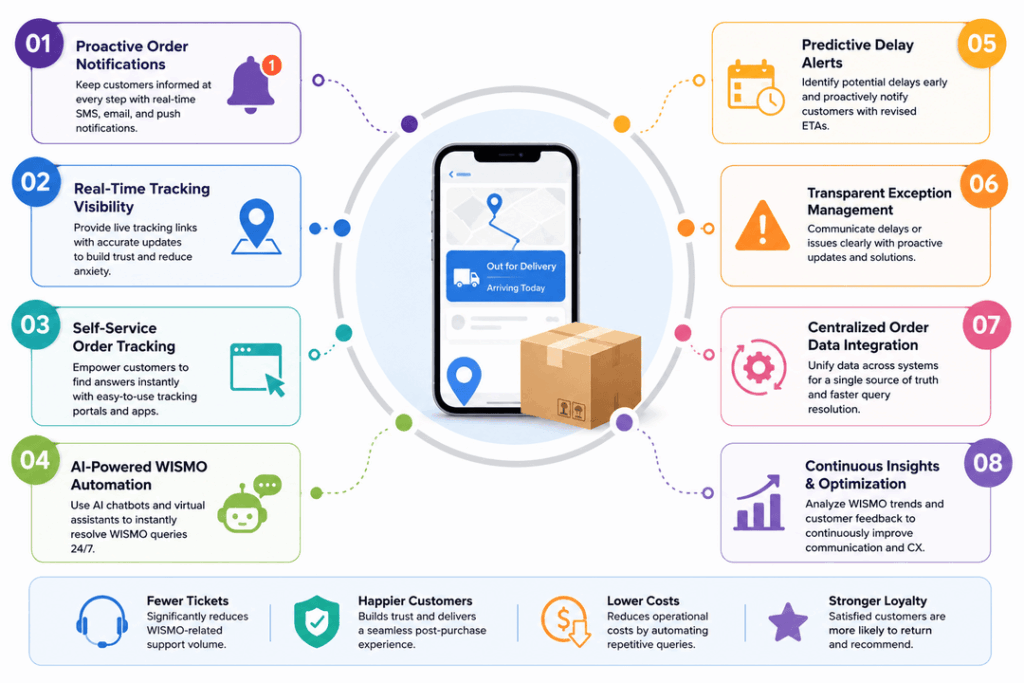
The most effective approach to reducing WISMO is answering the question before the customer thinks to ask it. Proactive shipping notifications sent at key milestones (order confirmed, picked and packed, shipped, out for delivery, delivered) keep customers informed throughout the journey. The best implementations go further, sending alerts when there is a delay or exception rather than leaving the customer to discover the problem themselves. Post-purchase CX automation makes this scalable even for brands shipping tens of thousands of orders daily.
Self-Service Order Tracking That Reduces Inbound Contact
Branded tracking pages that pull real-time data from carrier APIs give customers a single, reliable destination to check their order status. When these pages are well-designed, easy to find, and accurate, they absorb a significant share of WISMO intent before it ever becomes a support ticket. The key is to make self-service tracking genuinely useful rather than simply redirecting customers to a carrier’s generic tracking page, where the experience is inconsistent and unbranded.
AI Agents With Real-Time Order Data Access
AI-powered support agents with direct access to order management and carrier systems can resolve WISMO queries instantly in chat or messaging channels. When a customer types “where is my order,” the AI pulls the latest tracking data, interprets the status, and provides a clear, human-readable answer in seconds. For straightforward cases, this eliminates the need for a live agent. For more complex situations involving lost packages or delivery exceptions, the AI collects context and routes the conversation to a human specialist with all the relevant information already attached. More broadly, AI will not make most human skills obsolete, but it will change how they are used over 70% of today’s skills can be applied in both automatable and non-automatable work, meaning support teams are increasingly shifting from manual resolution to oversight, exception handling, and customer experience management.
Why WISMO Is a Symptom of a Wider Post-Purchase CX Problem
Brands that treat WISMO purely as a support efficiency problem are missing the bigger picture. High WISMO volume is a symptom of a post-purchase experience that has not received the same strategic attention as acquisition and conversion. When customers feel informed, confident, and cared for after they buy, they do not need to chase updates. Reducing WISMO at its root requires thinking about the entire post-purchase journey as a connected experience, from order confirmation through delivery and beyond, with the same level of design and investment that goes into the pre-purchase funnel.
How Outsourced Post-Purchase Support Reduces WISMO Volume at Scale
For brands dealing with high and variable WISMO volume, outsourcing post-purchase support is often a practical solution. Dedicated teams that specialise in WISMO customer service can integrate with a brand’s existing order management and tracking systems, handle inbound queries across channels, and work alongside AI tools to resolve routine cases quickly. The operational model flexes with seasonal demand, so brands are covered during peak periods without carrying excess headcount year-round. More importantly, these teams generate data and insights that feed back into improving proactive communication, gradually reducing the volume of WISMO queries at the source.
Conclusion
WISMO is still the most common ecommerce support question in 2026 because most brands have yet to close the gap between the purchase experience and the delivery experience. The technology to solve this problem exists. Proactive shipment notifications, real-time tracking, and AI-powered support can dramatically reduce inbound volume. What is often missing is the operational commitment to treat post-purchase CX as a strategic priority. The brands that do are seeing lower support costs, stronger customer retention, and a competitive advantage that compounds with every order shipped.