Introduction
As we integrate artificial intelligence further in applications, software development is set to witness a major change. One of the most exciting fronts in innovation is multimodal AI systems that can do the work of processing and generating both text and images. These models are reinventing the mechanisms that developers use to build products, particularly in domains such as design automation, content generation and user interaction. At the leading edge of this evolution, technologies like the GPT-Image 2 model empower software to generate and alter visual images with higher fidelity and context.
Table of contents
- Introduction
- Understanding Multimodal AI in Software
- Core Technologies Behind AI Image Systems
- Integration into Software Applications
- Use Cases in Software Development
- Performance and Scalability Considerations
- Security and Ethical Implications
- Developer Tools and Workflow Integration
- Future Trends in AI-Powered Software
- Conclusion
Understanding Multimodal AI in Software
Structured inputs and logic typically drive traditional software systems. On the other hand, AI systems input data and learn patterns between that data to be able to produce outputs dynamically. This unique ability is extended with multimodal AI in which different types of data, primarily text and images, are combined into a single model.
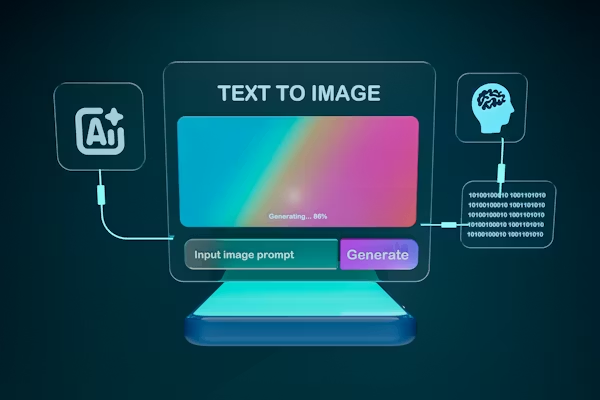
This essentially allows a developer to provide text input and get an image back, or submit an existing image with new prompt instructions for refinement. With the incorporation of models such as gpt image 2 model into applications, best interactive and intelligent user engagement can be formed, particularly in domains that are inclined towards creative or data environments.
Core Technologies Behind AI Image Systems
AI image generation relies on several advanced technologies:
- Diffusion Models: These models generate images by gradually refining noise into structured visuals. They are known for producing high-quality and realistic outputs.
- Transformers: Originally developed for natural language processing, transformers help models understand context and relationships within prompts.
- Neural Networks: Deep learning architectures enable the system to learn from vast datasets of images and descriptions.
- Computer Vision Integration: This allows models to analyze and modify existing images in addition to generating new ones.
Together, these technologies form the backbone of modern image generation systems used in software development.
Integration into Software Applications
The advantage of AI image models, on the other hand, is that they can be included in a multitude of other types of software. They enable developers to embed image generation features in web apps, mobile platforms, and enterprise applications using APIs or SDKs.
Such as a design platform for generating graphics in response to text prompts directly within the user interface. Similar to that, AI could automatically generate visual assets for each blog post or campaign content. Using various tools such as the GPT image 2 model, developers can save time while adding functions.
Use Cases in Software Development
AI image generation is not limited to creative industries. It has practical applications across multiple domains:
- UI/UX Design: Designers can quickly prototype interfaces by generating layouts and visual elements.
- Game Development: AI can create characters, environments, and textures, speeding up production cycles.
- E-learning Platforms: Educational software can generate custom illustrations to explain complex concepts.
- E-commerce Solutions: Platforms can produce product visuals or variations without additional photography.
These use cases demonstrate how AI is becoming a core component of modern software ecosystems.
Performance and Scalability Considerations
AI models are extremely powerful but they also have a bunch of technical problems. Image Generation, especially in higher resolutions, is a highly compute-hungry task. Developers need infrastructure, such as GPU acceleration and cloud (as opposed to edge) processing capabilities.
Scalability is another important factor. Many requests need to be process concurrently in the case of large user-facing applications. Use caching, load balancing and asynchronous processing when they can help performance.
Efficient implementations of models like the GPT Image 2 model guarantee fast responding apps with high-grade results.
Security and Ethical Implications
As with any AI tool, be mindful of security and ethical considerations. Need to keep logs of generated images in order not to misuse and create something false or harmful. Moderation Strategies Companies used moderation methods and best practices to ensure that AIs are employed responsibly.
Data privacy is also critical. Great caution with the training datasets must be exercised to prevent copyright or sensitive material abuse. From labeling AI-generated content to deciphering when it is appropriate to use, organizations are making strides toward transparency.
Developer Tools and Workflow Integration
Modern development workflows increasingly include AI tools as part of the standard toolkit. From code generation to automated testing, AI is enhancing productivity at every stage. Image generation models fit naturally into this ecosystem.
These models can be integrated and standardised into a CI/CD pipeline, so that assets required for the deployment can also be created automatically. Such a system could, for example, dynamically create thumbnails, banners, or preview images in response to changes in the content.
Using tool such as GPT image 2 model has lots of flexibility for teams that can try new features and iterate quickly without the need for extensive design resources.
Future Trends in AI-Powered Software
The future of AI in software development is closely tied to improvements in multimodal systems. We can expect:
- Higher Realism: Continued improvements in image quality and detail.
- Real-Time Generation: Faster processing enables instant results.
- Deeper Integration: AI is becoming a native part of operating systems and development frameworks.
- Cross-Platform Capabilities: Seamless functionality across web, mobile, and immersive environments like AR/VR.
These trends suggest that AI image generation will become a standard feature in many software products.
Conclusion
Very early on, multiscope AI is changing all the software development environment by creating brand & a new huge potential options for how we code or How our visual materials respond. Developers and businesses could have a slew of options just beyond the horizon with image generation models, some from automating design all the way to user experiences that are constantly changing.
Tools such as GPT Image 2 allow software teams to build intelligent and flexible apps that evolve with rapidly changing user expectations. It is early days for this technology, and its role in the future of digital innovation will only expand.