
What is martech, and why does it still claim 19.4% of the average marketing budget, even after falling to a five-year low (Source: Gartner 2026 CMO Spend Survey, reported by Chief Marketer)?
Martech is the software marketers use to find, reach, convert and keep customers. Email platforms, CRMs, analytics suites, ad tools and the AI features now built into all of them count.
The budget share is shrinking, yet most CMOs in the same survey still plan to spend more on marketing technology. That tension explains where martech stands in 2026. Teams are not buying fewer tools because the tools stopped mattering. They are buying fewer because the stack they already own is bloated, poorly connected and expensive to run.
If you understand what martech is and how the parts fit, you can avoid both mistakes: underinvesting, and paying for software nobody uses.
Key Takeaways
- Martech means any software used to plan, run or measure marketing.
- Most tools fit one of six categories, from CRM to attribution.
- A stack only works when customer data moves between tools.
- AI is now a feature of existing tools, not a separate category.
- Start from your marketing process, then pick tools, never the reverse.
Table of contents
What Is Martech?
Martech is short for marketing technology. The term covers every piece of software a marketing team uses to do its job, whether that is sending a newsletter, scoring a lead, testing a landing page or reporting on pipeline.
That is the martech definition in one line. The martech meaning in practice is broader. A single company’s “stack” might combine 20 or 30 products, each owned by a different person, each holding a slice of what the business knows about its customers.
The word took off in the early 2010s, when marketing began buying software on its own budget rather than waiting on IT. Since then the category has grown huge.
The annual martech supergraphic compiled by Scott Brinker and Frans Riemersma counted 15,505 marketing technology products in its May 2026 edition (Source: chiefmartec 2026 Marketing Technology Supergraphic). As CMSWire reported on the release, that was growth of under 1%, the slowest in the chart’s 15-year history.
Martech vs. adtech
People often blur the two. Adtech is the narrower set of tools used to buy, place and measure paid advertising: demand-side platforms, ad servers, ad exchanges. The UK Competition and Markets Authority mapped how these intermediaries fit together in its digital advertising market study. Martech is the whole toolkit, and adtech is one part of it. A useful rule of thumb: adtech helps you reach people you do not know yet, and the rest of martech helps you build a relationship with the ones you do.
How Marketing Technology Works
Strip away the vendor names and almost every martech tool does one of five jobs. It collects data, unifies it, decides what to do with it, acts on that decision, or measures what happened.
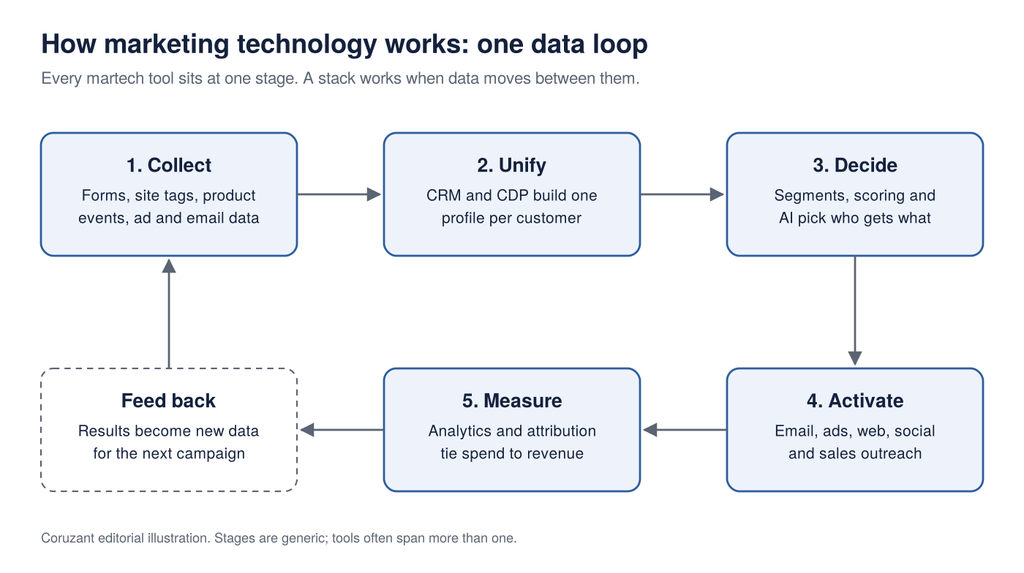
Picture a software company running a webinar. A form on the site collects a registration. The CRM matches it to an existing account, so sales can see the company is already a trial user.
A lead-scoring model flags the account as high intent. The automation platform sends reminder emails, and the ad platform stops showing that person acquisition ads. After the event, analytics connect attendance to the deals that closed six weeks later.
Five tools. One customer record moving through all of them.
When that record breaks, so does the stack. The registrant gets an ad for a product they already pay for. Sales calls someone who unsubscribed. Reporting credits the wrong channel. Most martech frustration usta data problem showing up in a tool.
The Main Categories of Martech
Thousands of products, but only a handful of categories matter for most teams. Grouped by the job they do:
| Category | What it does | Common examples |
|---|---|---|
| Data and CRM | Stores customer records and unifies data | CRM, customer data platform (CDP) |
| Automation and email | Sends triggered, personalized messages | Email platforms, marketing automation |
| Content and experience | Builds and manages what customers see | CMS, digital asset management, personalization |
| Advertising and social | Reaches new audiences on paid and social channels | Ad platforms, social scheduling tools |
| Analytics and attribution | Shows what worked and what it cost | Web analytics, attribution, BI dashboards |
| Sales and commerce | Connects marketing to revenue | Sales engagement, ecommerce, payments |
Data and CRM
This is the foundation. A CRM tracks accounts, contacts and deals. A customer data platform pulls behavioral data from your site, app and channels into one profile per person. Large B2B teams usually run both; small teams often start with a CRM alone.
Automation and email
Email still carries much of the load in B2C and B2B alike. Automation platforms send messages based on what a person did, such as abandoning a cart or downloading a guide. Ecommerce brands comparing these tools can compare the trade-offs in this breakdown of Klaviyo alternatives for ecommerce.
Content and experience
Your website, landing pages, product images and videos all live somewhere. A CMS publishes pages. Digital asset management keeps approved brand files in one place. Personalization tools change what a visitor sees based on who they are.
Advertising and social
Paid search, paid social and programmatic buying sit here, along with tools for scheduling and monitoring organic social posts. This is where martech and adtech overlap.
Analytics and attribution
Without measurement, the other categories run blind. Web analytics show traffic and behavior. Attribution tools try to assign revenue to the touchpoints that earned it, which is harder than vendors admit, especially as privacy rules limit tracking. In the UK, the Information Commissioner’s Office finalized its guidance on storage and access technologies in April 2026, covering tracking pixels and device fingerprinting alongside cookies.
Sales and commerce
The last mile. Sales engagement tools help reps follow up on marketing leads, and commerce platforms process the order. In smaller companies, these often sit outside the marketing team’s budget but inside its data flow.
How AI Is Changing Martech
Two years ago, “AI marketing tools” was its own shelf. In 2026 it is a feature inside nearly every product on the list above. Your email platform writes subject lines, the CRM drafts follow-ups, and your analytics suite answers questions in plain language.
The more interesting shift is agents: software that does not just suggest the next step but takes it, adjusting bids, launching test variants or routing leads without waiting for a person. The AI shifts marketing leaders should watch go deeper on how this is changing team structure and control.
AI also explains part of the slowdown in new products. Many thin tools that wrapped a chatbot in a marketing interface disappeared once the large platforms shipped the same feature for free. For buyers, that is good news. You rarely need a separate AI subscription to get AI.
Benefits of a Well-Built Martech Stack
The case for marketing technology is simple. It lets a small team do work that would otherwise need a large one, and it shows where the money went.
A good stack saves hours on repetitive tasks like list building, email sends and report pulls. It makes personalization possible at a scale no team could manage by hand. It gives sales a clearer view of which accounts are warming up. And it turns marketing from a cost center that reports activity into a function that reports revenue, which tends to matter a great deal at budget time.
None of that comes from buying more software. It comes from connecting the software you buy.
Common Martech Challenges
Tool sprawl. Stacks grow one urgent purchase at a time. Each tool solves a real problem, and two years later nobody remembers who owns half of them. Overlapping features mean you often pay twice for the same capability.
Integration gaps. Tools that do not share data create duplicate records and contradictory reports. Every manual CSV export between systems is a sign of a missing connection.
Data quality. Unified profiles are only as good as the data feeding them. Inconsistent field names, stale contacts and broken tracking quietly undermine everything downstream.
Unpredictable costs. More vendors now charge by usage, especially for AI features. In the Gartner 2026 CMO Spend Survey, 56% of CMOs said they had increased the share of martech budget going to consumption-based pricing. Usage pricing can be fair. It can also produce bills nobody forecast.
Skills. A tool is only as good as the person running it. Many teams buy enterprise platforms and use a fraction of what they paid for, because nobody had time to learn the rest.
How to Build a Martech Stack That Fits Your Team
You do not need the biggest stack. You need the right one for how your team actually works.
- Map your process first. Write down how a lead becomes a customer at your company, step by step. Every tool should support a step on that map.
- Audit what you already own. List every subscription, its owner, its cost and how often it is used. Cancelling unused seats is usually the fastest saving available.
- Pick your source of truth. Decide where the master customer record lives, usually the CRM, and make every other tool sync to it.
- Fill gaps, not wish lists. Add a tool only when a step on your map cannot be done well with what you have.
- Check integrations before features. A slightly weaker tool that connects cleanly beats a stronger one that needs manual exports.
- Assign an owner to every tool. Someone has to configure it, train others and decide when to retire it.
Growing B2B companies feel this most sharply. As informal processes break down, the stack has to carry more of the load, a pattern explored in the marketing challenges B2B companies face as they scale.
You can browse more marketing technology coverage for tool-specific deep dives.
Conclusion
Martech is not a product you buy once but a system of tools that only pays off when customer data moves cleanly between them. The categories are stable: data, automation, content, advertising, analytics and sales. What changes is how they connect, and in 2026, how much of the work AI handles inside each one.
If you are building or trimming a stack, start from your own process rather than a vendor’s feature list. Audit what you have, choose one source of truth for customer data, and add tools only where a real gap exists. A smaller stack that your team understands will outperform a larger one that nobody fully uses.
Read Next
For more on how marketing teams are putting technology and data to work, start here:
- 5 Marketing Challenges B2B Companies Face as They Grow
- How Data Creates Customer Relations
- The Website as a Revenue System: Redesign Budgets
Frequently Asked Questions
Martech is the software marketing teams use to reach, convert and keep customers. It includes CRMs, email platforms, analytics tools, ad platforms and content systems. If a marketer logs into it to do their job, it is part of martech.
Martech means marketing technology, a blend of the two words. The term describes both the individual tools and the combined set a company uses, often called a martech stack. It became common in the 2010s as marketing departments began buying their own software.
Martech is the full set of marketing software, while adtech is the subset used to buy and serve paid advertising. Adtech focuses on reaching new audiences through ads. The rest of martech focuses on managing relationships with people who already know your brand.
A martech stack is the combination of marketing tools a company uses together. A typical stack includes a CRM, an email or automation platform, a CMS, analytics and advertising tools. The stack works best when those tools share customer data instead of operating separately.
Martech is useful for companies of every size, not only enterprises. A small business might run a capable stack with a CRM, an email tool and web analytics. Larger companies add specialized tools as their processes and data volumes grow.