
Your marketing tech stack is almost certainly bigger than it was a year ago, even if you spent that year trying to cut it. Among companies that replaced a martech application last year, 62.9% ended up adding tools and only 22.6% saw their stack get smaller (Source: MarTech Replacement Survey 2025).
I see the same pattern in almost every stack I review. Someone replaces the email platform to save money. The new one doesn’t do SMS, so a second tool arrives. Then a connector to make the two talk. Six months later the “consolidation project” has produced three invoices where there used to be one.
You won’t find a best-tools list here. There are a hundred of those already, most of them written by vendors. What you will find is how a stack is put together, which layer each tool actually belongs to, and what a sane stack looks like for a company your size. If you need the definitions first, read what martech is and how it works, then come back.
Key Takeaways
- A martech stack has five layers. Data sits at the bottom, and everything depends on it.
- Integration needs its own budget and owner. Vendors won’t sort it out for you.
- Most B2B companies own more tools than their team can run.
- Your stack should match your stage. Startup, scale-up and enterprise need different things.
- Consent and data quality belong in every layer from day one.
Table of contents
- Key Takeaways
- What a Marketing Tech Stack Actually Is
- The Five Layers of a Martech Stack
- Signs Your Martech Stack Is Holding You Back
- Suite, Best-of-Breed or Composable?
- Martech Stack Examples by Company Stage
- What Makes a B2B Martech Stack Different
- Why Companies Replace Martech Tools
- How to Audit Your Martech Stack
- Conclusion
- Read Next
- Frequently Asked Questions
What a Marketing Tech Stack Actually Is
A marketing technology stack is the set of tools your team uses together to attract, convert and keep customers. Plus the connections between them.
That last part is the one people skip. Ten great tools that don’t share data are not a stack. They are ten subscriptions with a shared credit card.
Most articles on this topic give you categories: CRM, email, analytics, ads. Fine, but a category list doesn’t tell you what to buy first, what breaks when something else breaks, or why your marketing report and your sales report never agree. Sorting tools by layer answers all three.
The Five Layers of a Martech Stack
A stack works from the bottom up. When something fails at the top, the cause usually sits one or two layers lower.
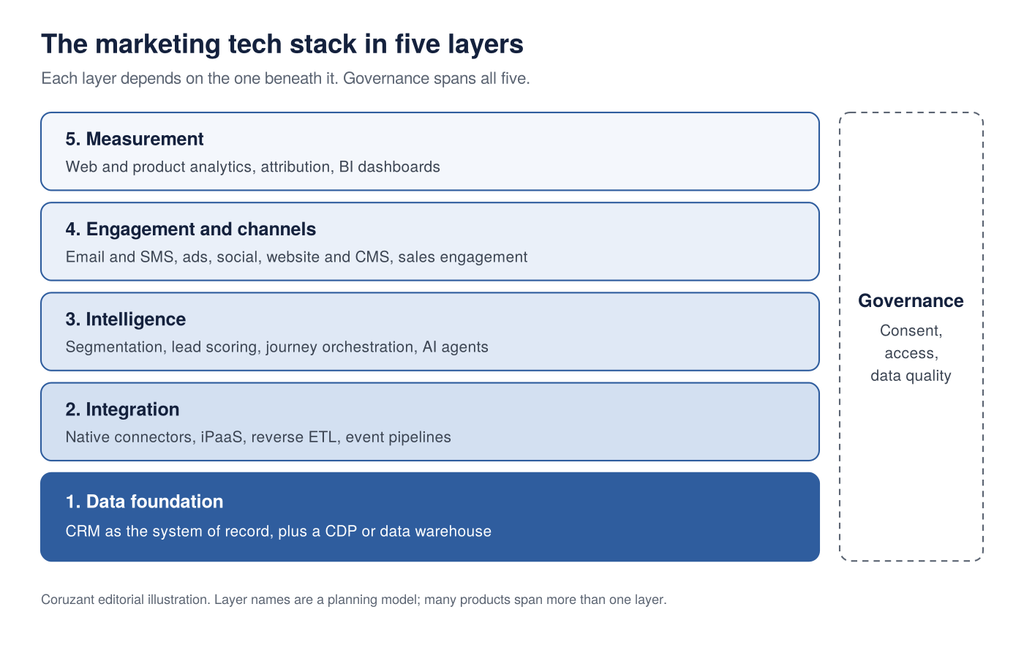
Layer 1: Data foundation
The customer record lives here. For most companies that means a CRM as the system of record, often joined by a customer data platform or a cloud data warehouse that collects behavior from the website, the product and every campaign.
If this layer is messy, nothing above it can be trusted. Duplicate contacts. Three spellings of the same company. A lifecycle stage field that half the team ignores. None of that looks urgent on its own, and all of it shows up later as segments that miss people and dashboards nobody believes.
Layer 2: Integration
Integration moves data between tools. It covers native connectors (your email platform syncing with your CRM), integration platforms (iPaaS), event pipelines, and reverse ETL tools that push warehouse data back into marketing apps.
Vendors have noticed where the pain is. In the 2026 supergraphic from Scott Brinker and Frans Riemersma, the number of iPaaS and data integration products grew 8% while the total count of martech products barely moved (Source: State of Martech 2026). Vendors are building where stacks break, and stacks break in integration.
If a tool can’t connect to your system of record without a weekly CSV, it isn’t part of your stack yet. It’s a side project.
Layer 3: Intelligence
This is the layer that decides what happens next: segmentation, lead scoring, propensity models, journey orchestration. Most of the AI in a modern stack lives here too.
Dennis DeGregor, who led Ogilvy’s Global Experience Data Practice when he spoke on The Digital Executive, splits that AI into two very different jobs:
“There’s generative AI, which generates the content, the texts, the images, the video, the audio, and then there’s what I refer to as targeting AI, which is the AI that determines the business rules for the marketing offer, which channel, what customer when, what is the offer?”
Keep that split in mind the next time someone demos an AI feature. Generative AI is easy to buy and easy to demo. Targeting AI is only as good as the data in layers one and two, which is exactly why so many AI pilots stall. CMOs now put an average of 15.3% of marketing budgets into AI initiatives, yet only 30% report mature readiness to scale those capabilities (Source: Gartner 2026 CMO Spend Survey).
Layer 4: Engagement and channels
The layer your customers actually see. Email and SMS, ad platforms, social tools, your website and CMS, chat, and the sales engagement tools reps use to follow up. Ecommerce teams choosing an email platform can compare the trade-offs in this look at Klaviyo alternatives for ecommerce.
Most stacks overspend here, because this is where the shiny demos are. Your website deserves a separate mention. It is usually the most expensive channel to rebuild and the least measured, a problem covered well in this piece on budgeting a website redesign around revenue rather than agency quotes.
Layer 5: Measurement
Web and product analytics, attribution, and the BI dashboards leadership reads on Monday morning. What worked flows back into the data foundation and sharpens the next decision.
Measurement is also what pulled marketers into analytics. Pejman Roshan, who was CMO at Menlo Security when he joined the same podcast, described the shift: “As the MarTech stack has gotten significantly more advanced and richer, there is [an] analytical side to marketing that I found absolutely captivating.”
It’s interesting work, but it isn’t precise. Privacy controls and cookie limits mean attribution is now an estimate. Anyone who promises you exact multi-touch credit across every channel is overselling.
Governance runs through all five
Consent management, access permissions and data quality rules apply to every tool that touches personal data. Leave them for the end and you will be retrofitting them for years, while the rules keep getting stricter. Under California’s Opt Me Out Act, every web browser must offer a built-in opt-out preference signal by January 1, 2027, according to the California Privacy Protection Agency. If that signal is honored in your consent tool but ignored by your ad platform and your CDP, you are not compliant. You just have a nice banner.
Signs Your Martech Stack Is Holding You Back
Stacks get worse slowly, and you usually notice it in meetings long before anyone traces the problem back to software.
You will recognize most of these:
- Marketing and sales report different pipeline numbers for the same quarter.
- Someone exports a CSV every Monday to move leads from one tool to another.
- A campaign launch waits on the one person who understands the automation.
- Finance asks about an invoice and nobody can say what the tool does.
- A customer who cancelled last month still gets your onboarding emails.
Each one points to a specific layer. Conflicting numbers usually mean a weak data foundation. The Monday export is a missing integration. The single bottleneck person is an ownership gap, and buying another platform won’t fix it. Name the layer first. Then decide whether to fix, replace or switch something off.
Suite, Best-of-Breed or Composable?
There are three ways to assemble the layers. Each one is really a decision about where you want the complexity to live.
| Approach | How it works | Best for | Main trade-off |
|---|---|---|---|
| All-in-one suite | One vendor covers most layers | Small teams, fast setup | Weaker depth in individual tools |
| Best-of-breed | Specialist tool per job, connected by integrations | Teams with specific channel needs | Integration and ownership overhead |
| Composable (warehouse-native) | Data warehouse at the center, tools read from it | Companies with a data team | Needs engineering support |
A suite keeps the complexity inside one vendor. You trade depth for simplicity, and that is often the right trade. Best-of-breed moves the complexity into your integrations and your team. You get the best email tool and the best ad tool, and you also get the job of keeping them in sync. Composable moves it into your data team. It’s the most flexible option, and it’s useless if you don’t have engineers to maintain it.
Most real stacks are hybrids, and that’s fine. A suite for CRM and automation, a specialist ad tool, product data piped through a warehouse. The hybrid that hurts is the one nobody designed, where every tool was an urgent purchase that made sense that week.
Martech Stack Examples by Company Stage
Your stack should follow your team size and the complexity of what you sell. Here is how a sensible B2B martech stack usually grows. Treat brand names as illustrations, not recommendations.
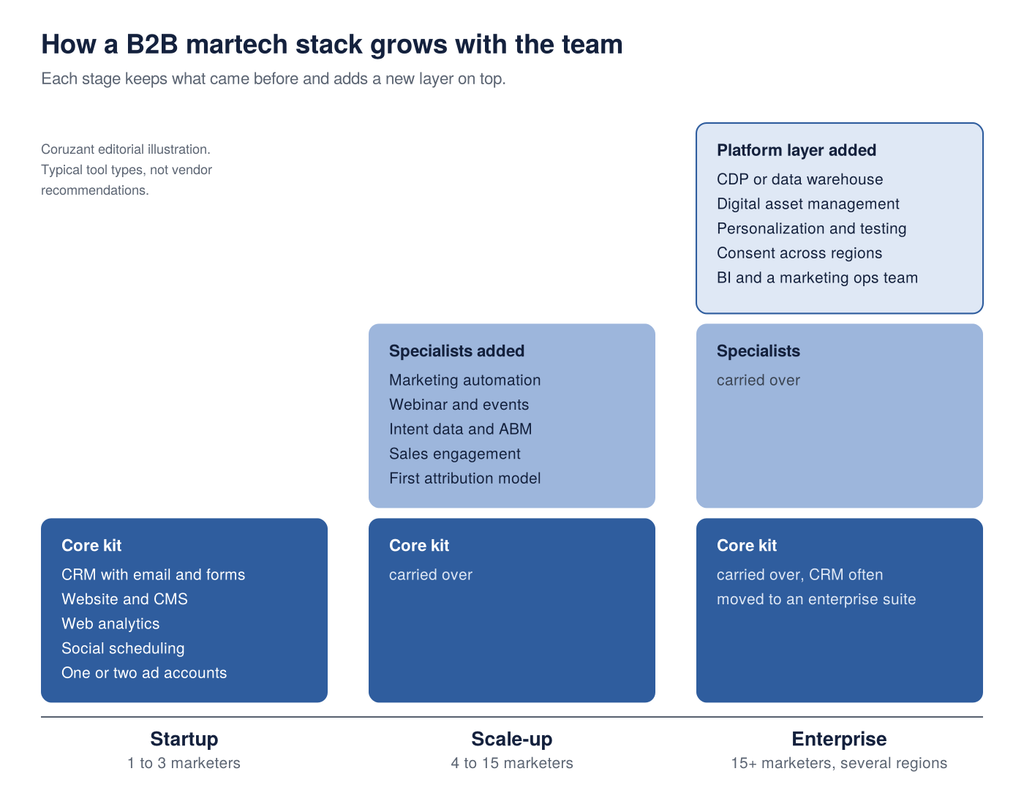
Startup (1 to 3 marketers)
Five or six tools. A CRM with built-in email and forms, web analytics, a CMS, a social scheduler, and an ad account or two. Many startups run almost everything inside one suite such as HubSpot or Zoho, and they should.
The goal at this stage is boring and important: one clean contact database, and enough measurement to know which channel actually brings customers. If you are a three-person team and someone is pitching you a CDP, close the tab.
Scale-up (4 to 15 marketers)
This is where specialists arrive. A dedicated marketing automation platform, a webinar or events tool, intent data, an account-based marketing platform, a sales engagement tool for the SDR team, and a first serious attempt at attribution.
It is also where integration debt piles up fastest. Each new hire brings a favorite tool from their last job. Each tool gets bought to solve a real problem. Nobody owns the full picture, and in a year you have the stack described in the opening paragraph.
Enterprise (15+ marketers, several regions)
Enterprise stacks add a platform layer: a customer data platform or warehouse-native setup, digital asset management, personalization and testing, consent management across regions, and a BI layer that blends marketing and finance data. Platforms such as Salesforce, Adobe or Snowflake often anchor the foundation.
At this size, running the stack is a job in its own right. That job is called marketing operations, and if you don’t budget for the people, you will pay for it in shelfware.
What Makes a B2B Martech Stack Different
B2C stacks are built around individuals and transactions. A B2B martech stack has to handle accounts, buying committees and sales cycles that last months. That changes several layers at once.
Your buyers are also doing more of the work before they ever talk to you. In a Gartner survey of 645 B2B buyers, 70% said they prefer a completely digital, self-service buying experience, and 45% had used generative AI during a purchase (Gartner, May 2026). The same research found 69% still go to a sales rep to check what the AI told them.
Buyers research alone, then they want a human who already knows the context. For your stack, that means:
- Intent and engagement data has to reach sales fast, because buyers show up late and well informed.
- Your website and content carry more of the pitch than your SDRs do.
- The handoff between marketing automation and the CRM must be clean enough that a rep sees the full account history in one screen.
If any of those three is weak, buyers feel it immediately. Growing companies usually hit all three at once, which this look at the marketing challenges B2B companies face explains well.
Why Companies Replace Martech Tools
Here is what teams say they look for when they replace a tool. Cost comes first, but data and integration are not far behind.
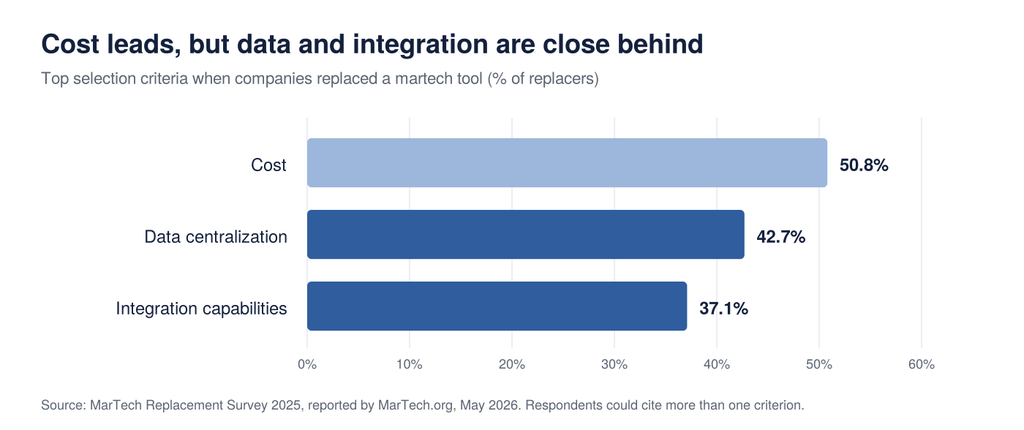
Here is how I read that chart. Cost gets the headline, because it is the easiest reason to defend in a budget meeting. But almost as many teams are really trying to fix their data foundation and their integrations, layers one and two. They are replacing a tool at layer four to solve a problem that lives at layer one. Sometimes that works. Often the same problem moves into the new tool, and the replacement cycle starts again.
How to Audit Your Martech Stack
Before you buy anything, find out what you already have. A proper audit takes days, not a quarter.
- Get the list from finance. Not from memory, and not from the marketing team’s wiki. Include free tools and anything paid on a personal card.
- Tag each tool to a layer. Two tools in the same layer doing the same job is your first consolidation target.
- Draw the data flows. For every tool, write down where its data comes from and where it goes. Every manual export is a broken pipe.
- Check real usage. Logins and active seats will show you what is shelfware.
- Give every tool an owner. A tool without an owner gets one this week or gets cancelled at renewal.
- Decide: keep, merge or cut. Then fix layers one and two before you spend anything on layers three to five.
Most teams buy from the top down. They start with the exciting channel tool and hope the data sorts itself out. It never does. Build from the bottom up.
Conclusion
Tool choice matters less than most buyers think. How the tools connect matters more. Get the data foundation clean. Give integration its own budget and its own owner. Add intelligence and channels only when the data underneath can carry them. And build consent and data quality into every layer from day one, because privacy rules are changing faster than your renewal cycles.
Then match the stack to your stage. A three-person startup does not need an enterprise CDP, and an enterprise cannot run on spreadsheets and goodwill. Audit what you have, cut what nobody uses, and make every new tool earn its place in a specific layer. If your team can’t run a tool, cancel it at renewal.
Read Next
For more on how marketing teams build on data and AI:
- What Is Martech? A Complete Guide to Marketing Technology in 2026
- Ten Shifts Every Marketing and Technology Leader Should Watch Closely
- How Data Creates Customer Relations
Frequently Asked Questions
A marketing tech stack is the combination of software tools a marketing team uses together, along with the integrations that connect them. It usually covers customer data, automation, channels, analytics and AI. It works best when every tool shares data with the CRM or a central data store.
A martech stack should include a data foundation such as a CRM, integrations that move data between tools, and engagement tools for email, ads, social and your website. It also needs measurement through analytics and attribution. Larger teams add intelligence tools for scoring, personalization and AI.
A B2B martech stack is built around accounts and buying committees rather than individual shoppers. It usually adds account-based marketing, intent data and sales engagement tools. It also needs a tight link between marketing automation and the CRM, because B2B sales cycles are longer.
A marketing technology stack should have as few tools as your process needs. Small teams often run well on five or six tools, while enterprises may use dozens. The better test is whether every tool has an owner, a clear layer and a working data connection.
Common martech stack examples include a startup stack built on one all-in-one suite, and a scale-up stack that adds marketing automation, intent data and sales engagement. Enterprise stacks often add a CDP, digital asset management and consent management. The right example depends on your team size and how mature your data is.