More than 25% of customer data platforms now support warehouse-centric architecture, the setup behind a composable CDP, according to the CDP Institute’s February 2026 industry update. Warehouse-native vendors are also growing nearly six times faster than the CDP industry as a whole.
That growth comes with a lot of vendor noise. Every company in this space will tell you their architecture is the safe one. Ask them what breaks in year two.
Key Takeaways
- A composable CDP uses your data warehouse as the customer database instead of a separate vendor copy.
- You assemble it from parts: collection, storage, modeling and activation.
- The biggest win is a single copy of customer data that you own.
- The biggest cost is engineering time. Real-time use cases and vendor count come next.
- It fits companies that already have a warehouse and a data team. Without both, a packaged CDP is easier.
Table of contents
What Is a Composable CDP?
A composable CDP is a customer data platform built on top of your own cloud data warehouse. Instead of copying customer data into a vendor’s database, you keep one copy in the warehouse you already run, resolve identities and build customer models there, and use lighter tools to send audiences to your marketing and sales channels.
You will also see it called a warehouse-native CDP or, less often, a headless CDP. The idea is the same. The warehouse is the center of gravity, and the CDP functions are spread across several tools that plug into it.
“Composable” means you pick and combine the parts yourself, the way engineers build software from components. You get to choose every part, and you also have to maintain every part.
Packaged vs Composable CDP: Where the Data Lives
The real difference is where the data lives.
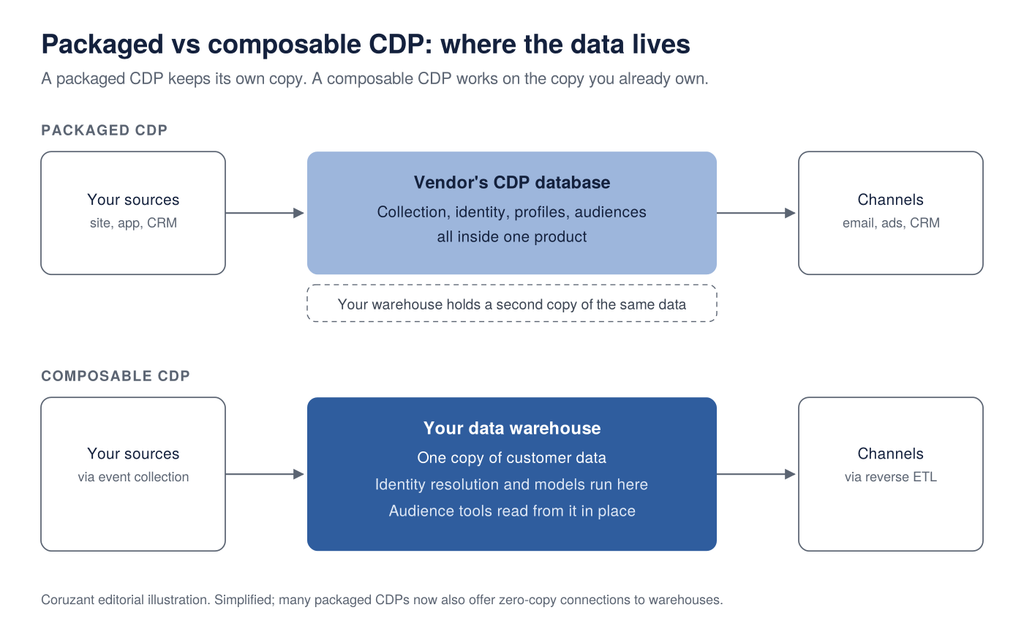
With a packaged CDP, your data flows into the vendor’s platform. The vendor handles collection, identity resolution, profiles and audiences inside one product. It is fast to set up and friendly for marketers. But if you also run a data warehouse, you now keep customer data in two places, and keeping them in sync becomes somebody’s job.
With a composable CDP, the warehouse holds the only full copy. Identity resolution and customer models run inside it. Activation tools read from it and push audiences out to email, ads and the CRM.
| Packaged CDP | Composable CDP | |
|---|---|---|
| Where customer data lives | Vendor’s database | Your data warehouse |
| Setup time | Weeks to a few months | Depends on how mature your warehouse is |
| Who runs it | Marketing operations | Data team plus marketing operations |
| Flexibility | Vendor’s data model | Your own data model |
| Real-time use cases | Usually strong | Depends on your pipelines |
| Pricing model | Usually by profiles or events | Several tools, plus warehouse compute |
The line between the two is blurring, and that is worth knowing before you sit through vendor demos. Salesforce launched a Zero Copy Partner Network back in 2024 so its CDP could work with data in Snowflake, Databricks and other warehouses without copying it. Adobe offers Federated Audience Composition, which builds Real-Time CDP audiences from warehouse data. Plenty of packaged vendors now sell a “composable option”. Ask exactly which parts run in your warehouse and which still copy data into theirs.
How a Composable CDP Works
A composable setup has four building blocks. You can buy each one separately or get two or three from the same vendor.
1. Collect. Event collection tools capture behavior from your website, app and product and load it into the warehouse. Data from your CRM, billing system, support desk and ad platforms comes in through standard data pipelines.
2. Store. The cloud data warehouse or lakehouse holds everything. This is the part most companies already have, which is why the composable pitch is attractive. You paid for the warehouse. You might as well use it for marketing.
3. Model. Your data team (or the activation tool) resolves identities, so that the anonymous visitor, the trial user and the billing contact become one person. Then they build the models marketing needs: lifetime value, churn risk, product usage tiers, account health.
4. Activate. Reverse ETL and audience tools read those models and sync segments to your channels. A marketer builds an audience of “trial users from target accounts who stalled at setup”, and the tool keeps it updated in the CRM, the email platform and the ad accounts.
The data team owns blocks two and three. Marketing usually owns block four. Block one tends to be shared, which means it tends to be nobody’s job. Sort that out early.
Composable CDP Examples
Here are the tools teams commonly use for each block. These are examples to help you map the market, not recommendations.
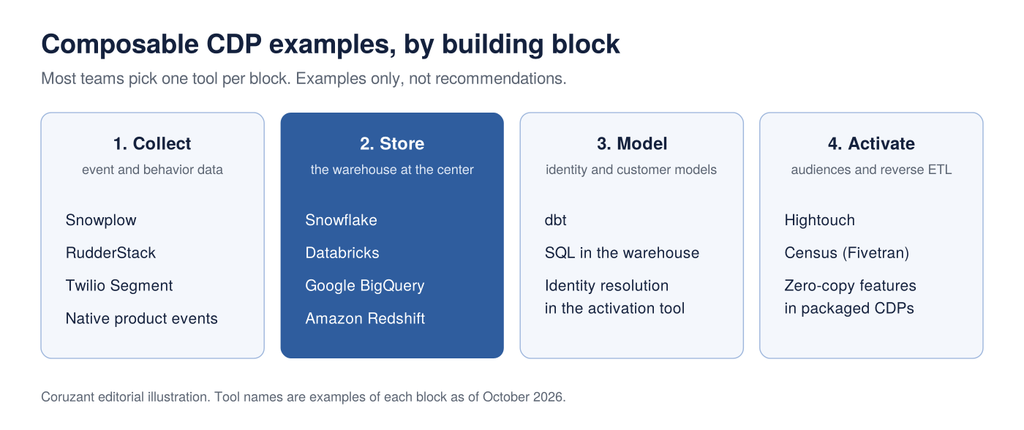
For collection, Snowplow, RudderStack and Twilio Segment are common choices. All three can load event data straight into a warehouse. For storage, the big four are Snowflake, Databricks, Google BigQuery and Amazon Redshift. Modeling usually happens in SQL, often managed with dbt. Activation is where the composable vendors compete hardest.
Hightouch is one of the best-known names there. It entered Gartner’s 2026 Magic Quadrant for customer data platforms directly as a Leader, with Gartner citing its “composable architecture leadership”, according to CX Today’s summary of the report. The same report saw ActionIQ, Redpoint Global, mParticle and Zeta Global drop off the Magic Quadrant. Census, another early reverse ETL player, agreed to be acquired by Fivetran in 2025, part of a wider wave of consolidation among data tools.
B2B SaaS company
Product usage is the most valuable customer data this company has, and it already sits in the warehouse because the product team needs it. A composable CDP lets marketing and sales use it directly. Accounts whose usage drops get flagged in the CRM for customer success. Trial users who hit a key feature get a different email track from those who don’t. No second copy of the product data, no nightly export to a marketing tool.
Ecommerce or retail brand
Orders, returns, loyalty points and web behavior land in the warehouse from several systems. The data team builds lifetime value and churn models there, and the activation tool sends high-value customers to the email platform and excludes recent buyers from acquisition ads. The trade-off shows up in real-time moments like cart abandonment, which often still need a fast path outside the warehouse.
Fintech or regulated business
Here the main argument is control. Customer financial data is sensitive, and every extra copy adds risk and audit work. Keeping one governed copy in the warehouse, with access controls the security team already manages, is, in my view, easier to defend to a regulator than sending full profiles into another vendor’s platform.
Benefits of a Composable CDP
One copy of the data. This is the biggest practical benefit. Fewer copies mean fewer sync jobs, fewer mismatched numbers and one place to apply consent and deletion. It also lines up with data minimisation, the principle that personal data should be “adequate, relevant and limited to what is necessary”, as the ICO puts it.
You own the data model. Packaged CDPs give you their data model and let you bolt custom fields onto it. A composable setup models customers the way your business actually works, whether that means accounts with buying committees, households, or users across several products.
Marketing gets the data team’s work. In most companies the data team already builds customer metrics for finance and product. Composable lets marketing use those same definitions instead of rebuilding them in a separate tool. When marketing and finance report the same revenue number, a lot of meetings get shorter.
Flexibility to swap parts. If your activation tool disappoints, you replace one block, and the data stays put. With a packaged CDP, leaving means migrating everything.
Pricing can be fairer. Packaged CDPs often charge by profile or event volume, which punishes growth. Composable pricing is spread across tools and warehouse compute. Whether that ends up cheaper depends on your usage, and you only find out if you tag warehouse compute by team.
Challenges of a Composable CDP
It needs engineers. Someone has to build and maintain pipelines, identity resolution and models. If your data team is already stretched, marketing requests will wait in a queue. In my view, this is where most composable projects stall.
Real-time is harder. Warehouses were built for analysis, not for reacting in seconds. Running heavy queries directly on the warehouse “can sometimes strain system resources or introduce latency”, as CMSWire noted in its analysis of zero-copy CDPs.
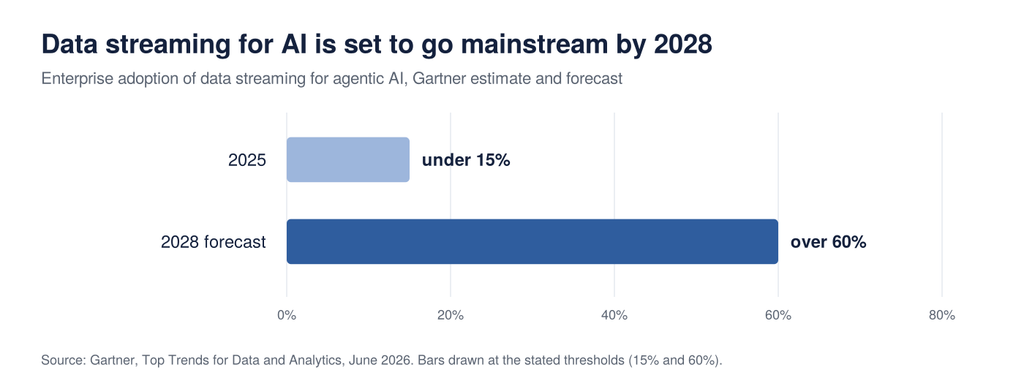
Gartner expects adoption of data streaming for agentic AI to go beyond 60% by 2028, up from under 15% in 2025 (Gartner, June 2026). If your use cases need in-session personalization or instant triggers, check how each composable tool handles streaming, and how much that costs in warehouse compute.
More vendors, more contracts. Four building blocks can mean four vendors. Naveen Gattu, co-founder of Gramener, described the enterprise mood when he spoke on The Digital Executive: “I just don’t need a guy doing data warehousing, a person doing data management, another vendor doing advanced analytics.” He was talking about data services, not CDPs, but the vendor fatigue is the same.
Marketers can lose independence. A good packaged CDP lets a marketer build an audience without asking anyone. In a weak composable setup, every new attribute is a ticket to the data team. The activation tool’s interface matters a lot here. Test it with your marketers, not just your engineers.
Warehouse costs can surprise you. Every audience refresh and every sync runs queries. Without monitoring, marketing usage can quietly push up the warehouse bill, and finance will ask the data team about it before they ask you.
Is a Composable CDP Right for You?
A composable CDP is usually a good fit if most of these are true:
- You already run a cloud data warehouse, and important customer data (product usage, billing, orders) already lives there.
- You have a data team that can own pipelines and models, or budget to hire one.
- Your customer model is unusual, such as accounts with many users, several products or households.
- Data governance and limiting copies of personal data matter to your security or compliance team.
- Most of your use cases are segments and syncs, not split-second personalization.
If you have no warehouse, no data team and one main channel, a packaged CDP or the CDP features in your existing CRM will serve you better. My honest view: plenty of companies buy composable because it sounds modern, then spend far longer building what a packaged CDP would have given them out of the box.
How to Get Started
- Audit what is already in your warehouse. List the customer data you already have, how fresh it is and who owns it.
- Pick two or three use cases. Something concrete, like syncing product-qualified leads to the CRM or suppressing current customers from acquisition ads.
- Agree on identity rules. Decide how you match an email, a user ID and an account before you buy anything.
- Run a pilot with one activation tool. Measure time to first audience and how often marketers need the data team.
- Set up cost monitoring. Track warehouse compute from marketing syncs from day one.
- Expand only when the pilot pays off. Add channels and use cases once the first ones run without constant fixes.
For where this sits in the wider stack, the layers of a marketing tech stack show why the data foundation has to come first.
Conclusion
If your customer data already lives in a warehouse, a composable CDP lets marketing use it directly instead of paying a vendor to hold a second copy. Packaged vendors know it, which is why so many now sell zero-copy connections.
The catch is people and time. You need a data team to build and run it, you need to plan around real-time limits, and you need to watch the warehouse bill. If you have those in place, composable is probably the strongest long-term option. If you don’t, start with a packaged CDP or your CRM’s built-in features, and revisit the decision when your data team is ready.
Read Next
For more on building the customer data layer of your marketing stack:
- CDP vs CRM: What Each Does and When You Need Both
- The Marketing Tech Stack in 2026: Layers, Tools and B2B Examples
- What Is Martech? A Complete Guide to Marketing Technology in 2026
Frequently Asked Questions
A composable CDP is a customer data platform built on your own cloud data warehouse. Customer data stays in the warehouse, identity resolution and models run there, and activation tools send audiences to marketing and sales channels. It replaces the separate database a packaged CDP would use.
The difference between a composable CDP and a packaged CDP is where customer data lives and who assembles the system. A packaged CDP stores its own copy of your data in one vendor product. A composable CDP uses your existing warehouse and combines several tools for collection, modeling and activation.
Common composable CDP examples combine Snowplow, RudderStack or Twilio Segment for data collection, Snowflake, Databricks, BigQuery or Redshift for storage, dbt for modeling, and Hightouch or Census for activation. Several packaged CDPs, including Salesforce and Adobe, also offer warehouse connections without copying data.
A composable CDP can be cheaper or more expensive than a packaged CDP, depending on your setup. You avoid per-profile pricing but pay for several tools, warehouse compute and engineering time. Companies that already run a warehouse and a data team usually see the best economics.
You need a data team, or at least dedicated data engineering support, for a composable CDP. Someone has to build pipelines, resolve identities and maintain customer models in the warehouse. Without that support, a packaged CDP is usually the more practical choice.