
Construction has one of the highest business turnover rates of any US sector. Crews change hands, firms merge, and the estimator you emailed last quarter may now be running a different company two states away.
That churn is why construction lists decay faster than almost any other B2B vertical. This guide compares five providers on what decides whether your file still works when you send: sourcing, verification frequency, and whether pricing is visible before you call.
Key Takeaways
- Construction data ages faster than most verticals, so refresh frequency matters more than record counts.
- A list you can download instantly has been sitting somewhere, which is the trade-off against speed.
- Providers split into two types: compiled databases refreshed on a cycle, and lists built to order when you buy.
- Published pricing is rare, and quote-only providers make budgeting harder before you see a record.
- Ask which trades and job titles are covered, since general contractor and specialty trade files differ.
Table of contents
What actually separates these construction list providers
The first split is compiled versus built-to-order. Compiled gives you volume immediately and refreshes on a schedule, while built-to-order is sourced against your filters when you buy.
The second is what gets checked. Some providers verify the email address only, leaving name, title, and phone unguaranteed, which matters when you need a named decision-maker.
The third is trade coverage. General contractors, electrical, HVAC, plumbing, and roofing are distinct populations, and strength in one does not imply strength in the others.
1. Emarketnow
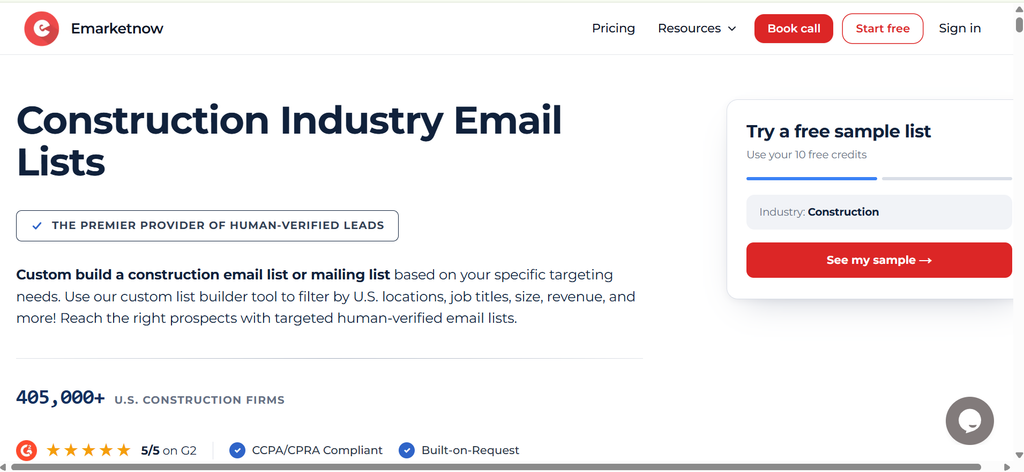
Emarketnow covers 405,000+ U.S. construction firms and builds every list at the point of order rather than selling from a standing file.
They describe instant downloads as a red flag, on the basis that a list ready immediately has usually been aging in a database.
You set criteria through their custom list builder, filtering by U.S. location, job title, company size, and revenue.
Their team sources contacts against those filters and manually reviews and validates records before delivery.
One data field is worth singling out. Alongside the usual company, contact, NAICS, and SIC fields, the available data fields include a Human-Verification Date, so you can see when a contact was actually checked rather than relying on a refresh cycle on trust.
Pricing is published, which is unusual here. A free tier gives 10 contacts monthly, Starter is $99 per month for 200 contacts within five business days, and Pro is $299 per month for 1,000 contacts within three business days plus unlimited CRM export.
There is no minimum commitment, and annual billing includes two months free. An Enterprise option delivers thousands of records as CSV or Excel with better per-record pricing at volume, adding firmographic, technographic, chronographic, and intent data.
Coverage spans general contractors, specialty trades, project managers, estimators, owners, homebuilders, commercial developers, civil engineering firms, and procurement teams.
Every order carries a 100% money-back guarantee; the data is CCPA and CPRA compliant, and the company holds a 5 out of 5 rating on G2.
Best for: Teams who want a list built to spec with a visible verification date and published pricing.
2. Coldlytics
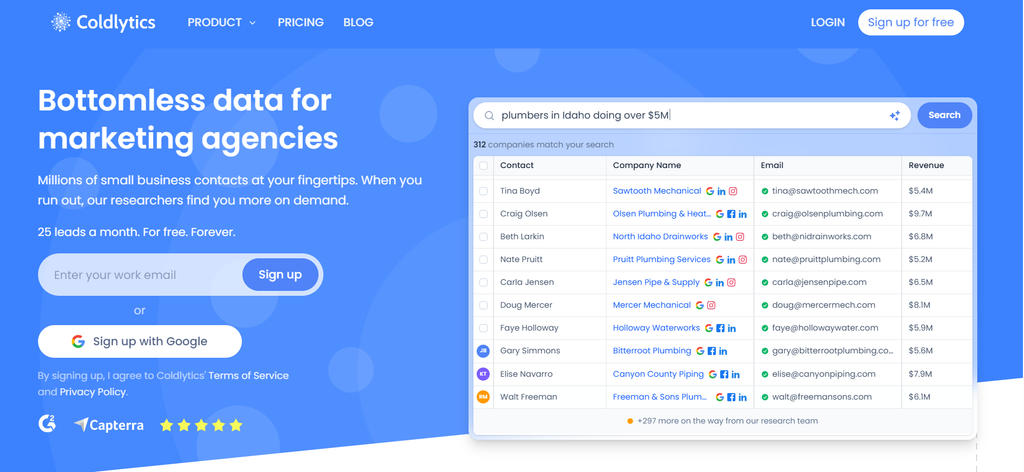
Coldlytics runs the closest model to built-to-order among the alternatives here. Their Voyager database covers millions of small businesses across the US, Canada, UK, Ireland, Australia, New Zealand, and South Africa, and when a tight search runs dry, one click hands it to their human research team.
Hand-sourced contractor contacts arrive within 24 hours on business days and stay exclusive to you for 30 days. That exclusivity window is rare, since most compiled lists are sold to everyone.
Coverage spans general contractors, roofers, electricians, plumbers, HVAC, and excavation firms. A free tier gives 25 leads monthly with no card required, and paid plans start at $49 per month.
Best for: Small teams targeting owner-operators who want exclusivity and a low entry price.
3. DMDatabases
DMDatabases has compiled construction data for over 30 years and claims the largest contractor email file at 500,000+ addresses across 400 or more market segments.
Published counts include 52,927 general contractors, 84,000 electrical, 91,000 HVAC, and 78,000 plumbing contractors.
Their differentiator is the scope of the guarantee. Rather than covering the email address alone, a 95% accuracy or money-back guarantee extends to contact name, job title, email, company name, mailing address, and phone.
Records are double-source verified at least annually, and the company is explicit that high turnover is why it verifies multiple times a year.
Pricing is quote-based, though some trade publication segments start around 32 cents per name.
Best for: Buyers who want scale plus a guarantee that covers more than just deliverability.
4. UpLead
UpLead lists 5,474,713 verified construction contacts, the largest file compared here. Records are sourced and verified in line with GDPR, CCPA, and CAN-SPAM.
Each record is unusually rich, covering name and role, verified email and direct phone, website, LinkedIn profile, company size, revenue, trade specialty, SIC and NAICS codes, and technologies used.
Specialty lists break out general, plumbing, electrical, roofing, and HVAC contractors, plus home builders.
Technology data is the standout. If you sell software into construction firms, filtering by what a company already runs is a layer most providers here do not offer.
Best for: Software vendors and teams that need technographic filtering alongside firmographics.
5. Salesgenie

Salesgenie is a Data Axle product and the most established platform here, rated 4.3 across more than 300 G2 reviews. Pricing starts at $99 per month with a free trial.
Its strength is geographic search. Map-based lead search lets you draw polygons around specific areas, and filtering supports SIC and NAICS codes plus radius search by ZIP, which suits selling within a defined territory.
The trade-off is that it is a general business database rather than a construction specialist. You get filtering depth and breadth, but not vertical curation.
Best for: Territory-based prospecting where geographic precision matters more than vertical depth.
Quick construction list provider comparison
| Provider | Model | Verification | Trade coverage | Pricing |
| Emarketnow | Built to order | Human review, verification date per record | Contractors, trades, developers, procurement | Published, free to $299/mo plus Enterprise |
| Coldlytics | Database plus on-demand research | Human research team, 30-day exclusivity | GC, roofing, electrical, plumbing, HVAC, excavation | Published, free tier, then from $49/mo |
| DMDatabases | Compiled | Double-source, annual minimum, 95% guarantee on six fields | 400+ construction segments | On request |
| UpLead | Compiled | GDPR, CCPA, and CAN-SPAM aligned | GC, plumbing, electrical, roofing, HVAC, builders | Published plans |
| Salesgenie | Compiled platform | Data Axle sourcing | General business, filtered by SIC and NAICS | From $99/mo |
How to choose
Start with volume. For a few hundred targeted contacts a month, a self-serve tier beats negotiating for an enterprise file you will not use.
Then weigh freshness against speed. Built-to-order costs a few days and gives records checked against your criteria, while a compiled file is instant and carries whatever decay has built up since the last refresh.
Finally, test small. Free tiers and low first-tier pricing exist so you can check deliverability against your own sending setup before committing budget.
Conclusion
Ask every provider the same question: when was this record last verified? Built-to-order providers answer precisely, and one publishes the date on the record itself.
For fresh construction data with pricing visible up front, Emarketnow is the strongest starting point.
Coldlytics suits smaller budgets wanting exclusivity, DMDatabases offers the broadest guarantee at scale, and UpLead leads on file size and technographic filtering.
Frequently Asked Questions
What is a construction email list?
It is a database of contacts at construction companies, typically including email, phone, job title, company name, and trade. Buyers use them for cold outreach, recruitment, and market research.
Why does construction data go stale so quickly?
Construction has unusually high business turnover, so firms close, merge, and change hands often. A contact accurate six months ago may now be at a different company.
How much should a construction email list cost?
It depends on model and volume. Self-serve tiers start under $100 per month, while compiled enterprise files are priced per record and get cheaper as volume grows.
Should I buy a pre-built list or a custom one?
Pre-built is faster; custom is fresher. If your targeting is narrow, built-to-order wastes fewer records and usually delivers better inbox placement.
What job titles should I target in construction?
It depends on what you sell. Owners and presidents decide at smaller firms, while procurement, project, operations, and safety leads evaluate at larger ones.
Are purchased email lists legal for B2B outreach?
In the United States, cold B2B email is permitted under CAN-SPAM if you identify yourself, avoid deceptive subject lines, and honor opt-outs. Confirm CCPA and CPRA coverage if you sell into California.