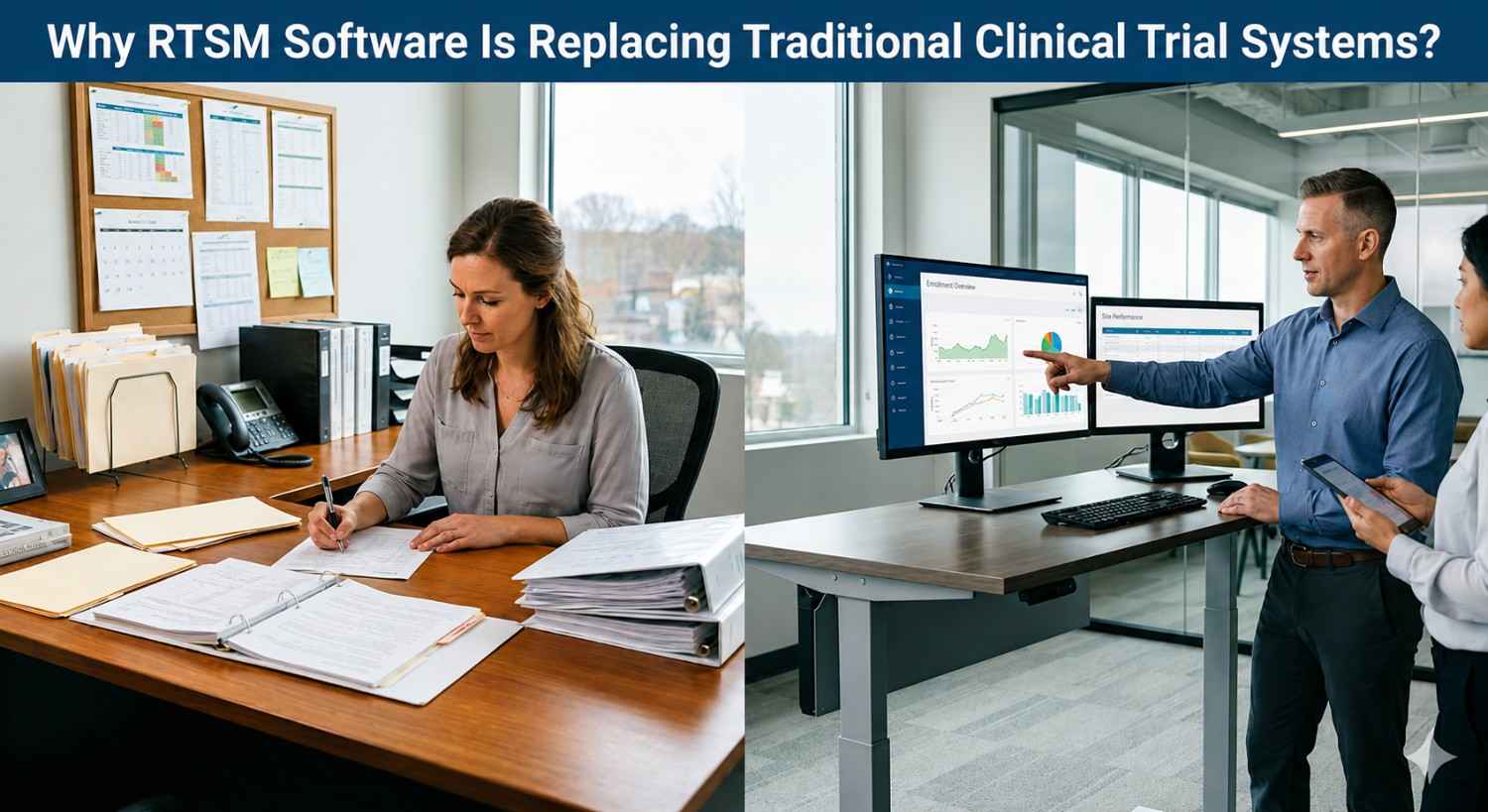
Most clinical trials were traditionally managed using manual coordination, spreadsheets, paper records, and disconnected tools. While these systems still get the job done, they often lead to issues like human error, delayed communication, missing data, and limited real-time visibility across trial sites.
As trials have become more global and complex, these older approaches are no longer efficient enough. Managing multiple locations, strict regulatory requirements, patient randomization, and drug supply tracking requires a more centralized and automated system.
RTSM (Randomization and Trial Supply Management) software offers a modern solution by streamlining these processes. It reduces manual effort, improves accuracy, and provides real-time tracking of patients, inventory, and site activities.
Overall, compared to traditional systems, RTSM makes clinical trial management more reliable, efficient, and better suited for today’s complex research needs.
Table of contents
What Makes RTSM Software Different from Traditional Trial Systems?
1. Automated Workflows
In traditional clinical trial systems, teams often have to enter patient data by hand, manage spreadsheets, and coordinate via email or phone calls.
For example, assigning a patient to a treatment group or tracking drug supply might involve multiple steps. This results in extra time and increases the risk of small mistakes, such as data-entry errors, because multiple people are involved. But RTSM software simplifies this by automating these processes.
Once the system is set up, it can automatically assign patients to the correct treatment group based on the study rules and update supply levels in real time. With fewer manual steps and less back-and-forth communication, the chances of errors automatically go down to zero.
2. Unified Platform
Before RTSM software, different parts of a clinical trial were handled using multiple separate tools. For instance, one system might manage patient data, while another tracks drug supply. If teams needed a complete view, they had to pull information from different sources, often manually.
Because these systems didn’t always connect well, data could become scattered, outdated, or inconsistent. With RTSM software, this is no longer an issue. It brings;
- Patient randomization and supply tracking in one system
- Real-time, up-to-date data across all sites
- Easier monitoring and faster decision-making
- A single and clear view of the entire trial
3. Provide Real-Time Insights
Getting a clear picture of what’s happening in a clinical trial using traditional systems can take significant time and effort. Teams often rely on manual reporting, disconnected databases, and delayed communication across sites, making it difficult to track study progress accurately. This lack of visibility can slow decision-making and increase the risk of operational inefficiencies. In fact, a large majority of clinical trials struggle to meet enrollment targets and timelines. In high-value drug development programs, these delays can translate into millions of dollars in lost revenue each day.
- Delayed or outdated reporting
- Data pulled from multiple sources
- Limited visibility into real-time trial activity
- Slower response to issues
Randomization and Trial Supply Management (RTSM) software addresses these challenges by providing a centralized and real-time approach to trial management. Instead of waiting for periodic updates, teams can instantly access accurate study information and respond faster to changing conditions.
- Real-time data updates across all sites
- Live dashboards for instant visibility
- Faster identification of risks or delays
With improved transparency and real-time insights, teams can make quicker, data-driven decisions, reduce operational delays, and maintain smoother clinical trial execution from start to finish.
4. Flexible Adaptation
Traditional clinical trial systems are not built to handle change easily. Once a study is live, even small updates, such as adjusting supply rules or modifying protocols, can become time-consuming. To do so, teams need to manually rework processes or reconfigure systems.
But RTSM software offers greater flexibility as the study evolves. Below are the perks you can experience.
- Faster implementation of protocol changes
- Minimal disruption to ongoing trials
- Easy adjustments to randomization and supply rules
- Greater flexibility as the study evolves
5. Proactive Trial Management
With traditional systems, teams often learn about problems only after they have already occurred. For example, a clinical site may run low on drug supply, experience delays in patient enrollment, or miss an important update, and the issue may only be discovered during a later review or manual check. These delays can disrupt study timelines, increase operational costs, and create unnecessary pressure on trial teams.
RTSM software helps organizations stay ahead of such challenges by providing real-time monitoring and automated notifications. The system can instantly send alerts when something requires attention, such as low inventory levels, enrollment imbalances, shipment delays, dosing issues, or unusual activity across study sites. This allows teams to respond quickly and take corrective action before small concerns develop into larger operational problems.
In addition, automated tracking and reporting improve visibility across the entire trial process. Study managers, sponsors, and CROs can access up-to-date information from a centralized platform, making it easier to coordinate tasks, monitor site performance, and maintain compliance. Instead of relying on manual follow-ups or spreadsheets, teams can make faster and more informed decisions based on accurate, real-time data.
By reducing delays, minimizing human error, and improving proactive decision-making, RTSM software supports smoother trial operations and helps maintain study continuity from start to finish.
6. Smooth Participant Management
Keeping track of everything related to patients in a clinical trial, from the moment they join the study to each visit they complete, is very difficult to do manually. With the RTSM platform, this process becomes much easier. Wondering how? Look at the points below.
- Assigning patients to the correct treatment group automatically
- Tracking patient visits and study progress
- Managing schedules and follow-ups
- Recording patient activity in one place
Conclusion
From the above points, it is clear that traditional systems have outgrown their effectiveness in today’s fast-paced and highly regulated clinical trial environment. What once worked with manual processes, spreadsheets, and disconnected tools now often creates unnecessary complexity, delays, and a higher risk of errors. As studies become more advanced and globally distributed, outdated methods can reduce efficiency and make it difficult to maintain accuracy, transparency, and compliance.
By adopting a modern RTSM solution such as Korio RTSM software, organizations can eliminate many of the operational bottlenecks that slow teams down. Automated workflows, centralized data management, and real-time visibility help streamline patient randomization, trial supply tracking, and site coordination while reducing manual effort and administrative workload.
Modern RTSM platforms also provide better scalability and flexibility, allowing sponsors and CROs to respond quickly to protocol amendments, regional requirements, and changing study demands. Improved transparency and faster decision-making contribute to stronger inventory control, reduced wastage, and more efficient study execution from start to finish.
Ultimately, moving to an advanced RTSM system is more than just a technology upgrade—it is a strategic investment that supports faster operations, improved compliance, better collaboration, and more reliable clinical trial outcomes.