
Cybersecurity has ceased being an IT issue; it is now a business survival strategy. With AI-powered cyberattacks, ransomware-as-a-service, and supply chain vulnerabilities of ever-evolving threats, organizations are finding it difficult to keep pace with them. Old security applications, frequently operating in silos, do not offer the visibility and speed needed to address the modern risks. It is here that Extended Detection and Response (XDR) is redefining how businesses are tackling cyber risk management.
This blog discusses the ways in which XDR is transforming risk management strategies and why it is becoming an indispensable part of a contemporary cybersecurity strategy.
Table of contents
- The Shift from Reactive to Proactive Cyber Risk Management
- What is XDR and Why It Matter s
- Addressing Modern Cyber Threats with XDR
- How XDR Enriches Cyber Risk Management Systems
- Role of Automation and Machine Learning in XDR
- XDR vs. Conventional Security Tools
- Best Practices for Implementing XDR in Cyber Risk Management
- Why Businesses Are Adopting XDR Rapidly
- Final Thoughts
The Shift from Reactive to Proactive Cyber Risk Management
The current cyber threats are more coordinated, intelligent, and quicker than ever before. The attackers use automation, machine learning, and multi-vector techniques to overcome conventional defenses. Based on the recent findings, ransomware attacks alone have blasted off, with the attackers targeting both enterprises and small businesses alike.
Old security systems are usually reactive in nature- they are only reactive to detect a threat after it has already started to cause damage. This method is no longer adequate. XDR presents a proactive model by constantly monitoring, analyzing, and responding to threats on endpoints, networks, and cloud environments. Rather than isolated detection, XDR offers a single security ecosystem that assists organizations in predicting and disarm dangers before they become entrenched.
What is XDR and Why It Matters
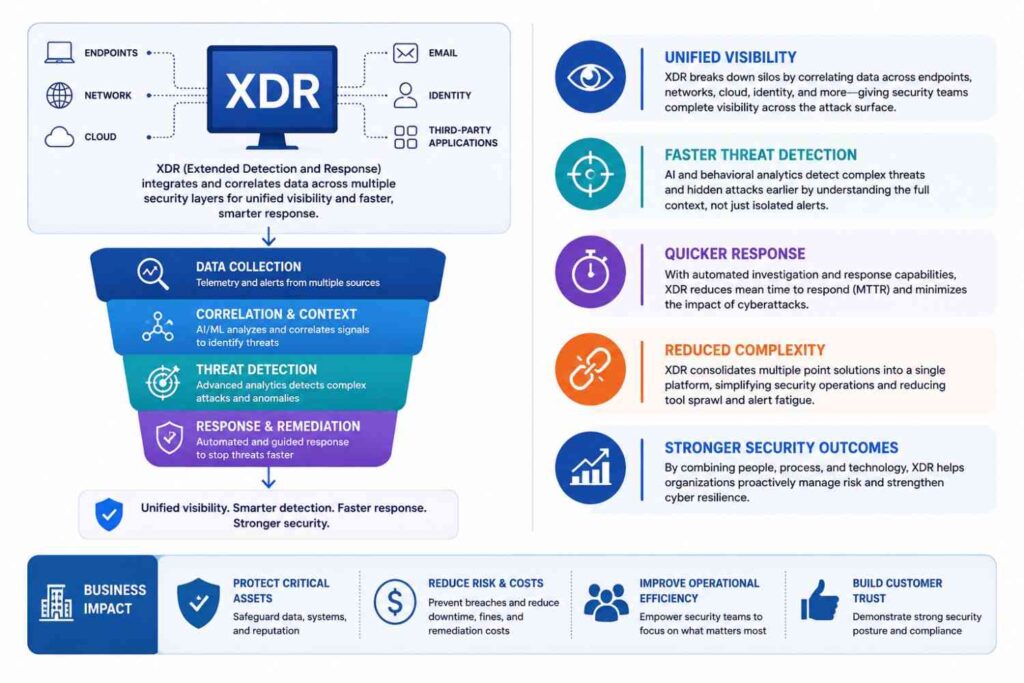
Extended Detection and Response (XDR) is a cybersecurity architecture that incorporates several layers of security into one platform. It gathers and matches data across endpoints, networks, cloud systems, and applications to deliver holistic visibility and quicker response capabilities.
This single point of access gets rid of data silos and allows security teams to identify trends that otherwise would have remained hidden. More to the point, XDR redirects the emphasis of alert management to risk prioritization- helping companies to figure out which threats are the most serious and act on them.
The Three Pillars of Cyber Risk Management Improved by XDR.
1. Threat Detection and Monitoring Continuous.
The possibility of monitoring systems 24/7 is one of the largest benefits of XDR. It is constantly collecting telemetry information across a variety of sources and applying sophisticated analytics to detect anomalies. In contrast to conventional tools, XDR is a machine learning tool that detects subtle changes in behavior that could potentially be a precursor to an attack. This minimizes false positives and makes sure that the actual threats are detected at an early stage. Owing to this fact, organizations can now have real-time visibility of their entire digital infrastructure, which is critical in the current hybrid and cloud-driven environment.
2. Intelligent Risk Assessment
Not all threats are equal. Prioritizing the alerts is one of the largest challenges in cybersecurity. XDR addresses this by integrating threat intelligence with contextual data. It assesses risks about such factors as the significance of the assets, the severity of the threats, and the consequences. This risk-based methodology enables security organizations to concentrate on high-threat alerts rather than wasting time on low-threat alerts. Machine learning also adds to this capacity; by analyzing past occurrences and forecasting possible patterns of attacks, it makes risk assessment more precise and operational.
3. Automated Incident Response
The speed is paramount in the reaction to cyber threats. Late reactions may cause serious financial and reputational losses. XDR is an automation of incident response using pre-made playbooks. These automated workflows can isolate compromised systems, block malicious activity, and contain threats in real time. This does not only helps in reducing the response time but also minimizes the effects of the attacks, enabling the organizations to recover faster and sustain business.
Addressing Modern Cyber Threats with XDR
- Ransomware Attacks
Ransomware remains one of the most destructive cyber threats. Modern XDR solutions are able to monitor ransomware behavior early and automatically isolate the behavior before it spreads across the network. XDR can greatly decrease the time of data exposure and time taken to recover data due to real-time monitoring and automated response.
- Supply Chain Vulnerabilities
Third-party vendors usually create unseen risks within an organization’s ecosystem. XDR improves the security of the supply chain through constant monitoring of external interactions and detection of suspicious activity. It issues early alerts on possible threats that may be caused by vendor networks- and helps organizations to reduce risks before they occur.
- AI-Driven Cyber Attacks
Attackers are moving toward the use of AI to develop adaptive and evasive threats. XDR offsets this by introducing machine learning-enhanced detection, which advances in line with new attack methods. XDR can identify real-time threats and anomalies to ensure even advanced threats are identified early.
How XDR Enriches Cyber Risk Management Systems
XDR is compatible with the main elements of cyber risk management:
- Risk Identification: Ongoing monitoring aids in identifying vulnerabilities and threats in all environments.
- Risk Assessment: Integrated intelligence is used to assess the severity and impact of threats.
- Risk Mitigation: Automated response will guarantee quick containment and recovery.
This combination not only makes risk management procedures easier but also improves overall security posture.
Role of Automation and Machine Learning in XDR
One of the sources of the effectiveness of XDR is machine learning. It enables:
- Behavior-based analysis to identify insider threats.
- Predictive analytics to foresee attacks.
- System-wide automated threat hunting.
- Fewer false positives to enhance efficiency
With automated repetitive tasks, XDR enables security teams to concentrate on strategic decision-making, as opposed to manual monitoring.
XDR vs. Conventional Security Tools
Traditional cybersecurity solutions tend to be independent, which presents visibility and response gaps. XDR eliminates these limitations by offering:
- End-to-end and inter-network visibility.
- Quick response and detection.
- Less alert fatigue due to prioritized alerts.
- Enhanced data correlations to precise threat analysis
This renders XDR as a game-changer in the minds of organizations that want to keep abreast of current security measures.
Best Practices for Implementing XDR in Cyber Risk Management
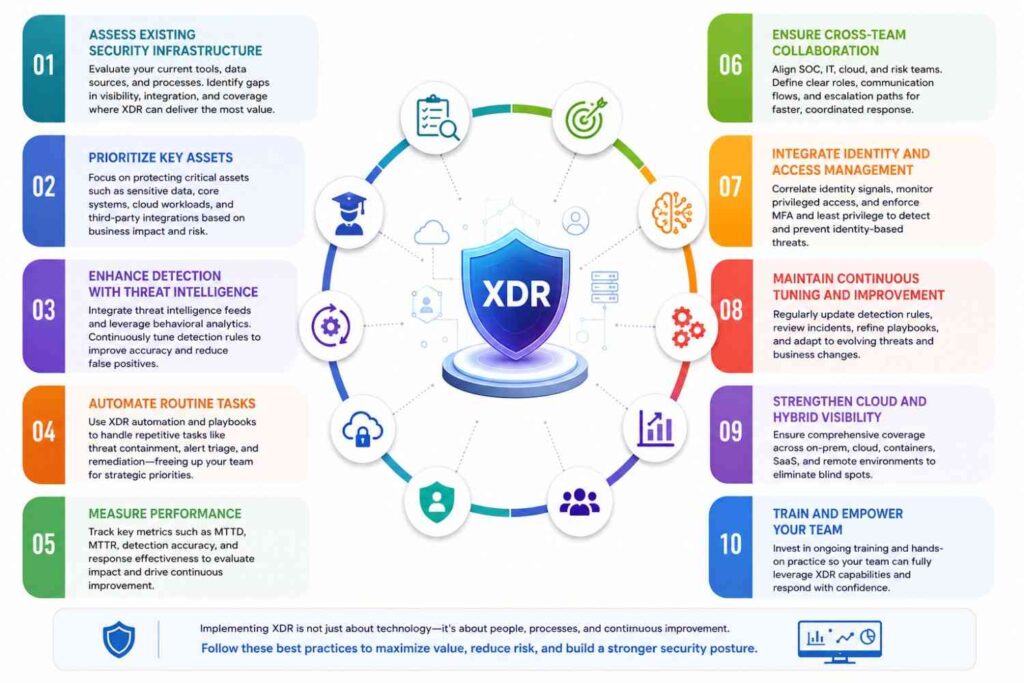
To fully leverage XDR, organizations should follow these best practices:
- Assess Existing Security Infrastructure
Start by evaluating your current security stack, including endpoint, network, cloud, and SIEM tools. Identify gaps in visibility and integration opportunities where XDR can unify and improve detection and response.
- Prioritize Key Assets
Focus protection on critical business systems such as sensitive data repositories, core applications, and cloud workloads. Mapping these assets to business impact helps improve alert prioritization and incident handling
- Enhance Detection using Threat Intelligence
Integrate threat intelligence feeds and behavioral analytics to improve detection accuracy. Continuous tuning of detection rules helps reduce false positives and adapt to evolving threats.
- Automate Routine Task
Use XDR automation to handle repetitive security actions like blocking malicious IPs, isolating compromised endpoints, and quarantining suspicious emails. This allows security teams to focus on higher-value investigations.
- Measure Performance
Track key metrics such as detection time, response time, and alert accuracy. These indicators help evaluate effectiveness and guide ongoing improvements in the security program.
- Ensure Continuous Improvement and Training
Regularly refine detection rules and response playbooks based on incident learnings. At the same time, ensure security teams are trained to effectively use XDR tools and respond to evolving threats.
Why Businesses Are Adopting XDR Rapidly
The digital transformation, remote work, and adoption of clouds have increased the attack surface faced by organizations today.
XDR solves these problems by offering:
- Total visibility in hybrid environments is important.
- Quick response to incidents and less downtime.
- Automation to enhance efficiency.
- Scalable security to meet the changing infrastructures.
With cyber threats constantly evolving, businesses require something that can keep pace with the change just as fast- XDR provides just that.
Final Thoughts
Cyber risk management is no longer about responding to threats- it is about being ahead of them. XDR provides organizations with the necessary tools to identify, evaluate, and act upon risks proactively. It changes the nature of cybersecurity, which has traditionally been seen as a reactive dynamic, to a strategic advantage through the integration of automation, machine learning, and unified visibility. For organizations that want to enhance their cyber resilience in the year 2026 and beyond, the adoption of XDR is not just an option, but it is a necessity.