Dentistry is becoming an increasingly useful example of what digital transformation looks like when software, connected hardware, 3D scanning, and advanced manufacturing converge in a physical service environment.
For most of its history, restorative and cosmetic dentistry depended on an analog supply chain. Impressions were taken with trays, poured into stone models and shipped to external laboratories. Design decisions moved slowly between clinician and technician, while production depended on physical molds, manual fabrication and repeated appointments.
Over roughly the past decade, that model has been rebuilt around digital data. Intraoral scanners create three-dimensional records, software converts anatomy into editable models, CAD/CAM systems turn those models into restorations, and visualization platforms allow proposed outcomes to be reviewed before treatment begins. AI-assisted analysis and increasingly connected software platforms are adding another layer to that stack.
The result is not merely faster dentistry. It is a transition from a chain of physical handoffs to a digitally integrated workflow in which information can be captured, analyzed, designed, transmitted and manufactured within the same technology ecosystem.
Key Takeaways
- Digital transformation in dentistry integrates software, connected hardware, and advanced manufacturing to enhance workflows.
- Intraoral scanners convert physical impressions to digital 3D models, streamlining data handling and reducing errors.
- AI and analytics support decision-making by processing clinical data and assisting in treatment planning.
- CAD/CAM systems enable the creation of restorations from digital files, reducing reliance on traditional analog methods.
- Cloud-based platforms foster collaboration between practices and laboratories without physical model transport, allowing access to advanced workflows.
Table of contents
- From physical impressions to 3D Scanning data
- AI and analytics add an interpretation layer
- CAD/CAM turns digital files into physical restorations
- 3D scanning and printing expands the manufacturing stack
- Digital smile design creates a visualization interface
- Connected systems turn the dental practice into a SmartTech environment
- Cloud software changes where expertise can sit
- Why smaller practices can now access advanced 3D scanning workflows
- The bigger technology story with 3D Scanning
From physical impressions to 3D Scanning data
The first major change is the conversion of physical anatomy into digital information.
In the conventional workflow, a clinician took an impression, poured it into a stone cast and sent the model to a dental laboratory. Every step involved physical material, manual handling and transport. Distortion could occur during impression-taking or casting, while a damaged model often required the capture process to be repeated.
An intraoral scanner changes the architecture of that workflow. The handheld optical device records the geometry of teeth and soft tissue as a sequence of images. Software then assembles those images into a three-dimensional digital model that can be viewed on screen almost immediately.
The significance is similar to digitization in engineering or manufacturing: once an object exists as data, it can be copied, analyzed, transmitted and processed by software.
A digital dental model can be sent to a laboratory in seconds, stored without physical shelf space and reused without degradation. It can also become the input for other technologies, including CAD software, treatment-planning platforms and manufacturing systems.
In effect, the mouth becomes a structured 3D dataset.
That does not eliminate error. Scan accuracy still depends on operator technique, the scanning strategy, software processing and the clinical indication. Digitalization changes where errors occur and how they can be detected; it does not remove the need for clinical judgment.
AI and analytics add an interpretation layer
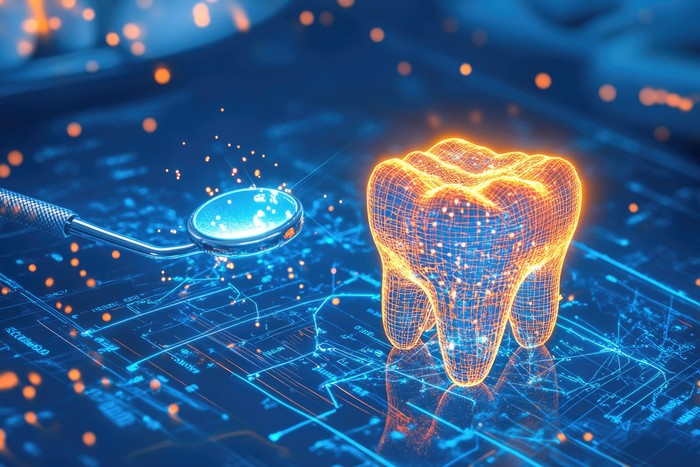
Once clinical information exists digitally, it becomes accessible to computational analysis.
This is where artificial intelligence and analytics are becoming increasingly relevant. Dental software can use machine-learning-based systems to assist with tasks such as image interpretation, segmentation, anatomical identification and treatment planning. In some workflows, software can highlight structures, identify patterns or generate design suggestions that a clinician can review.
The important distinction is between assistance and autonomy.
AI does not replace the dentist’s diagnostic or clinical responsibility. Its role is closer to decision-support technology: processing large quantities of visual or geometric information and presenting potentially useful findings or recommendations for human review.
The same principle applies to workflow analytics. Digitized practices can generate data about scan quality, case volume, turnaround time, manufacturing utilization and treatment stages. Instead of managing a case only as a sequence of appointments, a practice can increasingly manage it as a measurable digital workflow.
That makes dentistry part of a broader SmartTech trend in which physical services are becoming instrumented, measurable and software-mediated.
CAD/CAM turns digital files into physical restorations
The next layer is digital manufacturing.
CAD, or computer-aided design, allows a restoration to be shaped in software. That work may be performed by a clinician, an in-house technician or an external laboratory working from transmitted scan data.
CAM, or computer-aided manufacturing, then turns the digital design into a physical object. In dentistry, that commonly means a milling unit carving a restoration from a ceramic block, although additive manufacturing through 3D scanning and printing is also becoming increasingly important.
The digital production sequence can be summarized as scan, design, mill, seat.
From a technology perspective, this is essentially a compact manufacturing pipeline.
The scanner acts as the data-capture device. CAD software becomes the design environment. The milling machine or printer functions as the production unit. The restoration is the manufactured output.
Where an analog workflow required physical impressions, couriers, laboratory models and multiple appointments, a digitally equipped practice can, in suitable cases, complete much of that process in-house.
That does not mean every restoration should be produced in a single appointment. Case type, materials, complexity and clinical requirements still determine whether chairside production is appropriate, and external dental laboratories remain important for many treatments.
The wider technological shift is nevertheless significant: manufacturing capacity has moved closer to the point of care.
3D scanning and printing expands the manufacturing stack
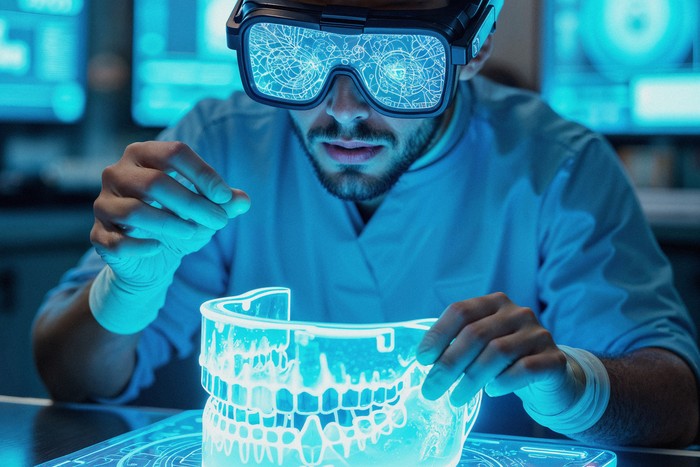
Milling is only one part of digital dental production.
3D printing is increasingly used for models, surgical guides, temporary restorations, aligner-related workflows and other dental components. Instead of removing material from a solid block, additive manufacturing builds an object layer by layer from digital design data.
That creates a different production model.
Once a design file has been approved, the same data can potentially be used to manufacture multiple objects with high repeatability. Digital files can also be modified without recreating a physical mold from scratch.
The broader implication is familiar from industrial manufacturing: the value increasingly sits not only in the physical object, but also in the digital file, the software workflow and the ability to reproduce or modify the design efficiently.
Dental practices are therefore beginning to operate within the same design-to-production logic already seen in engineering, prototyping and advanced manufacturing.
Digital smile design creates a visualization interface
Digital smile design, or DSD, adds another layer to the technology stack.
CAD/CAM is primarily concerned with designing and manufacturing restorations. Digital smile design operates earlier in the process, combining photographs, video and scan data into a planning and visualization environment.
Instead of discussing a proposed outcome only verbally, clinician and patient can work from a visual model.
That changes the user interface of cosmetic dentistry.
A proposed change to tooth shape, proportion or alignment can be displayed on screen and discussed before irreversible treatment begins. The patient is no longer required to imagine the clinician’s description; both parties can refer to the same visual representation.
The technology therefore serves two purposes: planning and communication.
Its limits are equally important. A digital preview is still a simulation rather than a guaranteed prediction. Biological response, clinical execution and material behavior can all affect the final result.
A cosmetic dentist in Henderson using this kind of workflow, for example, can present a proposed design digitally and revise it with the patient before treatment begins. That illustrates how technologies once associated mainly with specialist digital laboratories are increasingly appearing in everyday clinical environments.
Connected systems turn the dental practice into a SmartTech environment
The individual technologies become more significant when they are connected.
A scanner on its own simply captures data. A milling unit on its own simply manufactures an object. Their value increases when scanners, design software, cloud platforms, imaging systems and manufacturing equipment operate as parts of the same digital workflow.
This is where dentistry begins to overlap with concepts more commonly associated with IoT and connected manufacturing.
Not every dental device should automatically be described as an IoT device, but network-connected equipment increasingly exchanges data across local systems and cloud platforms. A scan can move from chairside hardware into planning software, from there to a laboratory or design platform, and finally into a manufacturing system.
Instead of information being carried physically between departments or businesses, data moves across the network.
That reduces one of the biggest structural costs of the analog model: the handoff.
In this sense, the modern dental practice increasingly resembles a small connected production environment in which sensing, software and manufacturing are integrated around a common digital record.
Cloud software changes where expertise can sit
Digital workflows also change the relationship between location and expertise.
In an analog environment, a physical impression or stone model had to travel to the technician who would work on it. With a digital scan, the file can be transmitted almost instantly.
That allows different parts of the workflow to be geographically separated without requiring the physical case to move with them.
A clinician may scan locally, a technician may design remotely, and a restoration may be manufactured either in the practice or at a laboratory. Cloud-based platforms can further centralize case management, communication and file exchange.
The result is a more distributed operating model.
This does not remove the value of specialist laboratories. Instead, it allows practices and laboratories to collaborate around shared digital information rather than around transported physical models.
The same pattern appears across many digitized industries: once the core asset becomes a file, specialist expertise can be connected to the workflow more flexibly.
Why smaller practices can now access advanced 3D scanning workflows
Digital dentistry was once associated primarily with large laboratories, specialist centers and practices able to absorb substantial capital investment.
That has changed as hardware, software and digital production tools have become more integrated.
Scanners, software licenses, milling systems and printers still represent a meaningful investment, but the economic calculation is increasingly based on workflow utilization rather than on hardware ownership alone.
A scanner can reduce physical impression handling and accelerate communication with laboratories. Chairside manufacturing can reduce some laboratory outsourcing. Digital records can simplify repeat work. Visualization tools can make treatment planning more collaborative.
The technology therefore tends to create the most value when deployed as a connected system rather than as a collection of standalone devices.
A scanner without an integrated downstream workflow may improve data capture but leave the rest of the process unchanged. A milling unit without sufficient case volume may remain underused. The return comes from connecting capture, design, communication and manufacturing.
That is one reason digital adoption has spread beyond large institutions.
The bigger technology story with 3D Scanning
Dentistry offers a compact example of several technology trends that are reshaping much larger industries.
Physical objects are being converted into data through 3D scanning. AI and analytics are helping interpret those datasets. CAD software is turning them into editable designs. CAM systems and 3D printers are converting those designs back into physical products. Cloud platforms are connecting specialists across locations, while visualization software is changing how users interact with complex technical decisions.
The same architecture appears in advanced manufacturing, construction, product development, healthcare and engineering.
What dentistry can credibly promise has therefore changed, but not in the sense of guaranteed outcomes.
The stronger promise is procedural: more information before treatment, faster movement of data, fewer physical handoffs, reusable digital records and, in appropriate cases, manufacturing timelines measured in hours rather than weeks.
The remaining constraints are equally technological and human. Hardware must be used correctly. Software output must be interpreted rather than blindly accepted. AI suggestions require clinical oversight. Digital manufacturing still depends on suitable materials and sound design.
The transformation is therefore not about replacing clinicians with machines. It is about embedding clinical expertise inside a much more sophisticated digital system.