
If you want clear skin without the side effects of traditional acne treatments, the science of oxygen delivery may be your answer. AO2 Clear is a simple but sophisticated approach based on pure oxygen in microscopic nanobubbles suspended in distilled water. The technology addresses the root causes that enable acne bacteria to thrive, with the goal of restoring balance at the pore level and supporting the skin’s natural defenses. Here’s a closer look at the engineering and biology that makes this possible.
Key Takeaways
- AO2 Clear utilizes oxygen delivery through microscopic nanobubbles to combat acne effectively without traditional side effects.
- Increased oxygen levels reduce the anaerobic environment favored by Cutibacterium acnes, promoting clearer skin.
- The proprietary nanobubbler process ensures stable delivery of oxygen deep into the skin’s pores over time.
- Clinical studies show a decrease in HIF-1α levels and improvements in skin conditions among users of the product.
- The formula is gentle, free of preservatives, and enhances the tolerability of other acne treatments without disrupting the skin barrier.
Table of contents
Oxygen and Skin Health: Importance in Bacterial Management
Healthy clear skin needs adequate oxygen to produce cellular energy, repair itself and support immune function. Oxygen levels inside pores and follicles drop, and conditions change. Cutibacterium acnes (formerly Propionibacterium acnes) is an aerotolerant anaerobe and is strongly implicated in acne vulgaris. It likes low-oxygen environments where it can reproduce, break down sebum, and cause inflammation. PubMed and other research from the National Institutes of Health confirm this organism thrives in anaerobic or microaerobic conditions and follicular hypoxia promotes its proliferation.
More oxygen in the local environment makes it less hospitable to these bacteria, i.e. clear skin. Oxygen itself is a natural antibacterial agent against anaerobes. And unlike antibiotics, which can also disrupt the wider microbiome, or chemical exfoliants, which can break down the barrier, molecular oxygen disrupts bacterial metabolism without the addition of foreign compounds. This principle has been applied in medical oxygen therapies for wound care and has been investigated for dermatological indications where hypoxia is an etiologic factor in chronic inflammation.
Size, Stability and Delivery of Nanobubble Engineering
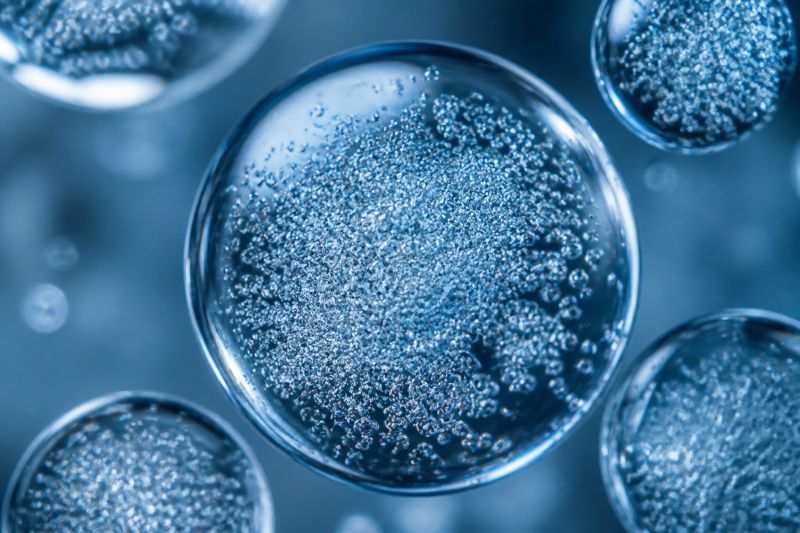
Normal bubbles pop quickly as they rise. Nanobubbles act differently. They are of the order of 100 nanometers in size (about one-thousandth the diameter of a typical skin pore) and are stable in solution for long periods of time. They repel each other due to their negative surface charge and do not combine to form larger microbubbles which would be less effective. This stability and high surface-area-to-volume ratio gives rise to an oxygen reservoir that slowly releases gas.
AO2 Clear uses a proprietary ceramic nanobubbler process to create billions of these oxygen filled nanobubbles in medical grade distilled water. This makes a very concentrated emulsion of oxygen. When applied to the skin, there is a steep concentration gradient between the oxygen rich product and the relatively oxygen poor interior of pores. Gas molecules flow down this gradient and saturate the follicular microenvironment. The nanobubbles are small enough to enter pores and are neutrally buoyant, enabling them to deliver oxygen deeper into the soil than surface applied treatments. Which leads to clear skin where the nanobubbler process happens.
Separate studies on oxygen nanobubbles in dermal formulations have demonstrated enhanced penetration of actives through membranes mimicking skin , lending credence to the theory that nanobubble carriers improve topical delivery. The AO2 approach is to simply focus on the oxygen itself, rather than carrying other ingredients, keeping the formula to two components: distilled water and the oxygen nanobubbles.
Clinical Takeaways: Biomarkers Confirm Skin Reaction & Oxygen Penetration
In a first-of-its-kind human study carried out with North Carolina State University and dermatological collaborators, researchers looked into what occurs after topical application of the oxygen nanobubble emulsion. The researchers obtained skin biopsies prior to treatment and at 30 and 60-minute intervals and used quantitative immunofluorescence imaging to monitor key biomarkers.
The key oxygen sensor was hypoxia-inducible factor-1 alpha (HIF-1α). This protein levels up when tissue oxygen is low and levels down when oxygenation improves. HIF-1α levels were significantly decreased at both time points after application, providing biochemical evidence that oxygen reached the epidermis and dermis. Parallel measurements revealed rapid increase of antioxidant enzyme NQO1 within 30 min and sustained increase of HO-1 through 60 min. These enzymes help the skin to neutralize oxidative stress. Importantly filaggrin (a key protein for barrier integrity) was unchanged, confirming that the treatment did not affect the stratum corneum.
These results are in line with the general dermatological knowledge that HIF-1α is a key regulator of epidermal responses to oxygen availability. Studies on PubMed have shown that the epidermis is under normal conditions in a relatively hypoxic state and that HIF pathways affect barrier proteins and cell behavior.
In another observational series, a clinician reported improvement in the majority of 66 patients using the product twice daily for one month, with many noting noticeable gains in acne control, post procedure recovery or tolerance of other actives, and clear skin. The biomarker data provide direct mechanistic support for the claimed oxygen delivery but larger randomized trials would strengthen the evidence base further.
The Oxygen Advantage Your Guide to Clear Skin
Benzoyl peroxide, salicylic acid or retinoids are commonly used in acne regimens. These can be effective but often cause dryness, irritation or barrier compromise particularly for sensitive or hormonal acne. The oxygen nanobubble method works upstream by changing the microenvironment that promotes bacterial overgrowth and the subsequent inflammation. It aims to reduce the anaerobic niche and, thus, the cascade to papules, pustules, and residual redness.
The formula contains no preservatives, fragrances, acids or oils and is said to be suitable for almost all skin types and for those who have adverse reactions to conventional treatments. Typically, users apply it after cleansing, twice daily. Its lightweight, residue-free texture can be layered with moisturizers or other prescriptions as needed. Others have observed that retinoids are better tolerated when the oxygen product is added to the routine, possibly because a calmer, better oxygenated barrier is more accepting of additional actives.

Science in Daily Care
The technology is based on three pillars: the intrinsic antibacterial effect of oxygen against anaerobes, the physical characteristics of nanobubbles which allow for stable delivery at high concentration, and the resulting concentration gradient that drives gas into the target tissue. Supporting data from human biopsies show measurable changes in oxygenation and antioxidant markers without disruption of the barrier. These observations are consistent with the biological context of C. acnes physiology and epidermal oxygen sensing as provided by the authoritative literature.
Everyone’s response will be different (hormonal factors, diet, stress and any other skincare regimen you may be on). The cumulative effects of clear skin are noticeable with regular use over a few weeks, because the product works by changing the follicular environment, rather than by immediate chemical exfoliation or sterilization. There are many tools and oxygen nanobubbles are one of them. In some cases, such as severe cystic acne or other underlying medical conditions, a dermatologist may need to be consulted.
Looking ahead
One example of how materials science can adapt a fundamental biological principle for everyday skin care is oxygen nanobubble technology. AO2 Packs oxygen in a form that is small enough and stable enough to reach the places where acne starts. It’s a clean, minimalist option based on measurable physiology. Ongoing research in topical gas delivery may further refine the field with the fusion of nanotechnology and dermatology. The science available, for now, provides a clear rationale for how increasing oxygen at the pore level can support healthier skin function and contribute to the goal of clear skin over time.
To summarize, we see a logical path to clearer, more balanced skin, combining nanobubble engineering with the known sensitivity of acne-associated bacteria to oxygen.
FAQs
It delivers pure oxygen via microscopic nanobubbles in distilled water. This raises oxygen levels inside pores, making the environment less hospitable to Cutibacterium acnes (the bacteria that thrive in low-oxygen, anaerobic conditions). Unlike benzoyl peroxide, salicylic acid, or retinoids, it does not add harsh chemicals, acids, or oils, so it avoids dryness, irritation, and barrier damage while still targeting the root conditions that let acne bacteria flourish.
Regular bubbles rise and pop quickly. AO2 Clear’s nanobubbles are about 100 nanometers across (roughly 1/1,000th the diameter of a typical pore), stay stable for long periods because of their negative surface charge, and remain neutrally buoyant. This lets them enter pores, create a steep oxygen concentration gradient, and slowly release gas deep into the follicular environment where acne starts.
A human biopsy study with North Carolina State University measured biomarkers before and after application. Hypoxia-inducible factor-1α (HIF-1α) dropped at 30 and 60 minutes, confirming oxygen reached the epidermis and dermis. Antioxidant enzymes NQO1 and HO-1 rose, while filaggrin (a key barrier protein) stayed unchanged. An observational series of 66 patients using it twice daily for one month also reported improvements in acne control and better tolerance of other treatments.
Apply after cleansing, twice daily. The lightweight, residue-free formula layers easily under moisturizers or prescriptions. Many users find retinoids and other actives more tolerable when the skin is better oxygenated and calmer, because the product does not compromise the barrier.
Yes. It contains only medical-grade distilled water and oxygen nanobubbles—no preservatives, fragrances, acids, or oils—so it is generally well tolerated across skin types, including those that react to conventional acne treatments. Results still vary with hormones, diet, stress, and other products; severe cystic acne or underlying medical issues should be evaluated by a dermatologist.