Ask who the largest payment processing companies are and you will get two different answers this year, both from sources the industry trusts. Global Payments took the top US spot in the 2026 TSG Directory of U.S. Merchant Acquirers with an estimated $2.8 trillion in 2025 processing volume across more than 53 billion transactions (Source: The Strawhecker Group).
The Nilson Report, running its own annual ranking on the same year of data, put Fiserv first.
Now, both are right. They count different things, and the gap between their methods tells you more about how the payments industry actually works than any single league table would. If you’re choosing a processor, that’s probably something you look into before making the final call.
Key Takeaways
- Two respected 2026 rankings name different largest US payment processors.
- The disagreement comes from methodology, not error.
- Global Payments moved to the top after closing its Worldpay acquisition.
- Gateway performance leaders are mostly bank-owned, not the familiar brands.
- Match the provider to your channel mix, not to a ranking.
Table of contents
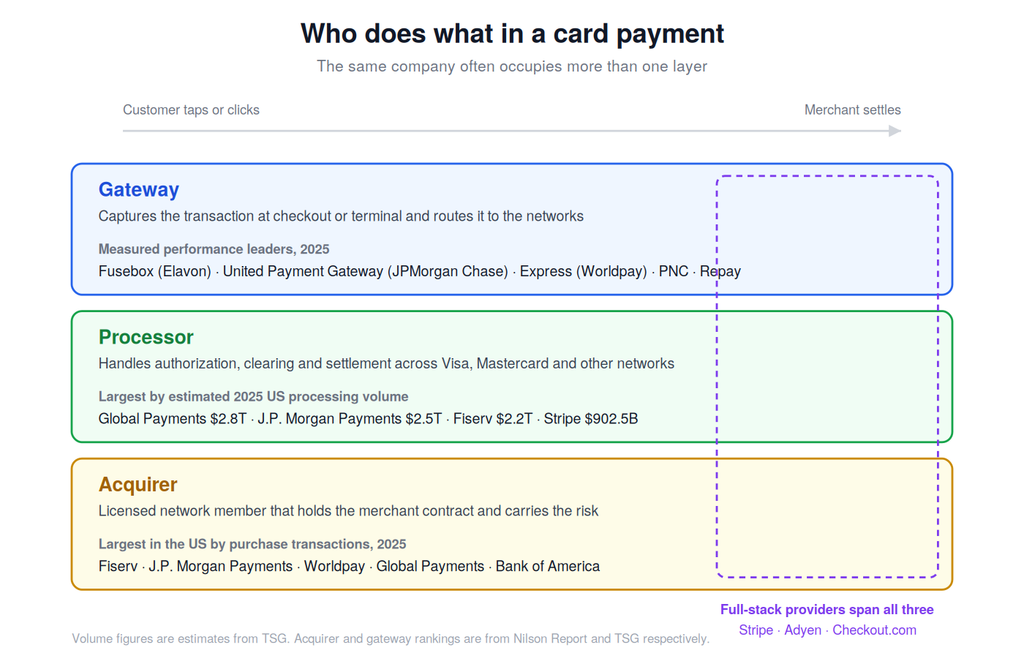
Gateway, processor, acquirer: three jobs, often one company
Three distinct functions sit between a customer tapping a card and money landing in your account.
The gateway captures the transaction and passes it along. Acting as the connective tissue, the piece that takes card data from your checkout page or terminal routes it toward the networks. We generally consider Authorize.Net, launched in 1996, as the first one.
The processor moves the transaction through authorization, clearing, and settlement. This is the plumbing work: talking to Visa and Mastercard, handling the messaging, making sure the right amounts move at the right time.
The acquirer is the licensed entity that holds the merchant relationship and carries the risk. Acquirers must be network members. When a chargeback goes badly, the acquirer is the one on the hook.
Rankings of “payment processing companies” almost always measure acquiring, because that is where the volume data lives. Keep that in mind when you compare lists.
Where Stripe, Adyen and Checkout.com blur the lines
The clean three-layer picture stopped matching reality years ago. Stripe, Adyen, and Checkout.com each run their own gateway, their own processing, and hold acquiring licences in multiple markets. Merchants experience one contract and one API.
That full-stack model is now spreading in both directions, alongside the open finance infrastructure reshaping how account data moves between providers. Checkout.com applied for a Merchant Acquirer Limited Purpose Bank charter in Georgia, and processes over $300 billion in ecommerce payments for clients including eBay and Klarna (Source: Nilson Report). Meanwhile the incumbent acquirers keep buying the software layers they used to partner with.
So a company can appear in a gateway ranking, a processor ranking, and an acquirer ranking at once, at three different positions. That is not a data problem. It is the market.
The largest payment processing companies in 2026
The figures below are TSG’s estimates of 2025 US processing volume, published in its 2026 directory. TSG covers more than 300 US payment companies representing over 95% of card volume in the country.
Global Payments
Roughly $2.8 trillion, first place. Global closed its $24.5 billion acquisition of Worldpay in January 2026, and that single transaction explains the ranking. Worldpay sat third in the previous year’s directory with an estimated $1.9 trillion for 2024. Combine the two and you get a new leader without either company growing much organically.
J.P. Morgan Payments
Roughly $2.5 trillion, second. JPMorgan Chase had held the top rank since at least the 2023 edition of the directory, and it lost the position without losing volume. Worth remembering when a competitor’s press release frames a rank change as momentum.
Fiserv
Roughly $2.2 trillion, third by TSG’s count and first by Nilson’s. Fiserv’s Clover point-of-sale suite is the growth engine on the small business side, now selling in Australia and, through a Sumitomo Mitsui Card Company partnership, launching in Japan.
Stripe
Roughly $902.5 billion, fourth. TSG’s Alex Ferguson has said Stripe will very likely pass $1 trillion in US-sourced payment volume during 2026 (Source: Digital Transactions). Stripe’s growth is concentrated in software platforms and ISV-enabled merchants rather than traditional retail.
Adyen
Roughly $316 billion in US volume, ninth. The US figure understates Adyen considerably, since it is a European acquirer with a global enterprise book. It ranks among the largest acquirers in Europe on Nilson’s separate regional table.
The rest of the top ten
Wells Fargo at roughly $675 billion, PayPal at $585 billion, Elavon at $442 billion, Bank of America at $428.7 billion, and Block at $200.2 billion. Elavon, the acquiring arm of U.S. Bank, is the fifth largest US merchant acquirer by Nilson’s separate count.
Why two credible rankings name different leaders
Here is the actual explanation, and it comes down to two choices each publisher made.
They measure different quantities. Nilson ranks US acquirers by purchase transactions and by Visa and Mastercard purchase volume. Its 2025 US table lists the five largest as Fiserv, J.P. Morgan Payments, Worldpay, Global Payments, and Bank of America, based on combined global brand and domestic-only purchase transactions, with the top five up 3.2% on 2024 (Source: Nilson Report). TSG estimates total US processing volume, a broader figure that captures activity outside the two big card brands.
They treat the merger differently. Nilson’s 2025 US ranking lists Worldpay and Global Payments as separate companies, because for the year being measured they were. TSG’s 2026 directory reflects the combined entity, because the deal closed in January. Neither approach is wrong. One describes the year that happened, the other describes the market you would buy into today.
You can see the same effect in Nilson’s European table, where Worldpay and Global Payments still appear as separate names among the 45 largest acquirers. Across that survey, 55 participating acquirers handled 228.96 billion transactions in 2025, up 5.9% (Source: Nilson Report).
The practical lesson: when a vendor cites a ranking, check which quantity was measured and which year the data covers. Both details change the answer.
Global payment gateway providers, and what performance data shows
Search for global payment gateway providers and you get the same handful of names every time. The measured performance data points somewhere else entirely.
The gateways that win on measured performance
TSG evaluates gateways through its Global Experience Monitoring platform on transaction activity, capture ability, uptime, and latency. Its 2025 assessment named Fusebox, from Elavon, the best-performing gateway. The runners-up were the United Payment Gateway from JPMorgan Chase and Express from Worldpay. The same three led on transaction speed.
The specialised categories went elsewhere again. PNC recorded the highest authorization rate. Bank of America took best gateway reliability in North America, while Worldpay led on reliability globally. Repay Holdings took the uptime award.
Notice what these have in common. They are bank-owned or acquirer-owned infrastructure, and almost none of them show up in the listicles.
The gateways merchants actually shortlist
Stripe, Adyen, Checkout.com, Worldline, Rapyd, and Nuvei dominate the consideration set for good reasons that have little to do with latency benchmarks. Developer experience, documentation, market coverage, and how quickly you can go live tend to decide these evaluations.
Coverage varies more than the marketing suggests. Nuvei provides local acquiring in 53 markets. Worldline ranks sixth among European acquirers. Rapyd has built a fintech-as-a-service menu spanning acquiring and payouts since 2016. If you sell in one country, that spread hardly matters. If you sell in fifteen, it decides your approval rates.
The gateway’s job has also shifted. As TSG’s Michael Trilli put it to Digital Transactions, stability in network access and settlement still matters, but the tangible value has moved toward raising approval rates and cutting fraud through transaction intelligence. A gateway that stays up but approves fewer good transactions is costing you more than an outage would. Larger merchants increasingly address this with multi-rail payment orchestration, routing each transaction to whichever path is most likely to clear.
How to choose between them
Start with your channel mix. In-store and omnichannel volume pushes you toward the large acquirers with terminal estates and unified reporting. Pure ecommerce, especially cross-border, favours the full-stack providers with local acquiring in your target markets.
Then ask about approval rates specifically, not uptime. Uptime is table stakes. A percentage point of authorization rate on real volume is worth more than most of the fee negotiation you are about to do.
Confirm where the compliance burden lands. Some models keep card data entirely off your systems, while others leave you responsible for PCI-compliant hosting and the audit that comes with it.
Check whether your provider is mid-merger. Two of the top three US processors are currently absorbing acquisitions, and integration periods affect support quality, product roadmaps, and contract terms in ways that no ranking captures.
Finally, read the ranking’s methodology before you let it influence anything. As this year demonstrates, the same market produced two different leaders depending on what got counted.
Conclusion
The largest payment processing companies in 2026 are a short list of very big businesses getting bigger mostly through acquisition rather than growth. Global Payments and Worldpay are now one company. FIS took Global’s Issuer Solutions business in the same restructuring. The consolidation is the story, and it is why the rankings moved.
For your own decision, the league table is a starting point and not much more. Your channel mix, your markets, and your approval rates will tell you more than volume estimates ever will. Ask any prospective provider how they measure authorization performance on merchants like you, and see whether they have an answer ready.
Keep reading for more on payment infrastructure and fintech operations:
- The Role of Fintech in Democratizing Small Business Lending
- 3 Banking Processes That AI Can Automate Without Touching the Core Banking System
- 11 FinOps Use Cases Reshaping AI and Cloud Spend in 2026
Frequently Asked Questions
The largest payment processing companies in the US are Global Payments, J.P. Morgan Payments, Fiserv, Stripe, and Wells Fargo by estimated 2025 processing volume. Rankings differ by publisher because some measure total processing volume while others measure Visa and Mastercard purchase transactions. Merger timing also shifts the order year to year.
A payment gateway captures transaction data at checkout and routes it toward the card networks, while a payment processor moves that transaction through authorization, clearing, and settlement. Many companies now provide both, along with acquiring, under a single contract. The distinction still matters when you compare pricing and performance.
That depends on the measurement. The Nilson Report ranked Fiserv first among US merchant acquirers for 2025 based on purchase transactions, while TSG’s 2026 directory placed Global Payments first on estimated total US processing volume after its Worldpay acquisition closed.
Providers with the broadest local acquiring footprints include Nuvei with 53 markets, Adyen, Worldline across Europe, and Rapyd. Coverage matters most for cross-border merchants, because local acquiring typically improves authorization rates compared with routing every transaction internationally.
Payment processors earn revenue from a per-transaction fee, a percentage of transaction value, or both, layered on top of interchange and network fees. Larger providers increasingly earn more from value-added services such as fraud prevention, orchestration, point-of-sale software, and data products than from processing margin alone.