Union Pacific wants to buy Norfolk Southern for $85 billion and build the first US transcontinental railroad, and the Surface Transportation Board’s statutory deadline for deciding it is August 28, 2027 (Source: Surface Transportation Board). Most of the public argument is about competition, captive shippers and gateway access.
The part that has actually broken every previous deal of this size is less glamorous. It is the computer systems.
Key Takeaways
- Every modern Class I rail merger has produced service disruption.
- IT cutovers sit at the center of most of those failures.
- CPKC lost car visibility for roughly three months after a 2025 cutover.
- Union Pacific says sequencing and change management are the difference.
- STB comments close November 18, 2026, with a decision due by August 2027.
Where the Merger Stands
The applicants filed in December 2025. The STB found the application incomplete in January 2026, a unanimous decision, and the railroads filed a revised version on April 30. The Board accepted it on May 28 but held the proceeding in abeyance, ordering supplemental information on competitive enhancements, captive shipper access, diversion analysis, gateways and downstream merger effects.
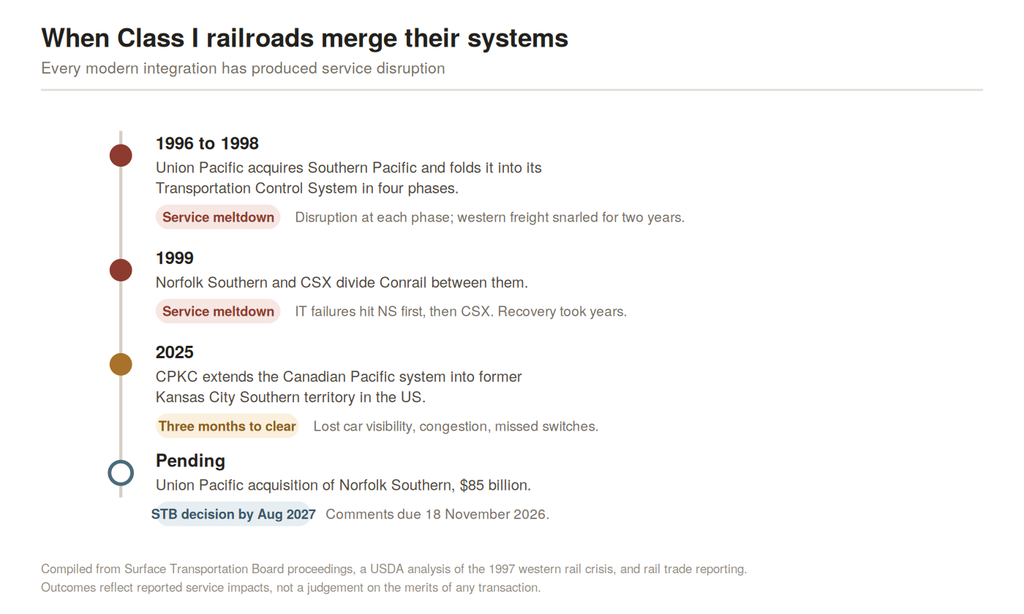
Supplemental filings landed in July. On August 18, 2026 the Board lifted the abeyance and set a schedule: notices of intent to participate were due September 4, and comments, protests and requests for conditions are due November 18. The companies are targeting a mid-2027 close.
This is also the first time the STB will apply the tougher merger rules it adopted in 2001, which put a heavier burden on applicants to show a transaction serves the public interest.
Why Rail IT Is Harder Than It Looks
A railroad’s software is not a back-office function. Dispatching, crew calling, car tracking and waybill data are the operation.
If the system loses track of where a car is, that car does not move. Likewise, if a crew cannot generate a work order, the switching does not happen. If dispatching goes down, trains stop. There is no degraded mode where the railroad runs at eighty percent while IT sorts things out, because the physical network fills up behind any blockage and stays full long after the software is fixed.
Layer onto that decades of accumulated business rules, thousands of customer integrations, union agreements encoded into crew systems, and users spread across a continent with varying tolerance for change. This is the environment where the decision to keep, replace or rebuild a legacy system carries operational consequences rather than budget ones.
Both railroads run core operations on mainframe infrastructure. On the eastern side that means the NS mainframe and its horse screen, the environment Norfolk Southern crews and dispatchers work through every shift. Merging two systems of that kind is not a data migration with a cutover weekend. It is thousands of people learning a different set of screens while the freight keeps moving.
The Record
Union Pacific and Southern Pacific, 1996 to 1998. UP folded SP into its Transportation Control System in four phases. A federal analysis of the resulting crisis found disruption at each one, as trains were held while car locations, contents and routing instructions were entered into UP’s system. Combined with congestion around Houston, it produced a service meltdown that snarled western freight for two years and drew STB intervention.
The Conrail split, 1999. Norfolk Southern and CSX divided Conrail between them. IT problems hit NS immediately, and CSX followed with its own. Recovery took years rather than months. This one is directly relevant, because Conrail is a predecessor of today’s Norfolk Southern. This railroad has already been through it once.
BNSF. The IT cutover following the Burlington Northern and Santa Fe merger was chaotic, though it drew less attention than the other two.
CPKC, 2025. Canadian Pacific Kansas City extended the CP system into former Kansas City Southern territory in the US. Unforeseen data problems meant the railroad lost visibility into car locations, particularly at customer facilities. Cars could not move until their data was corrected by hand, and crews and shippers struggled to create work orders. Congestion, missed switches and delays spread across Louisiana, eastern Texas and Mississippi. It took roughly three months to clear, with the STB chairman demanding answers as chemical shippers diverted to trucks to keep plants running.
Four attempts, four sets of problems, across three decades and different management teams. At some point a pattern stops being bad luck.
What Union Pacific Says Is Different
The railroad has not ignored the history. Its chief information officer has pointed to UP’s own migration to a new dispatching system, carried out in phases over seventeen months without affecting operations or customers, and to a subsequent extension of that system onto a terminal railroad that also went cleanly. The argument is that integration failure is a change management problem, not an inevitability, and that UP has recent evidence of doing it properly.
The chief executive has made a sequencing argument alongside it: the operating plan comes first, because that is where the customer benefit sits, and the technology cutover follows rather than leads.
Both points are reasonable. There is also a counterpoint from someone who has just lived through it. CPKC’s chief executive has said that cutting over your own internal system is not comparable to extending one railroad’s system across another’s network, and that the complexity is orders of magnitude greater. UP’s seventeen-month migration was the first kind. The NS integration would be the second.
The Case That This Is Overstated
Not everyone reads the history as a reason for alarm, and the counterargument deserves a fair hearing.
Rail industry analysts have pointed out that integration disruption is temporary while network benefits are permanent, and that much of the damage in the older cases came from operational and infrastructure decisions rather than software. UP’s problems after the SP acquisition owed a great deal to congestion around Houston and the condition of the track it inherited. Blaming the computers alone flattens a more complicated story.
There is also a timing argument. A two-year regulatory review gives planners far longer to prepare than most corporate integrations get, and both railroads know exactly which failure modes the STB will be watching for. Being the fifth attempt has advantages.
Whether that outweighs a consistent record is a judgement call, and it is the one the Board will effectively be making.
What to Watch
The November 18 comment deadline is the next real marker. Filings from shippers, rival railroads and labour organisations will say more about integration risk than either applicant’s public messaging, and after CPKC the STB has a fresh example in front of it.
Watch for whether the Board attaches service-related conditions to any approval, because that would be the clearest signal that it treats the IT question as a public interest matter rather than an internal one. And for anyone running a large integration outside rail, the sequencing lesson about replacing core systems without disrupting service generalises well beyond freight.
Read Next
More coverage on enterprise infrastructure and modernization:
- The Strategic Importance of Modernizing Legacy Systems
- Replacing Legacy Core Systems in 2026 Without Disrupting Policyholders
- Tech’s Remaking of Retail Operations
Frequently Asked Questions
Rail merger IT integration fails often because railroad software is operational rather than administrative. Dispatching, crew calling and car tracking cannot be degraded gracefully, so a data problem becomes a physical blockage on the network, and congestion persists long after the software issue is resolved.
During the 2025 CPKC cutover, the railroad extended the Canadian Pacific system into former Kansas City Southern territory and lost visibility into car locations. Cars could not move until data was corrected manually, producing congestion and delays across Louisiana, eastern Texas and Mississippi for roughly three months.
The Surface Transportation Board’s statutory deadline for deciding the Union Pacific and Norfolk Southern merger is August 28, 2027. Comments, protests and requests for conditions are due November 18, 2026, and the companies are targeting a mid-2027 close.
Yes. Norfolk Southern and CSX divided Conrail in 1999, and IT problems hit Norfolk Southern immediately after the split before affecting CSX. Conrail is a predecessor of today’s Norfolk Southern, so the railroad has direct experience of a difficult integration.