Banking as a service is the model that lets a software company offer bank accounts, cards, and payments without holding a banking charter, and the market for it sits at roughly $28.96 billion in 2026 with a projected climb to $65.78 billion by 2031 (Source: Mordor Intelligence). That growth is real. It is also more conditional than it was three years ago.
Between 2023 and 2025, US regulators worked through a wave of enforcement against the banks sponsoring these programs, and the wreckage of the Synapse bankruptcy left thousands of end customers unable to reach their own money. The model survived. What changed is who gets to participate and what it costs to get in.
If you are evaluating banking as a service now, the mechanics matter less than the diligence.
Key Takeaways
- Banking as a service lets non-banks offer regulated financial products through a chartered partner.
- The sponsor bank holds the charter and carries the regulatory liability, not the fintech.
- Regulators issued consent orders against multiple sponsor banks between 2022 and 2026.
- Compliance maturity, not pricing, is now the main selection criterion for a partner.
- BaaS, embedded finance, and open banking describe different layers of the same shift.
Table of contents
What Banking as a Service Actually Means
Strip the marketing off and the arrangement is simple. A licensed bank rents out the parts of itself that require a license. Deposit accounts. Card issuing. Payment rails. Lending authority. A non-bank company plugs into those capabilities through APIs, wraps them in its own interface, and puts its own brand on the front.
Your customer sees your app. The money sits in an FDIC-insured account at a bank most of them have never heard of.
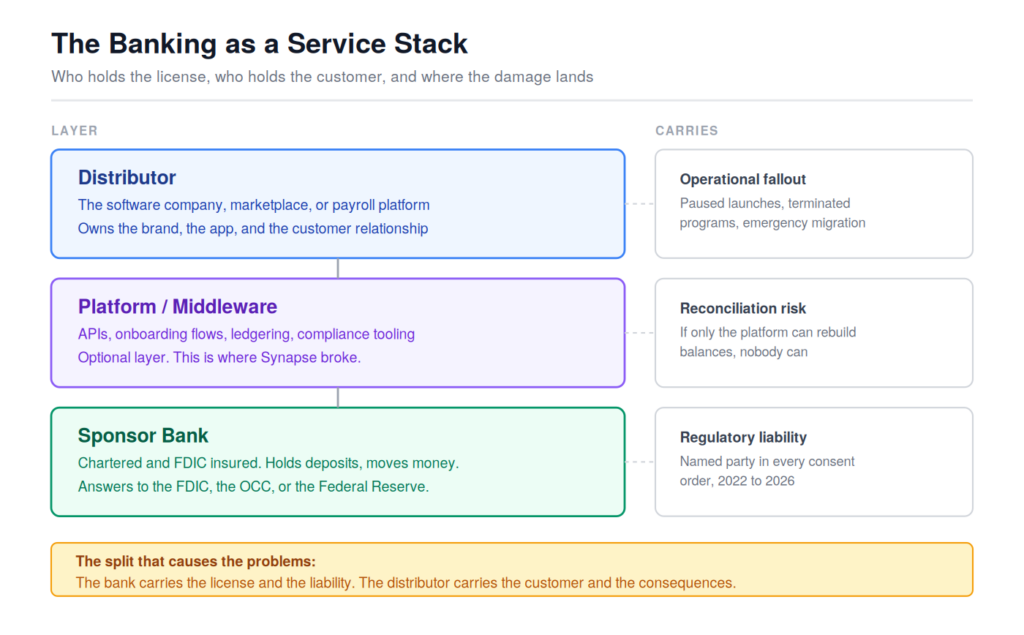
That split is the entire point, and it is also where every problem in the model originates. The bank carries the regulatory obligations. The fintech controls the customer relationship. When those two things drift apart, which they did repeatedly, nobody is quite sure who is watching the ledger.
The Stack: Who Does What
Most BaaS arrangements have three layers, though the boundaries blur depending on how the deal is structured.
The sponsor bank
A chartered, insured institution. It holds the deposits, executes the payments, and answers to the FDIC, the OCC, or the Federal Reserve depending on its charter. Community and regional banks dominate this layer because BaaS gave them a deposit growth channel they could not build organically.
The platform layer
Middleware. Companies in this tier translate a bank’s legacy core into something a developer can actually use, handling API design, onboarding flows, ledgering, and often a slice of compliance operations. This is the layer that failed in the Synapse collapse, when the reconciliation between the platform’s records and the banks’ records could not be untangled.
Some fintechs skip it entirely and integrate directly with a sponsor bank. That takes longer and requires real in-house compliance staff. It also removes a single point of failure.
The distributor
You. The software company, marketplace, payroll provider, or retailer putting financial products in front of end users. Your job is distribution and product, plus a share of compliance that is larger than most first-time entrants expect.
BaaS, Embedded Finance, and Open Banking Are Not the Same Thing
These three terms get used as synonyms in vendor copy, which makes research harder than it needs to be.
Banking as a service is the supply side. It is the infrastructure and the license access that make everything else possible.
Embedded finance is the demand side, meaning the actual experience of paying, borrowing, or banking inside a non-financial product. Coruzant has covered how businesses benefit from embedded finance as a distribution strategy, which is the lens most operators care about.
Open banking is neither. It is a data-sharing framework, usually regulator-driven, that lets a third party read account information or initiate a payment with the customer’s permission. It moves data. BaaS moves the underlying capability. The UK counted 13.3 million active open banking users and 31 million open banking payments in 2025, which shows how much of modern fintech runs on plumbing that most consumers never see.
Why Companies Build on BaaS
Speed is the honest answer. Obtaining a bank charter in the US takes years and a great deal of capital. Partnering takes months.
Beyond speed, the economics work in specific situations. A payroll platform that adds instant pay earns interchange and float instead of paying a third party for the same function. A B2B marketplace that adds working capital lending turns a transaction fee into a credit spread. A vertical SaaS product with 5,000 customers in one industry knows those customers better than any bank does, and that underwriting advantage is worth more than the license itself.
Banks get something too. Deposits, fee income, and exposure to a customer base they could not reach through branches. For a $900 million community bank, a single strong fintech program can move the balance sheet in a way that opening ten branches never would.
That asymmetry is exactly what got several of them in trouble.
What the Regulatory Reckoning Changed
Here is the part the vendor guides skip.
Between 2022 and 2025, the FDIC, the OCC, and the Federal Reserve issued consent orders against seven sponsor banks running BaaS programs. The named party in every one of those actions was the bank, not the fintech partner. The June 2023 Interagency Guidance on Third-Party Relationships made the principle explicit: using a third party does not reduce a bank’s own responsibility.
The pressure has not lifted. On May 21, 2026, the OCC made public an April 2026 consent order against Community Federal Savings Bank, a single-branch institution in Woodhaven, New York, over BSA/AML failures tied directly to rapid expansion into payment processing and fintech-adjacent business lines. The bank held roughly $866 million in assets at the end of 2025 while running wire and ACH volumes, including cross-border activity, that its compliance function had not scaled to match.
Read the pattern rather than the individual case. Regulators are not hostile to the model. They are hostile to growth that outruns controls.
Three practical consequences follow for anyone building on BaaS now:
Diligence runs both directions. Sponsor banks reject applicants who would once have been signed on a demo call. Expect questions about your AML program, your complaint handling, your ledger architecture, and your funding runway.
Concentration limits are real. Some banks now cap sponsor banking at a fixed share of total deposits and revenue as a matter of formal board policy, which means a large partner may simply not have room for you.
The fintech absorbs the operational damage. When a sponsor bank gets an enforcement action, the bank pays the regulatory price and the fintech pays everything else: paused product launches, terminated programs, an emergency migration to a new partner. Building a regulator-ready operation from the start is cheaper than rebuilding one under a deadline.
Where BaaS Gets Used
The categories that hold up commercially share one trait. Financial services solve a problem the core product already had.
Payroll and workforce platforms add earned wage access and pay cards. Vertical SaaS in trucking, construction, or healthcare adds fuel cards, invoice factoring, or claims payments. Marketplaces add seller accounts so funds settle inside the platform instead of leaving it. Retailers and travel brands add branded cards and installment credit.
Cross-border commerce is the fastest-moving segment, since multi-currency accounts and local payout rails are painful to build and easy to embed.
The category that consistently disappoints is the standalone neobank with no distribution advantage. Acquisition costs are brutal, deposits are unsticky, and the unit economics rarely survive contact with reality.
How to Choose a Sponsor Bank
Price is the wrong first filter. Ask these instead.
What is the bank’s enforcement history? Consent orders are public. Search the FDIC, OCC, and Federal Reserve enforcement databases for any institution you are considering. An active order usually means the bank cannot add new partners or products without regulatory non-objection, which quietly kills your roadmap.
Who owns the ledger? If your platform provider is the only party that can reconstruct customer balances, you have recreated the exact failure mode from Synapse. The bank should be able to independently access and reconstruct customer activity.
How concentrated is the program? A bank where sponsor banking is 60% of revenue is carrying risk that will eventually land on you.
What happens if you have to leave? Ask about data portability and exit timelines before you sign, not after. Migration between sponsor banks takes months and rarely happens on a calm schedule.
Who runs compliance, and with what headcount? Transaction monitoring, sanctions screening, and complaint handling are where these programs break. Vague answers here are the strongest negative signal you will get. The threats hiding in a fintech stack are usually procedural rather than technical.
Conclusion
Banking as a service still does what it promised. You can launch a financial product in months instead of years, keep the customer relationship, and earn revenue that used to belong entirely to a bank. The infrastructure is better than it was in 2021 and the surviving providers are considerably more serious.
What you cannot do anymore is treat compliance as something the partner handles. The bank carries the license and the liability, but you carry the consequences of its failures, and regulators have made clear they will keep testing that seam. Budget for a real compliance function, pick a sponsor with a clean record and room on its balance sheet, and confirm you can leave before you commit to staying.
Read Next
More fintech infrastructure coverage worth your time:
- Cross-Border Acquiring: The Technology Behind Faster, Smarter, and More Secure Global Payment Processing
- OpenFuture World Reshaping the Evolution of Fintech and Open Finance
- How Fintech Tools Simplify Commercial Real Estate Financing
Frequently Asked Questions
Banking as a service is a model in which a licensed bank provides its regulated capabilities, such as deposit accounts, card issuing, and payment processing, to a non-bank company through APIs. The non-bank company delivers those products under its own brand while the chartered bank holds the deposits and carries the regulatory obligations.
Banking as a service is the infrastructure layer, while embedded finance is the customer-facing result. BaaS describes the bank partnership and API access that make regulated products available to a non-bank. Embedded finance describes the experience of using those products inside a non-financial app, such as paying or borrowing without leaving the platform.
Banking as a service is regulated through the sponsor bank rather than through a separate BaaS rulebook. The chartered institution answers to the FDIC, the OCC, or the Federal Reserve, and June 2023 interagency guidance confirmed that using a third party does not reduce a bank’s own compliance responsibility. Fintech partners are supervised indirectly through the bank’s oversight obligations.
Banking as a service pricing is rarely published and varies widely by program size and product mix. Typical structures combine a monthly platform fee, per-account and per-transaction charges, and a share of interchange revenue. Compliance staffing is the larger hidden cost, since sponsor banks now expect partners to fund real transaction monitoring and complaint handling.
Synapse was a banking as a service middleware provider whose 2024 bankruptcy left end customers unable to access funds because platform records and partner bank records could not be reconciled. The failure pushed regulators and sponsor banks to demand that the chartered institution be able to independently reconstruct customer balances, which is now a standard diligence question for any new program.