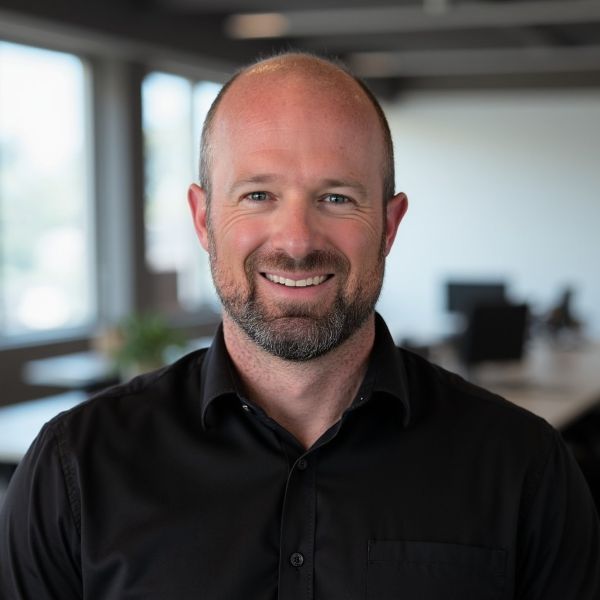
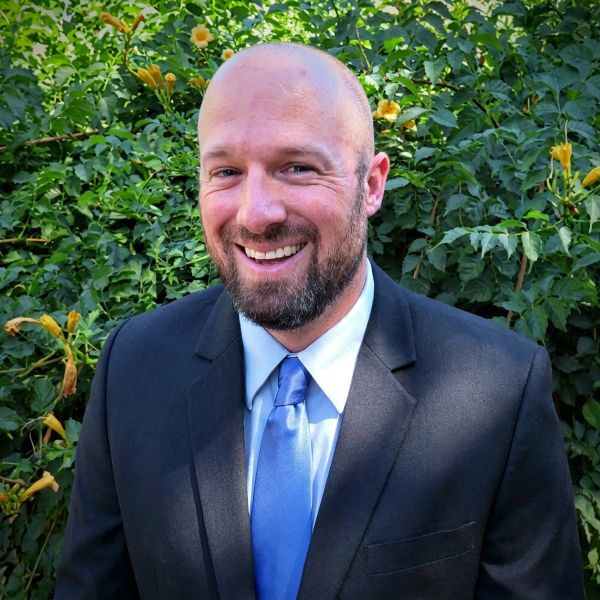
Joel Perez is a full-stack software engineer, technology leader, CTO, and Co-Founder of Mindful Software, where he focuses on building human-centered technology that helps people create meaningful change in their lives.
His career spans software engineering, IT leadership, infrastructure, and product development. In his previous role with Rocket Communications, Joel created and led a team of engineers building a 3D-rendered satellite visualization tool used to train space operations teams. The platform combined real and user-generated satellite data to create realistic scenarios for testing space domain awareness.
Before moving fully into software development, Joel built a deep technical foundation in systems, networking, and IT leadership. His background includes system administration and IT management roles at organizations including Apergy, PCS Ferguson, Transwest, and Northrop Grumman. As IT Manager at PCS Ferguson, he oversaw infrastructure supporting servers, networks, and hundreds of employees.
Joel’s path into software engineering was anything but conventional. In 2017, after accepting a role running server infrastructure for Apergy, a $2 billion enterprise, his wife Amy encouraged him to step away and spend a year traveling. During that trip, Joel revisited an old curiosity: software engineering. He had always been drawn to the creative freedom of being able to build almost anything, but had never believed it was the right fit for him. With the space to explore it again, he realized he didn’t just enjoy development—he wanted to reshape his career around it.
In 2023, Joel felt another pull he couldn’t ignore: it was time to build his own product. He and Amy had both experienced the value of dream interpretation as a tool for reflection, clarity, and personal guidance. But the process was often slow, scattered, and difficult to sustain. Amy suggested turning that experience into an app, and myDream was born.
Across his career, Joel has combined technical depth, leadership, and a builder’s curiosity with a desire to create tools that feel useful, personal, and deeply human.
Outside of work, Joel competes in state and national golf tournaments and qualified for the 2025 U.S. Mid-Amateur. He is also an avid outdoorsman who enjoys spending time in the mountains skiing and has recently taken up bow hunting.
[Q U I C K N O T E S]
- Position: Entrepreneur, Software Engineer
- Industry: Software, HealthTech
- Location: Longmont, CO, USA
- LinkedIn: Joel Perez
- Website: Mindful Software, myDream
- Instagram: myDream
- YouTube: myDream
Joel, can you start off by telling us about yourself and why you chose technology (and entrepreneurship) as a career?
Engineering has always been both a curiosity and a natural gift for me. Even as a child, I would sit in bed in the morning wondering how things worked. The question “how does that work?” has always been incredibly compelling to me.
I eventually found my way into the technology side of engineering almost by accident. When I was 14, I broke my wrist snowboarding right after my parents bought our first family PC. Since I couldn’t play many sports with my arm in an over-the-elbow cast, I started experimenting with the computer. Later, while studying mechanical engineering in college, I realized I was good at fixing computers and decided it might be a good profession.
Fifteen years later, after my wife and I quit our jobs to travel the world, I had a thought: “Why don’t I try coding again?” I had always wished I liked it, but a few bad teachers had convinced me that I didn’t. I took my first basic coding course while we were in Pai, Thailand, and that was the moment I decided it was time to change careers.
Can you tell us what drives you to be successful as a technology executive and entrepreneur?
The primary driver of my desire for success is making people’s lives better. Early in my career, I did that by fixing their computers and solving practical problems. Now, I get to do it more directly and creatively by building products that can reach people at scale.
Tell us about your vision of your career in the next 2-3 years?
Over the next two to three years, my focus is making myDream successful. We have built a tool that helps people access deeper self-understanding through their dreams. Once we reach escape velocity, we will scale the team and product to support the user base we believe we can reach.
I also expect other projects to emerge as partners in the space ask for help bringing their own ideas to life. What I find most interesting about software right now is how different the industry is going to look in just two or three years. We are operating on the cutting edge. While some of the LLM hype is overblown, it is still incredibly exciting to see how much AI has already changed the industry.
They also revealed limits. Many frameworks work well in stable markets but require adaptation elsewhere. That experience taught me to assess strategies by how they perform under local constraints.
What’s the one or two accomplishments that you’re proud of?
The biggest work accomplishment that comes to mind is my work on SpaceACME. I was hired as a Junior Software Engineer and given a greenfield project: a web-based 3D visualization tool for satellite maneuver planning and collision avoidance. I had no experience in 3D rendering at the time, but I built the entire proof of concept myself in three months.
That proof of concept went on to win a $1.7 million contract from the U.S. Space Force, and I was promoted to Lead Engineer within three months.
What advice do you have for other up-and-coming engineers or leaders?
I have advice for both engineers and leaders: no matter what you do, you need to be constantly learning. Never be afraid to be a novice at something. Successful engineers and leaders, now and in the future, need to take on things they do not already know.
Modern AI tooling is giving both leaders and engineers something close to a dedicated team at their fingertips, and that drastically changes the abilities and priorities of both roles.
For leaders, this means smaller, nimble teams are now vastly more effective than many large teams and organizations. The focus for leadership in 2026 needs to be cutting organizational overhead and replacing it with quality documentation, strong tooling, and clear systems. For engineers, the work is shifting away from narrow, highly specialized tasks and toward broader architectural thinking. If you are an engineer at a large company with a very small area of focus, you should be broadening your skill set as quickly as possible. The “golden handcuffs” job many people have today is going to shrink down to the architects and engineers who can best leverage AI tooling. You need to become that person.
Are you active on social media professionally? If so, what platforms work best for engaging your followers?
I’m not very active on social media professionally. I keep up with LinkedIn, but that is the main platform I use. Most of my engagement there comes from sharing insights from operating at the cutting edge of AI tooling over the past year.
Who was your biggest influence?
As a child, my biggest influences were my father and my maternal grandfather. Today, my biggest influence is my wife. She is incredibly smart, talented, and driven, and she pushes me to be better every day. She challenges me and my assumptions in a way that helps me continue improving.
What is the most challenging part of your work as a founder and tech executive?
For me, the most challenging part comes down to the hard choices. It means sticking to my morals even when the incentives point in another direction. Questions around selling data or ad tracking are a big example of that.
The hardest decisions for me revolve around my team and the realities of the business cycle. It took time to find the amazing team I have, and preparing for the possibility of scaling down if growth is slower than expected has been one of the hardest things I have faced so far.
What do you have your sights set on next?
I have my sights set on going as deep as possible with integrated AI tooling to make myself and my team as efficient as we can be. We already use a high level of dedicated AI tooling, but there is always room to improve. To me, leadership means spending an hour of my time to save my team tens, hundreds, or even thousands of hours downstream.
Much of what we are building now will help us move faster on myDream, but it will also become reusable infrastructure for every future project.
We also have exciting features planned for myDream, including dynamic chat, lucid dreaming and dream recall instruction, therapist integrations, and wearable integrations.

What is a day in your life like?
I start my day with a double-shot latte and sit down at my desk to warm up my brain with daily statistical checks around user counts, subscriptions, and analytics. My mornings are usually my most productive time, when I can focus on tangible work like coding or tooling integrations.
We have daily standup at 10, and most of my meetings happen between 12 and 3. Outside of those windows, I try to squeeze in as much focused, productive time as possible.
Around 5, I usually head outside to work on my golf game until sundown. After that, it’s dinner and quality time with my wife. Once she goes to bed, I usually find my way back to the computer, where I do most of my learning and research before going to sleep somewhere between midnight and 1 a.m.
Do you have any hobbies?
My biggest hobby is high-level competitive amateur golf. I play in state and national amateur tournaments and have been competing at that level for 15 years. Last year, I qualified for my first USGA championship and played in the 44th U.S. Mid-Amateur.
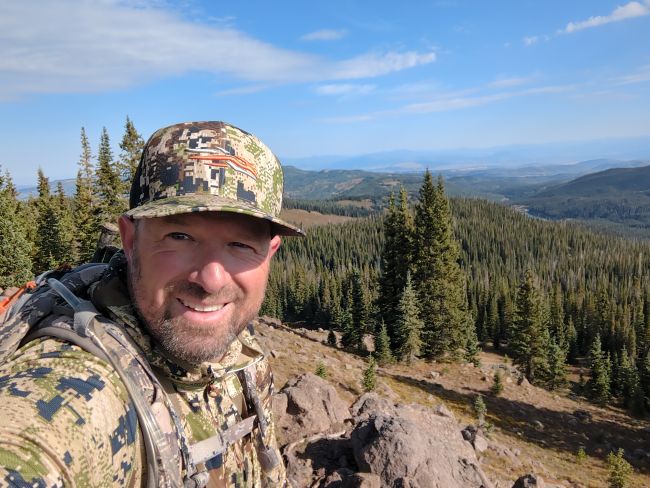
When I’m not golfing, I’m usually skiing or snowboarding in the winter and bow hunting in the fall.
What makes you smile?
Spending time with the amazing people in my life. That can mean anything from deep, fulfilling conversations to joking around with friends.
What are you never without?
My honesty and authenticity. We are all human, and we all experience everything from the highest highs to the lowest lows. I will never be anything other than myself.
What scares you?
Nothing scares me more than letting people down. I make mistakes just like everyone else, but knowing that does not make it any easier or less terrifying.
What is your favorite vacation spot?
Having seen more than 30 countries and spent a year on the road, this is a tough question. I’m torn between Pai, Thailand, for the peace and amazing food, and Bandon Dunes, which is my favorite golf destination to date.
List any other work, published articles, interviews or accomplishments:
- The Digital Executive Podcast (Coming Soon!)
- Anchorpoint Partners (Coming Soon!)
~ Joel