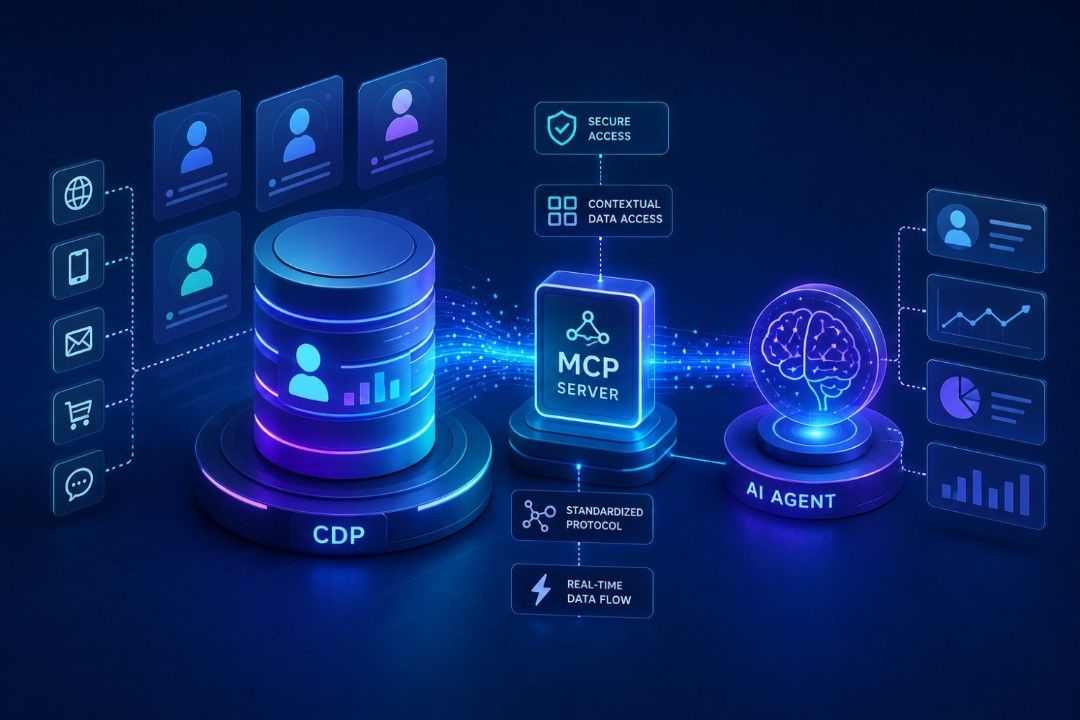
If you’ve spent any time in marketing-data circles this year, you’ve run into two acronyms colliding: CDP (Customer Data Platform) and MCP (Model Context Protocol). Put them together, and you get a phrase that’s spreading fast: “agentic CDP.” But the term is often used more as a marketing label than as an actual architectural description. That skepticism is understandable. According to Gartner, only 17% of marketers achieve high utilization from their Customer Data Platforms (CDPs), leading many enterprises to question whether traditional platforms truly deliver on their promises. As organizations look to unlock more value from their customer data, integrating AI agents through standards like MCP is emerging as the next step in the evolution. Here’s what an agentic CDP means in practice, how the pieces fit together, and what separates a real implementation from a rebrand.
Table of Contents
- The Acronym Soup, Defined
- A Brief Timeline of MCP Adoption
- Why CDPs Are a Natural Fit for This Pattern
- How an MCP Server Actually Works, in Plain English
- What an Agentic CDP Looks Like in Practice
- Security and Governance Considerations for Agentic CDPs
- Total Cost of Ownership: Buying an Agentic CDP vs. Building One
- What to Evaluate in an Agentic CDP Before You Rely On It
- Where This Category Is Headed
The Acronym Soup, Defined
- CDP (customer data platform): software that unifies first-party customer data, behavioral, transactional, and identity into a single, addressable profile.
- LLM (large language model): the engine behind ChatGPT, Claude, and Copilot, capable of understanding and generating natural language.
- MCP (Model Context Protocol): an open standard, introduced by Anthropic in late 2024, that defines how an LLM connects to external tools and data sources in a structured, secure way.
- Agent: an LLM that doesn’t just answer a question but can take multi-step actions, call a tool, evaluate the result, call another tool, to get to an answer or complete a task.
An ‘agentic CDP’ is what you get when a customer data platform exposes its data to an LLM through an MCP server, so a marketer can ask the CDP a question in plain English instead of building a dashboard or filing a request with a data team. Anthropic’s original announcement of MCP is worth reading directly if you want the underlying rationale; it was framed as a fix for the M-by-N integration problem, where every AI application previously needed a custom connector for every data source.
A Brief Timeline of MCP Adoption
It’s worth noting how quickly this moved, because it explains why ‘agentic CDP’ as a category label barely existed eighteen months ago. Anthropic released MCP as an open standard in November 2024. Within months, other major model providers, including OpenAI and Google DeepMind, had announced support for the same protocol rather than building competing standards, which is unusual in a market that typically fragments around proprietary integrations. By 2026, MCP had been donated to the Linux Foundation’s Agentic AI Foundation, cementing it as neutral, vendor-independent infrastructure rather than a single company’s product.
That timeline matters for buyers because it means the underlying protocol risk, the fear that you’d standardize on a connector format that gets abandoned in two years, has largely been retired. What’s still very much in flux is what sits on the other side of that protocol: how complete the data is, how it’s governed, and whether the vendor built it as a first-class capability or added it as a checkbox feature to keep pace with competitors.
Why CDPs Are a Natural Fit for This Pattern
The whole point of a CDP is that it has already done the hard part: stitching fragmented, cross-device, cross-channel data into a single customer view. The CDP Institute’s working definition of the category centers on exactly this, software responsible for maintaining a persistent, unified customer record that other systems can build on. That resolved, structured foundation is exactly what an LLM needs to give a reliable answer. Without it, an agent is reasoning over raw, disconnected event logs and guessing at identity, which is where most ‘chat with your data’ tools fall apart in practice.
How an MCP Server Actually Works, in Plain English
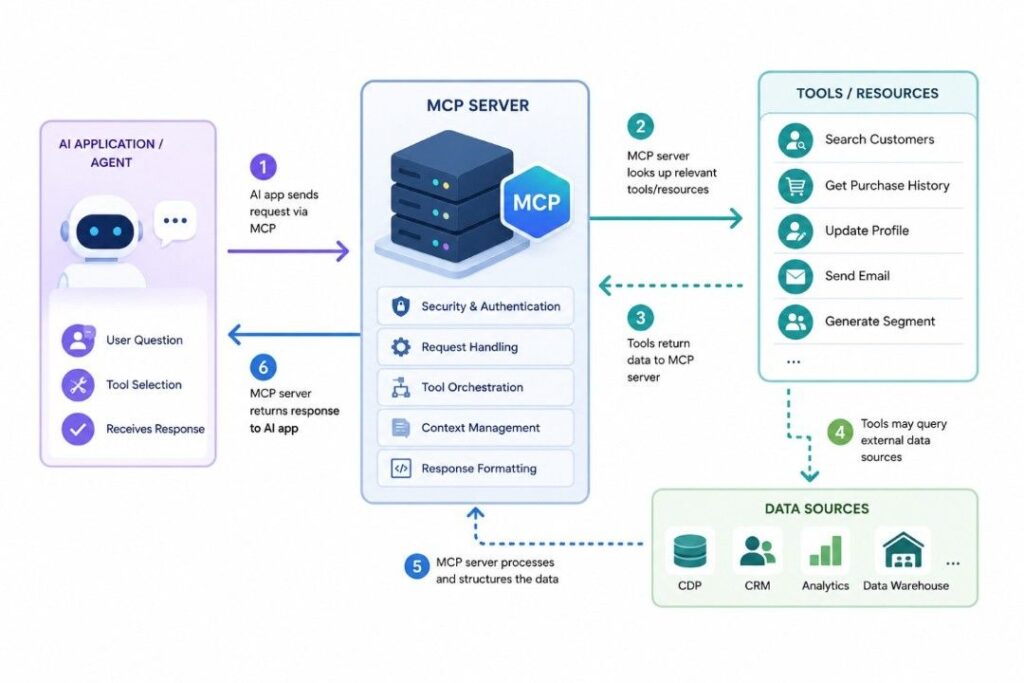
An MCP server doesn’t hand an LLM raw database access. Instead, it exposes a defined set of ‘tools,’ specific, named functions the model is allowed to call, each with a fixed schema. When a marketer asks ‘what was our conversion rate from paid social last week,’ the LLM doesn’t write its own SQL from scratch; it matches the question to the right tool, the tool runs a parameterized, read-only query against live data, and the result comes back with the numbers sourced and visible.
This matters for two reasons. First, it’s auditable; you can see exactly which query produced which answer, and re-run it. Second, it’s safer: the model can’t wander outside the tools it’s been given, which is the difference between a governed analytics layer and an LLM improvising against your production database.
There’s a useful analogy here to how APIs replaced screen-scraping in the early web. Before APIs were standard, an application that needed data from another service would often simulate a user clicking through a website and parse the resulting HTML, brittle, unauditable, and prone to breaking the moment the source site changed its layout. APIs replaced that with a defined contract: specific endpoints, specific parameters, specific response formats. MCP is doing the same thing for LLM-to-data connections that APIs did for application-to-application connections, replacing ad hoc prompting-and-scraping patterns with a defined, versioned contract.
What an Agentic CDP Looks Like in Practice
Instead of a marketer switching between four dashboards, they open the AI client their team already uses, Claude, Copilot, or ChatGPT, and ask a question directly. Celebrus AI’s MCP Server is one current example of this pattern: the platform exposes marketing and fraud data through a standard MCP Server, so the AI client picks the right tool from the underlying data model, acquisition, engagement, funnels, identity, and so on, and returns an answer grounded in the same live, identity-resolved behavioral data that powers the rest of the platform, rather than a separate, narrower export built just for the chatbot.
Security and Governance Considerations for Agentic CDPs
Handing an LLM the ability to query customer data, even through a governed MCP layer, raises legitimate questions that CTOs and CISOs are right to push on before signing off. A few worth asking explicitly during procurement:
- Does the MCP server enforce the same role-based access controls as the rest of the platform, or is it a separate permission model that could accidentally expose data a given user shouldn’t see?
- Is there an audit log of every question asked and every query run, so a compliance team can reconstruct what an agent accessed and why?
- Does the data leave your environment during a query, or does the model call back into infrastructure you control? This matters enormously for regulated industries like banking, insurance, and healthcare.
- Can prompt injection, a malicious or malformed input designed to trick the model into calling a tool it shouldn’t, actually succeed against the specific tool schema, or does the schema validation reject anything that doesn’t match an expected shape?
The reassuring part of the MCP architecture, when implemented properly, is that most of these risks are mitigated by design rather than by policy. A tool-based, schema-validated interface is structurally harder to misuse than a raw natural-language-to-SQL translator, because the space of things the model is even allowed to attempt is bounded in advance.
Total Cost of Ownership: Buying an Agentic CDP vs. Building One
Some enterprise data teams look at MCP’s openness and reasonably ask whether they should just build their own agentic layer on top of their existing warehouse rather than buying a platform that already has one. It’s a fair question, and the honest answer is that it depends on what you’re actually trying to save.
Building an MCP server yourself is genuinely not that hard for a narrow use case: a handful of well-defined tools against clean, already-modeled tables. Where the cost balloons is in everything adjacent to the tools themselves: identity resolution across anonymous and authenticated sessions, real-time data capture that doesn’t depend on tags, role-based access control that mirrors your existing governance model, an audit trail that satisfies a compliance review, and ongoing maintenance as your schema evolves. Most of that work has nothing to do with MCP specifically; it’s the same data engineering lift that would be required to support any analytics surface, and a homegrown MCP layer inherits every gap already present in the underlying data.
The practical comparison, then, isn’t really ‘buy an agentic CDP versus build an MCP server.’ It’s ‘buy a data platform that already solves identity resolution and real-time capture versus build both the data foundation and the conversational layer on top of it yourself.’ Framed that way, the calculation usually comes down to how much of that underlying data work your team has already done, and how much appetite there is to own it going forward.
What to Evaluate in an Agentic CDP Before You Rely On It
- Is the data behind the MCP tools live, or a batch export refreshed on a schedule?
- Does identity resolution cover anonymous and pre-login activity, or only logged-in users?
- Are the MCP tools schema-validated and permissioned by role, or is access all-or-nothing?
- Can you bring your own LLM, or are you locked into one vendor’s model?
- Does the answer reconcile with the platform’s other analytics surfaces (dashboards, BI), or can the chat layer and the dashboard disagree?
- Is there an audit trail sufficient to satisfy your compliance or security review process?
Where This Category Is Headed
MCP adoption moved unusually fast for an open standard; most major LLM providers support it, and enterprise data vendors are racing to expose their platforms through it. That’s good for buyers in theory, but it also means ‘MCP-enabled’ is quickly becoming a checkbox claim rather than a differentiator. The real question isn’t whether a CDP has an MCP server; most will soon. It’s what’s on the other side of that server: how complete the identity resolution is, how current the data actually is, and whether the answers it hands back are ones you’d be comfortable acting on without double-checking them in a dashboard first.
Expect the next round of differentiation to happen at the governance layer rather than the connectivity layer. Once every vendor can plausibly claim MCP support, the platforms that separate themselves will be the ones that can show a clean audit trail, a role-based permission model that actually holds up under a security review, and a data foundation complete enough that the agent’s answers don’t quietly diverge from what the rest of the organization sees in its dashboards.