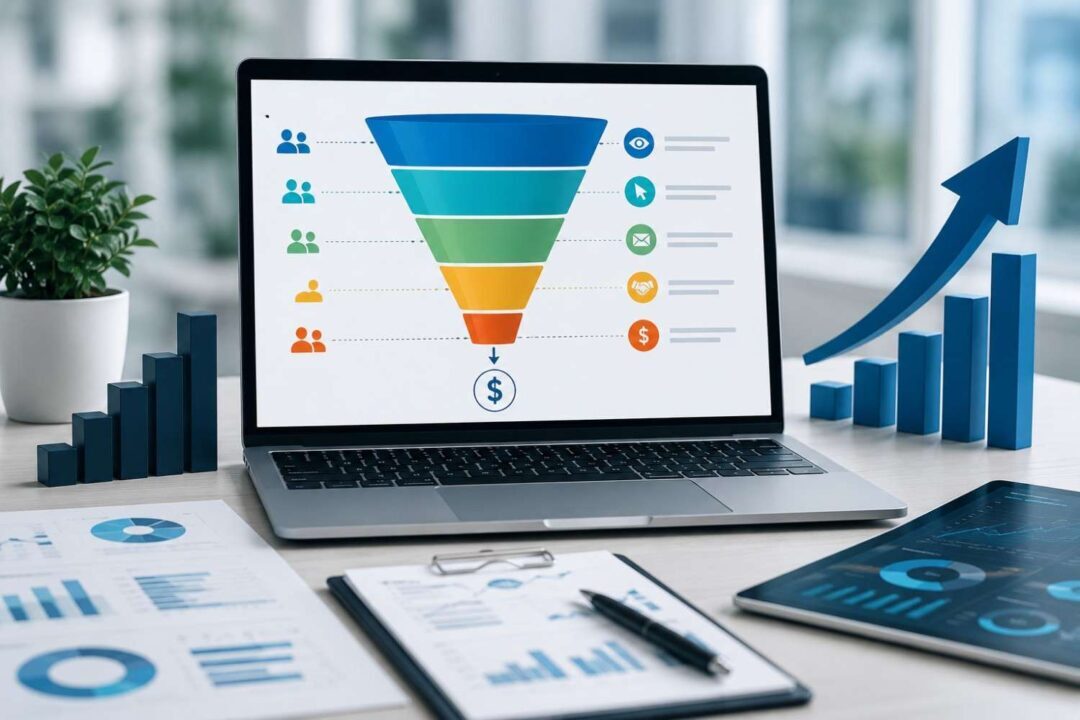
If you’re managing go-to-market strategy, you already know that funnel performance directly impacts your bottom line. But here’s the thing that keeps me up at night: most organizations treat funnel building like a one-time project. Launch it, set it and forget it. That’s not how this works.
There’s a difference between having a funnel and having one that’s actually optimized for your business model. And honestly, the gap between mediocre and great funnels comes down to whether you’re paying attention to the data.
Table of contents
Understanding Funnel Metrics Beyond Surface-Level Conversion
Let’s talk about what actually matters. When you look at your funnel, you’re probably tracking conversion rate. That’s fine. But here’s where people get stuck: conversion rate alone doesn’t tell you where your real bottlenecks are. It’s like looking at your car’s fuel gauge when the engine is making a weird noise. You’re looking at the wrong thing.
Break down conversion rates by stage. Seriously. Not everyone who lands on your page enters the funnel. Not everyone who enters moves to the next stage. Some people ghost after the first email. Others disappear after seeing the price. Each of those drop-off points tells you something different.
Here’s what you need to be tracking:
Stage-specific conversion rates. This matters way more than your overall conversion rate. Imagine a mid-market SaaS company with a two percent overall conversion rate. When they broke it down by stage, they found their landing page was actually converting at five percent. But only thirty percent of those people were opening the second email. That’s where the real problem was. Not the landing page. The email sequence.
Time to conversion. How long does it actually take someone to move from awareness to purchase? SaaS companies see longer cycles than ecommerce. You need to know your baseline. A typical B2B SaaS company might see a forty-five to sixty-day sales cycle. An ecommerce brand might see three to seven days. If your cycle is way longer than industry average, something’s broken.
Drop-off analysis. This is the real goldmine. Where exactly are people leaving? After the landing page? And after the first email? They see the price tag? Each answer points to a different problem. We’ve seen scenarios where companies discover that forty percent of prospects drop off right after they’re asked to enter their company size. That single form field was killing conversion. Remove it, move it to a later stage, or make it optional, and suddenly the funnel breathes again.
Cohort analysis. Users acquired in January convert differently than users acquired in June. Users from paid ads convert differently than organic traffic. Track them separately. You’ll spot patterns you’d otherwise miss. A common pattern we see: organic traffic converts at higher rates but takes longer. Paid traffic converts faster but at lower rates. That’s useful information for your CAC calculations.
Cost per acquisition by stage. Everyone talks about overall CAC. But you need to know how much you’re spending to move someone through each stage. That’s where the real optimization happens. If you’re spending five dollars to get someone to your landing page but one hundred dollars to get them to book a demo, that’s a problem worth solving.
Funnel Architecture for Different Business Models
Okay, so here’s what trips people up. They think all funnels should look the same. They don’t. Not even close.
Self-serve models like Slack or Dropbox need a completely different approach than enterprise sales. With self-serve, you’re optimizing for speed and frictionless onboarding. Get people to experience core value fast. That’s the whole game. Slack’s funnel is basically: sign up, create a workspace, invite a team member, send a message. Four steps. They could add more friction, but they don’t.
Mid-market SaaS is this weird hybrid. You need self-serve for initial engagement, but also a sales component for bigger deals. Your funnel has to identify which prospects are ready for a conversation with an actual human. That routing decision is critical. Think about it like this: a startup founder signing up for project management software might just need a free trial. A manager at a 500-person company needs to talk to sales. Same product, completely different funnel paths.
Enterprise sales? Totally different beast. You’re not trying to convert everyone. You’re trying to find the right accounts, engage the right stakeholders, move deals through a messy process. Your funnel is less about conversion rate and more about lead scoring and routing. According to research from Forrester, enterprise B2B deals involve an average of five to seven decision-makers. Your funnel has to account for that complexity.
Most teams mess this up by applying one template everywhere. Your funnel architecture should match your business model, not the other way around. I see this mistake constantly.
Optimization Through Testing and Data Analysis
Here’s the thing that separates good teams from great teams: they actually test stuff. Most organizations build a funnel, launch it, and then ghost it. But funnels decay. User behavior changes. Market conditions shift. What worked six months ago might be killing your conversion rate today.
You need a structured testing framework. Start with your biggest bottleneck. If you’re losing fifty percent of visitors after the landing page, that’s where you focus first. Not the email sequence. Not the checkout page. The landing page.
Test one variable at a time. Headline. Value proposition. Form fields. Call-to-action placement. Change one thing, measure it, move on. Here’s a realistic scenario: a B2B software company tests their landing page headline. Current headline: “Project management software for teams.” They test against: “Ship projects forty percent faster.” The second one wins. Conversion goes from 2.1% to 3.4%. That’s a sixty percent improvement from one variable. That’s why testing matters.
According to Conversion Rate Experts, average landing page conversion sits between two and three percent across industries. But the top performers in your space? They’re doing better. A study by HubSpot found that top-performing B2B landing pages convert at five to eight percent. That gap between average and top performer is where your optimization focus should be.
A/B Testing:
Here’s what people get wrong about A/B testing: they declare winners too fast. You need statistical significance. A small improvement that’s not statistically significant is just noise. Run tests long enough to get at least one hundred conversions in each variation. I know that sounds like a lot, but it matters.
Once you have decent traffic, multivariate testing becomes interesting. Test multiple variables at the same time. See how they interact. But don’t start there. Master single-variable testing first. We’ve seen companies jump to multivariate testing with low traffic volumes and end up with meaningless results because they didn’t have enough data to reach statistical significance.
For businesses looking to implement modern funnel strategies at scale, exploring current tools becomes critical. Here’s a detailed breakdown on ai-powered funnel builder tools that can support testing and optimization without needing a massive engineering team.
Building for Scale and Maintainability
As your funnel grows, you need systems. Documentation. Clear ownership. Regular audits. Otherwise it becomes this black box that nobody understands.
Document your funnel logic. Why did you choose that specific headline? What was the rationale behind that email sequence? When people leave or you need updates, documentation saves you from starting from scratch. A realistic scenario: you hire a new marketing manager. Without documentation, they spend two weeks reverse-engineering why certain decisions were made. With documentation, they’re productive in two days.
Establish clear ownership. Someone needs to monitor performance, run tests, make decisions. Without that, funnels just drift. Performance decays. Nothing gets fixed. We’ve seen companies where marketing owns the landing page, sales owns the demo request process, and customer success owns the onboarding funnel. Nobody owns the overall conversion journey. That’s a recipe for suboptimal performance.
Quarterly audits. Look at conversion rates by stage. Identify new bottlenecks. Check whether your assumptions from six months ago still hold up. They probably don’t. Markets change. Competitors launch new offerings. Your messaging needs to evolve.
Build feedback loops with actual people. Talk to customers who didn’t convert. Ask to your sales team about objections they’re hearing. Talk to support about what questions new customers have. This qualitative data informs your quantitative testing. You need both. A SaaS company we know about discovered through sales team feedback that prospects were confused about pricing. They were losing deals in the discovery call because people didn’t understand the value proposition. They updated their landing page copy to address that confusion. Conversion went up. Data alone wouldn’t have caught that.
Integration With Revenue Operations
Your funnel doesn’t exist in a vacuum. It connects to your CRM, your email platform, your analytics system, your sales team’s workflow. All of it.
Lead scoring is where this gets real. Not every lead is ready for sales. You need a system that identifies which ones are qualified and routes them accordingly. This requires actual alignment between marketing and sales on what qualified looks like. Good luck with that conversation, by the way. But seriously, misalignment here kills funnels. Marketing thinks a qualified lead is anyone who downloaded a guide. Sales thinks it’s someone who scheduled a demo. You need to define it together.
Research from Marketo found that companies with aligned sales and marketing teams achieve twenty percent annual revenue growth compared to four percent for misaligned teams. That’s not small. That’s the difference between scaling and stagnating.
Data Quality:
Data quality matters more than people realize. Bad data in your CRM leads to bad lead scoring, which leads to sales teams wasting time on garbage leads, which tanks conversion rates and kills your revenue forecast. A realistic scenario: your lead scoring model says a prospect is qualified because they visited the pricing page three times and opened five emails. But they’re actually a competitor doing research. Your sales team wastes hours on a deal that was never real. That’s what bad data does.
Your funnel metrics should feed into revenue forecasting. If you know your sales cycle length, your conversion rate by stage, and your deal size, you can forecast revenue with reasonable accuracy. That becomes your planning tool for hiring, budgeting, and growth strategy. A B2B SaaS company with a sixty-day sales cycle, a two percent conversion rate, and a fifty-thousand-dollar average deal size can forecast that it needs one thousand qualified leads per month to hit a six-million-dollar monthly revenue target. That math drives everything: how much to spend on ads, how many sales reps to hire, and when to expand into new markets. The importance of accurate funnel forecasting continues to grow as digital channels play a larger role in business growth. McKinsey research found that more than one-third of B2B revenue now flows through digital channels, making it increasingly important for organizations to measure and optimize funnel performance across every stage of the customer journey. Businesses that combine funnel analytics with revenue operations are better positioned to make informed strategic decisions and allocate resources effectively.
The Bottom Line
Funnel building isn’t a project. It’s ongoing work. The organizations that actually win treat their funnel as a system to be continuously measured, tested, and refined.
Start by understanding your current performance. Find your biggest bottleneck. Run a structured test. Measure results. Move to the next bottleneck.
This compounds over time. A ten percent improvement at each stage adds up to significant revenue impact. That’s where real growth comes from. Not from some magic tactic. From consistent, boring, data-driven optimization.