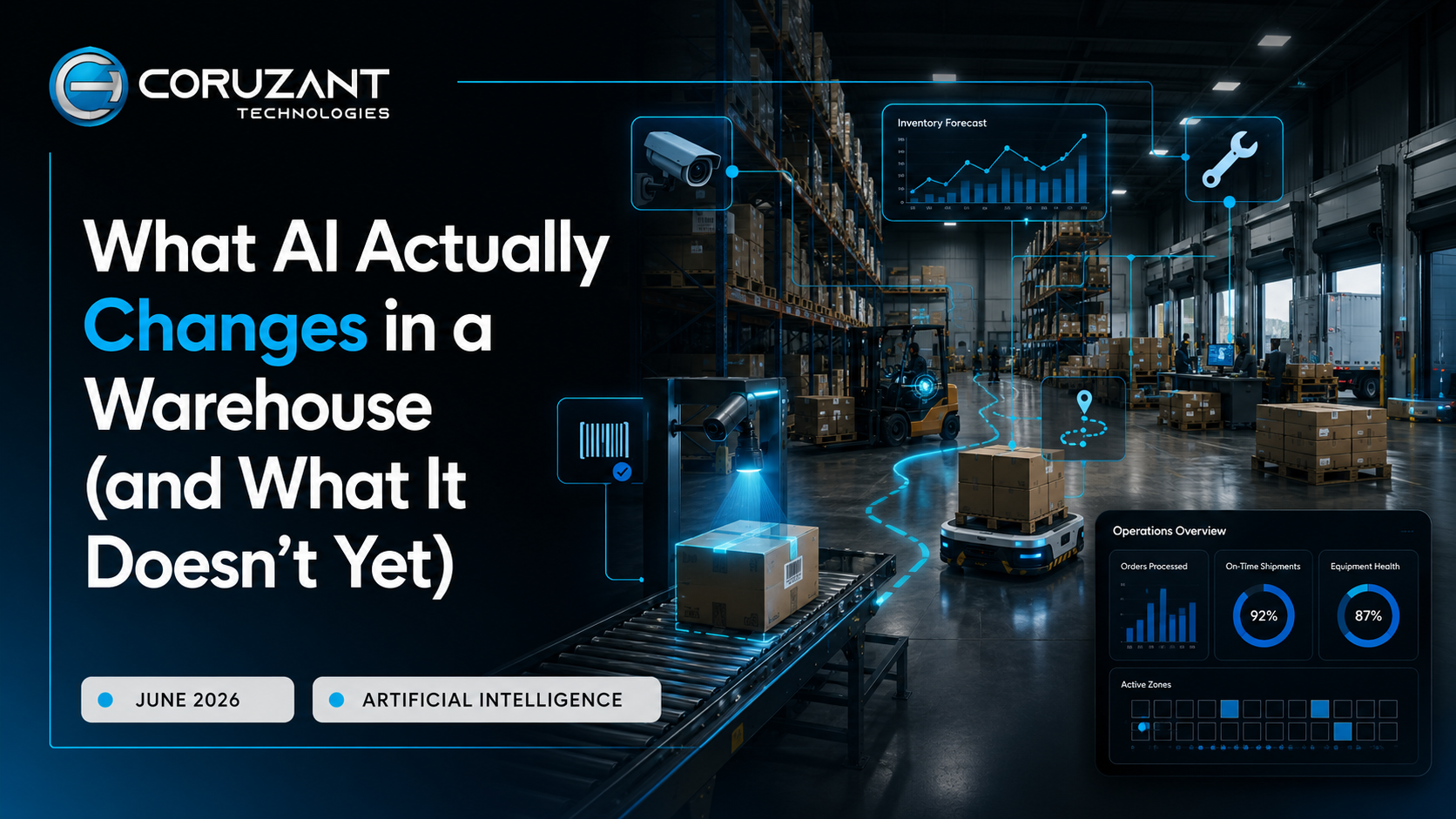
AI in logistics is having its hype moment. Open any vendor deck and you will be promised an autonomous, self-running warehouse that thinks for itself. Having spent real time inside fulfillment, I find the truth more interesting than the pitch.
AI is genuinely changing some parts of warehouse work, leaving others almost untouched, and the line between the two is worth understanding before you sign for the demo you just watched. Here is where the technology already earns its keep, and where “AI-powered” is still mostly a sticker on the box.
Key Takeaways
- AI in logistics excels at demand forecasting and inventory positioning, providing the highest return on investment.
- Optimization, such as slotting algorithms and pick-path logic, also offers significant benefits in warehouse efficiency.
- AI can effectively notice anomalies, flagging issues like inventory discrepancies and damaged goods before they escalate.
- However, the dream of fully autonomous warehouses is still unrealistic due to the complexity of real-world tasks.
- Successful AI implementation builds on well-organized operations; it cannot rectify chaotic systems.
Table of contents
Start With Where AI Is Already Winning
The highest-return use of AI in logistics is not a robot. It is a forecast. Machine learning models read seasonality, trend, promotions, supplier lead times, and a dozen other signals far better than the spreadsheet heuristics they replace, and they sharpen as data accumulates. Getting the right inventory into the right location before the orders arrive is the single most valuable thing AI does in this industry, and it happens entirely in software, before a single box is touched. If you adopt only one form of AI, make it demand forecasting and inventory positioning.
Optimization Is the Other Real Win
The second genuine win of AI in logistics is optimization, and it is gloriously unglamorous. Slotting algorithms decide where each SKU should live so that the fastest-moving items are the easiest to reach. Pick-path logic decides how a worker should walk the floor to touch the most orders with the fewest steps. Walking is the most expensive thing that happens in a warehouse, and quietly shaving it down, order after order, compounds into real money. Add volume and labor planning, predicting next week’s order curve by the hour so you staff to reality instead of to a guess, and you have the unglamorous core of where AI pays for itself.
AI Is Quietly Good at Noticing
There is a third category that gets less attention than it deserves: noticing. Machine learning is very good at flagging the thing that does not fit. An inventory count that has quietly drifted from the system. An order that pattern-matches to fraud. A SKU suddenly selling ten times its normal rate. Computer vision is maturing fast here too, dimensioning packages, flagging damage, and counting stock with less human effort. None of this is glamorous, but catching an exception early is worth far more than it sounds, because the alternative is finding it three steps downstream when it is expensive to fix.
Now the Part of AI in Logistics the Demos Skip
Here is where the pitch and the reality part ways. The dream of a robot that can reach into any bin and grab any item is, for the diverse catalog of real ecommerce, still mostly a dream. Robots are spectacular at structured, repetitive, predictable tasks. They struggle with infinite variety, a catalog where the next pick might be a paperback, then a kettlebell, then a bag of marshmallows. General-purpose piece-picking works in narrow, constrained niches today, not as a universal replacement for human hands. The fully autonomous, lights-out warehouse is real only where the SKU set is small and uniform. For most ecommerce, people and machines still split the work, and will for a while.
The Physical World Breaks the Magic
The deeper reason is something roboticists named decades ago, a principle often called the Moravec paradox: the things that are effortless for people, like recognizing a crushed box or improvising when an item is not where it should be, are precisely the things machines find hardest. Software comfortably handles the ninety-five percent of cases it has seen before.
The other five percent, the damaged item, the return that does not match the manifest, the SKU that showed up in the wrong packaging, still needs a human, and that five percent is where operations actually live or die. Agentic AI is promising against this long tail, but it is brittle the moment atoms stop behaving like data. It needs guardrails and a person in the loop, not blind trust.
The Unsexy Prerequisite Nobody Sells You
The hardest truth for buyers is that AI amplifies a well-run operation; it does not rescue a chaotic one. Feed a model messy SKU data, inaccurate inventory, and inconsistent processes, and it will hand you confident, expensive nonsense. The biggest gains attributed to AI very often come from the boring work that has to happen first: cleaning the data, getting counts accurate, making processes consistent. For enterprises operating on fragmented infrastructure, this baseline preparation typically requires targeted legacy system modernization services to dismantle data silos and ensure old core software can actually feed an intelligent model. The model is the last mile, not the first. The teams that get value buy it after they have earned the data, not as a substitute for doing so.
How to Tell Real From Hype When You Are Buying
If you are an operator or an investor trying to read a logistics AI pitch, a few questions cut through fast. What, specifically, does the model predict or decide, and against what baseline, what happens at the exceptions, and who handles them, and what data does it require, and is yours clean enough to feed it. And be quietly skeptical of any “fully autonomous” claim aimed at a high-variety catalog. Those of us who run an ecommerce fulfillment operation learn to love the vendors who answer those questions plainly, and to distrust the ones who change the subject back to the robot.
AI is changing the warehouse, but as a decision layer laid over a working operation, not as a replacement for it. The companies pulling ahead are not the ones chasing the autonomous-warehouse video. They are the ones using AI in logistics to forecast better, optimize harder, and catch problems sooner, on top of a floor that was already well run. Understand which half of the pitch is real, and you will spend your money and your attention on the things that actually move the operation.