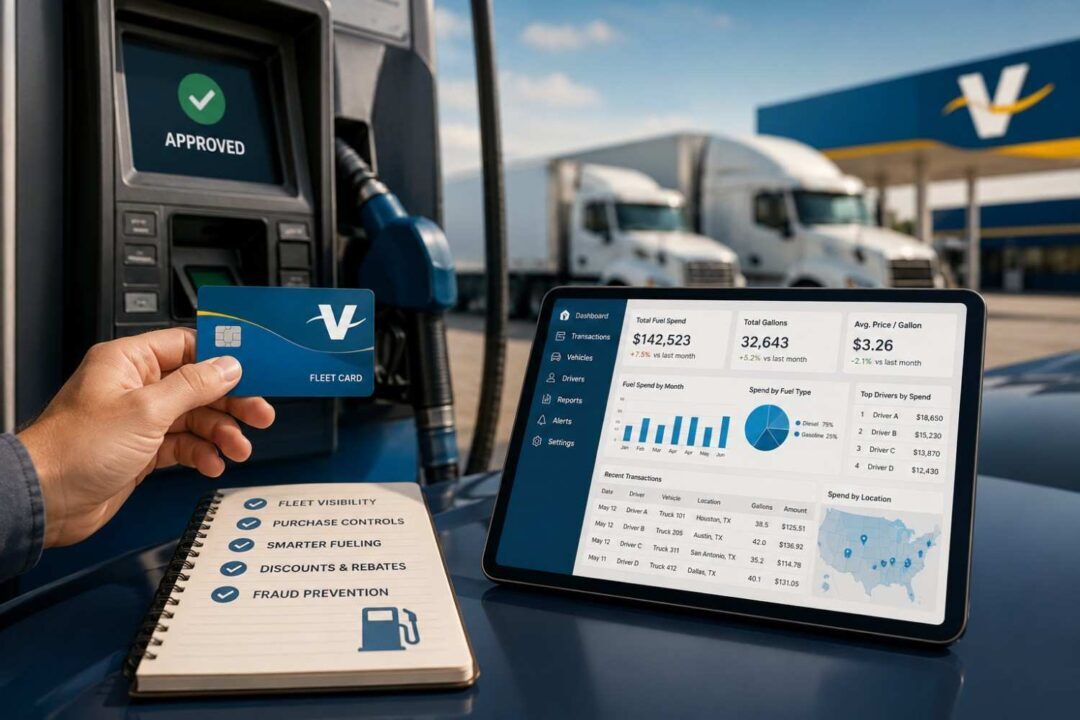
Administrative teams at fleet-dependent businesses spend hours each month chasing receipts, reconciling credit card statements, and manually entering fuel transactions into spreadsheets. That back-office workload costs real money in labor and delays, and it produces reports riddled with gaps and errors. Valero fleet card management tools eliminate most of that manual work by automating transaction capture, organizing expenses by driver and vehicle, and generating reports that are ready for review the moment a purchase clears.
This shift toward automation is reshaping the industry. The global fuel card market reached $1.62 billion in 2024 and is projected to hit $3.1 billion by 2034, according to Fact.MR. Businesses are investing in these solutions because they reduce fuel costs through a combination of purchase controls, reporting visibility, and negotiated discounts that manual processes simply cannot match.
Table of contents
How Fleet Visibility Exposes Hidden Waste
Reducing fuel costs starts with knowing exactly where the money goes. General-purpose credit cards produce monthly statements that show totals, but they lack the transaction-level detail needed to identify specific inefficiencies. Fleet card programs solve this by capturing structured data at every fueling event.
Over 90% of fleet cards in the United States require drivers to enter fleet-related data at the pump, including odometer readings, driver ID codes, and vehicle identification numbers, according to a Visa fleet card innovation study. That data feeds directly into a centralized tracking dashboard where managers can filter expenses by driver, vehicle, route, or time period. Many providers also offer advanced management platforms, including Valero fleet card management tools, that help businesses monitor purchasing activity, enforce spending controls, and generate detailed fuel usage reports across an entire fleet.
This monitoring capability reveals the kind of waste that stays invisible in aggregate reports. One driver might refuel daily on a route that only requires every-other-day stops. Another might consistently choose stations with above-average pricing when a cheaper approved location sits two minutes away. A third might show gallons-per-mile figures that point to excessive idling or a vehicle in need of maintenance. Each of these patterns represents an opportunity to optimize spending, but only if the reporting system makes them visible.
Setting Purchase Limits That Prevent Overspending
Purchase controls are the most direct way to reduce fuel costs because they stop unauthorized spending before it occurs. Fleet card programs let managers define rules at the individual card level: daily gallon caps, per-transaction dollar limits, fuel-type restrictions, approved station networks, and allowed hours of use.
These limits turn every fuel purchase into a structured, rule-governed transaction. If a driver attempts to buy premium fuel when only regular is approved, the card declines the transaction at the pump. If a purchase exceeds the daily gallon cap, the card blocks the sale. This kind of automated enforcement removes the need for managers to review every receipt and catch problems after the fact.
Fuel accounts for more than 49% of commercial fleet operational expenses, based on data cited by Market Growth Reports. When nearly half of a fleet’s operating budget flows through fuel transactions, even small improvements in purchase discipline create meaningful savings. A fleet spending $3.30 per gallon across 50 vehicles can recover thousands of dollars annually just by tightening gallon limits and restricting fuel grade selections.
Station Network Strategy for Smarter Fueling
Where drivers fuel directly affects what a fleet pays per gallon. Regional price differences in 2024 were significant: the Gulf Coast averaged $2.89 per gallon while the West Coast reached $4.18 per gallon, based on EIA data. For fleets operating across multiple states, routing drivers to lower-cost stations within the approved network produces immediate savings.
Closed-loop fleet cards, which restrict transactions to a single brand’s stations, offer the deepest per-gallon discounts. These cards held the largest market share by card type in 2024 because the combination of negotiated pricing and tight security makes them effective for cost-focused fleet operators. Drivers who fuel at approved locations along their regular routes avoid detours, which saves time and reduces unnecessary mileage.
Dual-network cards provide broader access for fleets with dispersed routes. These programs are growing fastest in the fleet card market because they balance discount availability with the convenience of fueling at multiple branded stations across a wider geographic area. For businesses expanding into new service territories, that flexibility keeps drivers on schedule without sacrificing cost controls.
Discounts and Rebate Structures That Compound Savings
Per-gallon discounts at participating stations lower the base cost of every fill-up. For a fleet purchasing 10,000 gallons per month, even a five-cent-per-gallon discount saves $500 monthly and $6,000 over a full year. Many card programs also include tiered rebate structures that deepen the savings as monthly volume increases.
Fleet managers who implement structured card programs with proper communication and oversight report fuel consumption reductions of 5% to 15%, according to Shell Fleet Solutions. Those gains come from the combined effect of negotiated discounts, waste elimination through purchase limits, and behavior changes driven by monitoring.
The truck fleet operator segment is projected to reach $2.26 billion by 2034, based on Fact.MR projections. That growth signals strong demand from businesses that understand how dedicated fleet card programs deliver sustained cost reduction. The rebates and discounts embedded in these programs are not one-time gains. They are recurring savings that compound in value as the fleet grows and monthly fuel volume increases.
Fraud Prevention Through Layered Security
Unauthorized fuel spending is a persistent threat. Common fraud patterns include drivers sharing cards with people outside the fleet, pumping fuel into personal vehicles, purchasing convenience store items on the company account, and fueling outside approved hours. Without automated detection, these transactions blend into normal activity and go unnoticed for weeks.
Fleet card programs address fraud through real-time transaction alerts that flag purchases outside normal parameters. A card used at 2:00 a.m. when the driver is not scheduled, a fill-up at an unapproved station, or a transaction that exceeds daily limits all trigger immediate notifications to fleet management.
This layered approach to security creates accountability at every level. Drivers know their fueling behavior is tracked. Managers receive alerts when something looks wrong. The audit trail provides documentation for follow-up conversations or formal reviews. Together, these features protect fleet budgets and keep fuel expenses aligned with approved spending levels.
Putting It All Together for Sustained Fuel Cost Reduction
Reducing fuel costs is not a single action. It is a combination of visibility, controls, network strategy, discounts, and security working together. Fleet card programs bundle all of these capabilities into a single platform, which is why businesses across industries are adopting them at an accelerating rate.
The commercial fleet fuel card market reached $11.25 billion in 2024, growing at 8.7% annually. That pace of adoption reflects a straightforward calculation: companies that implement fleet card solutions spend less on fuel, recover more from discounts and rebates, and gain the reporting access and efficiency needed to continuously optimize their operations.
For any business where fuel is a major line item, the right fleet card program delivers measurable, recurring savings that strengthen the bottom line year after year. Fuel cards turn a volatile, hard-to-manage expense category into a structured, data-driven process that improves with every billing cycle.