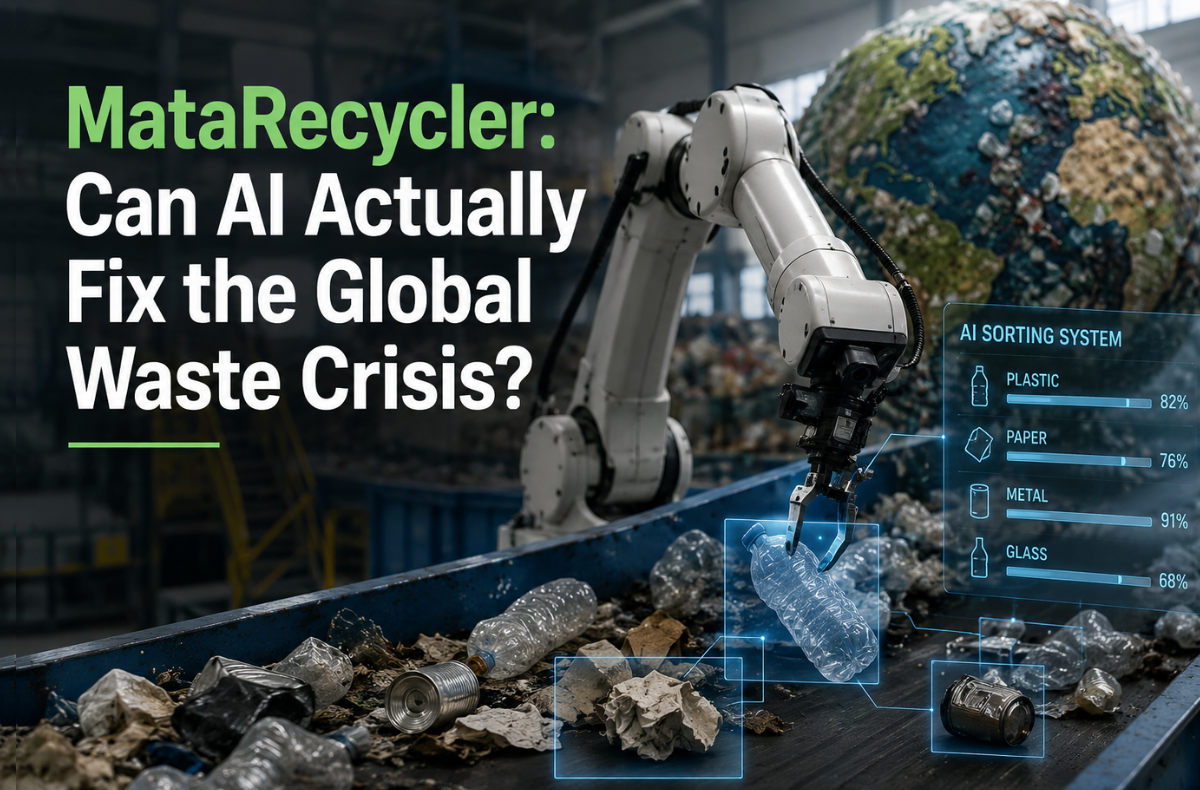
The world generates over 2.5 billion tonnes of solid waste each year, and according to the World Bank, that figure could climb to nearly 3.9 billion tonnes by 2050. In the United States, the EPA reports that only about 32% of the 292 million tons of waste produced annually gets recycled or composted; the rest goes to landfills or incinerators. MataRecycler has emerged in direct response to this gap, positioning itself as an AI-driven effort to make recycling smarter, faster, and far less wasteful.
Here’s the frustrating part. Manual sorting lines, confusing public guidance, and high contamination rates have left recycling infrastructure struggling to keep pace with modern waste volumes. Contamination in U.S. curbside programs ranges from 17% to 25%, according to The Recycling Partnership, meaning roughly one in every five items placed in a recycling bin actively damages the rest of the load. MataRecycler was built specifically to fix what those systems cannot.
This post breaks down exactly how the MataRecycler concept works, what the data say about its impact, and where smart waste management technology is headed next. You’ll get the real numbers and an honest look at the limits of AI in waste management.
Key Takeaways
- MataRecycler is an AI-driven smart waste management system that improves recycling accuracy and reduces contamination rates.
- It integrates AI-powered bins, IoT sensors, and a mobile app to provide real-time tracking and guidance for better recycling practices.
- MataRecycler shows accuracy rates of 95% to 98%, outperforming human sorters who average 85% to 90%.
- The system significantly cuts operational costs, with businesses reporting landfill cost reductions of 40% to 60%.
- MataRecycler addresses the global waste crisis by enhancing recycling infrastructure, but it also requires public engagement and investment to be fully effective.
Table of Contents
- What is MataRecycler and How Does It Work?
- Why Does Conventional Recycling Keep Failing?
- How Accurate is MataRecycler Compared to Human Sorting?
- What are the Main Advantages of MataRecycler?
- What Technology Powers MataRecycler?
- Where Has Smart Recycling Proven It Works?
- What are the Limits of AI in Waste Management?
- The Future of MataRecycler and Smart City Environmental Initiatives
- AI Can’t Fix the Waste Crisis Alone; But It Changes What’s Possible
- FAQs
What is MataRecycler and How Does It Work?
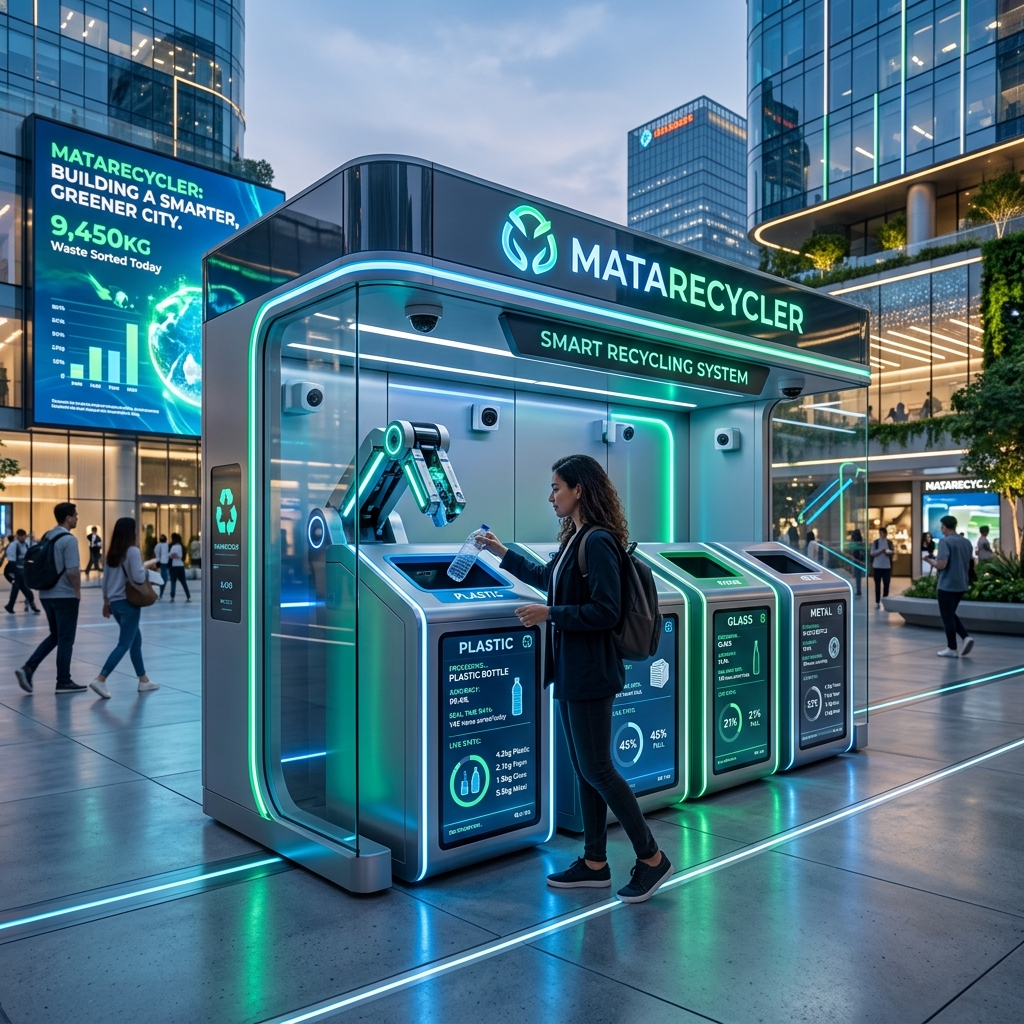
MataRecycler is a smart waste management concept that integrates AI-powered smart bins, IoT sensors, a mobile app, and cloud analytics into a system platform. Instead of relying only on human sorters, MataRecycler uses connected hardware and software to guide both households and municipalities toward cleaner recycling from the first moment waste is discarded.
The process is simple to follow:
- Scan. You drop an item into a MataRecycler smart bin. A high-resolution camera scans it in seconds.
- Identify. The AI classifies the material- plastic, paper, metal, glass, or electronics- based on shape, color, and texture.
- Route. The system directs the item to the correct stream and flags contamination before it spreads.
- Track. Smart Sensors monitor fill levels and send data to a cloud dashboard.
This automated material separation catches mistakes that the human eye misses, and it does so without fatigue. The MataRecycler concept provides the same guidance on your phone, so you can scan an item, see exactly where it goes, and track your recycling impact over time.
Why Does Conventional Recycling Keep Failing?
Traditional recycling depends on manual sorting and unclear rules. That combination creates three problems that drag down the whole system. Learning about Recycling Centers Near You can also make it easier to dispose of recyclable materials correctly and improve participation in local recycling programs.
High contamination rates. Contamination in US curbside programs ranges from 17% to 25%, according to The Recycling Partnership. Roughly one in five items placed in a recycling bin causes problems for the rest of the load. When contamination gets too high, the entire batch goes to landfill.
Inconsistent participation. A 2023 Recycling Partnership survey found that 94% of Americans say recycling is important to them. The barrier isn’t motivation; it’s confusion. People don’t know what goes where, and they stop trying when they suspect their effort doesn’t matter.
Inefficient collection. Waste collection eats up 20% to 30% of a city’s operational budget. Trucks run fixed routes whether bins are full or empty, burning fuel on half-empty pickups.
The single-stream recycling model made recycling easier for households but harder for facilities. Mixed materials are tougher to separate cleanly, and that’s exactly where tech-driven waste sorting changes the math.
Here is how MataRecycler compares to traditional recycling systems.
| Feature | Traditional Recycling | MataRecycler |
|---|---|---|
| Sorting accuracy | 85–90% (human) | 95–98% (AI) |
| Contamination rate | 17–25% | ~4% (post-AI pilot) |
| Data visibility | Minimal or none | Real-time dashboard |
| Collection scheduling | Fixed routes | Dynamic, fill-level driven |
| User guidance | Generic signage | Step-by-step app guidance |
| Cost trend | Rising landfill fees | 40–60% cost reduction reported |
| Self-improvement | None | Continuous machine learning |
Traditional recycling infrastructure reacts to problems. MataRecycler anticipates them. That fundamental difference between reactive and predictive waste management is what makes AI-powered recycling systems structurally superior at scale.
How Accurate is MataRecycler Compared to Human Sorting?
Machine learning sorting accuracy is the headline number, and it’s a big one. MataRecycler’s computer vision recycling systems achieve accuracy above 95%, with some setups reaching 98%. Human sorters average 85% to 90% on a good shift, and that drops as fatigue sets in and volume rises.
Here’s how the methods stack up:
| Sorting Method | Speed (picks per minute) | Accuracy |
|---|---|---|
| Human sorters | 30 to 40 | 85% to 90% |
| AMP Robotics AI system | Up to 80 per arm | Over 95% |
| Kefalonia RECLAIM facility | 120 | 98% |
A camera never gets tired. It doesn’t repeat the same mistake twice. And the machine learning engine improves with every cycle, adapting to new packaging shapes and seasonal shifts in waste composition. According to a January 2026 analysis by Market.us, computer vision now powers over 60% of the AI-powered recycling robot market.
What are the Main Advantages of MataRecycler?
The value of MataRecycler shows up in three measurable areas: cleaner materials, lower costs, and better data.
Reduced contamination and higher material quality
Clean sorting keeps recyclables valuable. A controlled pilot at a mid-sized material recovery facility (MRF) clearly demonstrated the difference. Manual sorting hit 88% correct classification with a 14% contamination rate. After an AI-assisted line was introduced, correct classification jumped to 96%, contamination in outbound bales dropped to 4%, and rejected bale volume fell by 68%.
Cleaner materials re-enter supply chains instead of heading to landfill. That’s the engine of circular-economy infrastructure where old aluminum becomes new aluminum, and glass returns as glass.
Lower operational costs
Smart sorting of operational costs favors automation in the long run. IoT fill-level sensors enable dynamic routing, which cuts collection truck frequency by 30% to 50%. Businesses adopting smart recycling programs report 40% to 60% reductions in landfill costs.
For cities facing budget pressure, those savings aren’t abstract. They free up money for other priorities.
Better data for sustainability reporting
MataRecycler logs every sorting decision. Real-time dashboards track recycling patterns, consumer participation in recycling, and operational efficiency. That visibility supports ESG reporting and helps businesses meet Extended Producer Responsibility (EPR) requirements now rolling out in states like Colorado and Oregon.
What Technology Powers MataRecycler?
Three technologies work together to make MataRecycler run.
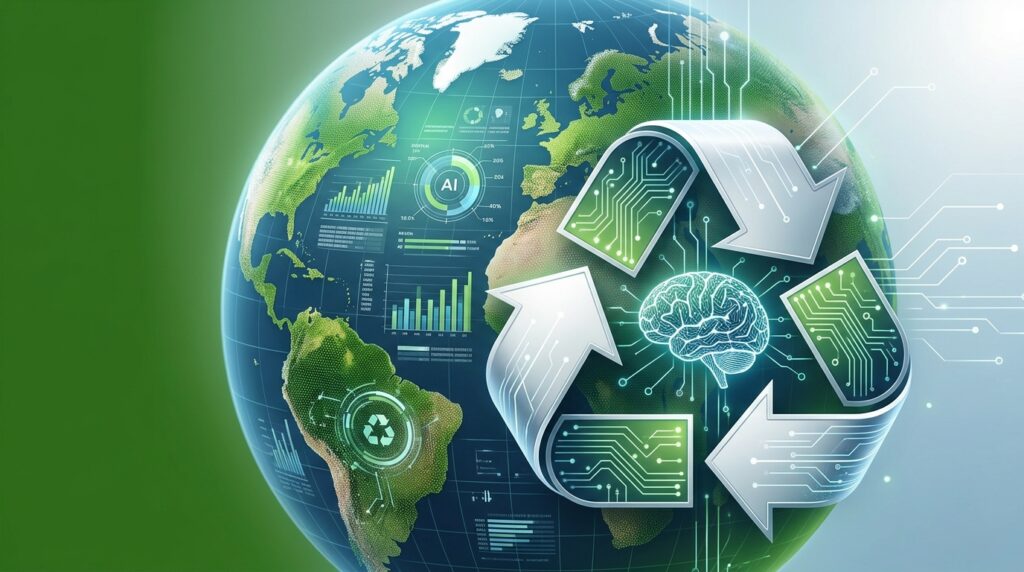
- Artificial intelligence. Computer vision identifies over 70 recyclable materials in milliseconds, classifying each by shape, color, and density.
- Internet of Things (IoT). Smart bin sensors monitor fill levels and bin conditions, then send alerts when collection is needed.
- Machine learning. The system learns from accumulated data, refining recognition over time and adapting to new materials and local habits.
Most technology depreciates as it ages. MataRecycler does the opposite: the longer it runs, the more accurate it gets.
Where Has Smart Recycling Proven It Works?
These aren’t lab experiments. Real facilities are running AI-powered recycling technology today.
On the Greek island of Kefalonia, an EU-funded project called RECLAIM deployed a portable AI recycling facility small enough to fit in a shipping container. It hit 98% classification accuracy at 120 picks per minute, even when tourist-season waste spiked by at least 60%.
In San Jose, California, the city reached a waste diversion rate above 80%, one of the highest among major US cities, partly by using technology to detect contamination. AMP Robotics, based in Colorado, runs AI-powered sorting systems that handle up to 80 picks per minute per arm at facilities across North America and Europe.
The environmental payoff adds up fast:
- A single AI recycling robot can divert up to 10 million items from landfills in one year.
- Recycling one tonne of paper saves about 17 trees and 7,000 gallons of water.
- Recycling aluminum uses 95% less energy than producing new metal from raw ore.
- Recycling and composting prevented roughly 186 million metric tonnes of CO2-equivalent emissions in the US in 2018 alone.
The World Economic Forum estimates the circular economy could create $4.5 trillion in economic value by 2030. Smart recycling systems are the physical infrastructure that makes that possible.
What are the Limits of AI in Waste Management?
Any honest look at MataRecycler has to name its limits. The technology is powerful, but it’s not a silver bullet.
Upfront infrastructure costs are real. Smart bins, AI hardware, connectivity, and system integration all require investment before savings materialize. For smaller cities and lower-income communities, that initial cost is a genuine barrier.
Behavior change still matters. Technology can’t fix human habits on its own. If residents toss wet food into dry recycling, even the best AI struggles. Public education and incentives need to work alongside the hardware.
Data privacy deserves attention. Sensor networks collect behavioral data at the community level. Who owns it, how it’s stored, and who can access it are fair questions that demand clear answers.
Digital access isn’t universal. An app-based system works best for smartphone users with reliable internet. In low-connectivity areas, that creates an equity gap.
So can AI fix the global waste crisis? On its own, no. But paired with participation, investment, and smart policy, MataRecycler moves the system closer to where it always should have been.
The Future of MataRecycler and Smart City Environmental Initiatives
The next phase of MataRecycler development focuses on deeper integration with smart city environmental initiatives and broader global deployment:
- Solar power integration at recycling facilities to reduce energy consumption and greenhouse gas emissions
- Predictive maintenance systems that alert staff to equipment issues before failures cause costly operational downtime
- Real-time smart city dashboards giving city managers instant visibility into facility processing data, collection schedules, and recycling performance across entire districts
- Expansion into emerging markets across Southeast Asia, Sub-Saharan Africa, and Latin America, where gaps between waste generated and waste properly managed are widest
The future of waste management also involves a feedback loop that doesn’t exist yet: using MataRecycler sorting data to inform packaging design decisions upstream. If data shows that specific material combinations consistently fail AI classification, manufacturers can redesign packaging during the development phase, preventing sorting failures before products ever reach consumers.
Pilot programs across Europe and Asia are already testing smart bin integration, adaptive collection routing, and data sharing with city managers. These are the foundational components of mature, citywide recycling technology innovation in practice.
AI Can’t Fix the Waste Crisis Alone; But It Changes What’s Possible
For decades, recycling improvement strategies focused on persuading individuals to sort better. The contamination rates prove that approach has limits. MataRecycler shifts the burden onto the infrastructure rather than the individual, using AI-powered recycling systems to deliver accuracy, consistency, and data transparency that no public education campaign can reliably achieve at scale.
The platform doesn’t solve everything. Upfront costs remain a real constraint. Behavior change still matters. Complex materials still challenge classification systems. But the direction is measurably right, and the results from Kefalonia, San Jose, and municipal pilot programs show that AI recycling accuracy rates above 95% translate directly into better outcomes for communities, cities, and the planet.
Global waste crisis solutions aren’t built from a single product or policy. They’re built from layered improvements across many points in the waste stream. MataRecycler addresses several of those points simultaneously, and it keeps getting better with each cycle it processes.
FAQs
MataRecycler is a smart recycling system that uses AI and sensors to automatically identify, sort, and track waste. It removes human error from the recycling process, so more materials actually get recycled rather than going to landfill.
MataRecycler reaches accuracy rates between 95% and 98%, compared to 85% to 90% for human sorters. The gap widens under the fatigue and time pressure of real facility conditions.
Yes. Companies using smart recycling programs typically report 40% to 60% reductions in landfill disposal costs, plus cleaner data for ESG sustainability reporting.
Yes. The MataRecycler app guides you on how to sort each item, tracks your recycling habits, and shows the environmental impact of what you’ve diverted from landfill.
Not on its own. MataRecycler dramatically improves sorting accuracy and cuts costs, but solving the crisis also requires public participation, upfront investment, and supportive policies such as Extended Producer Responsibility laws.