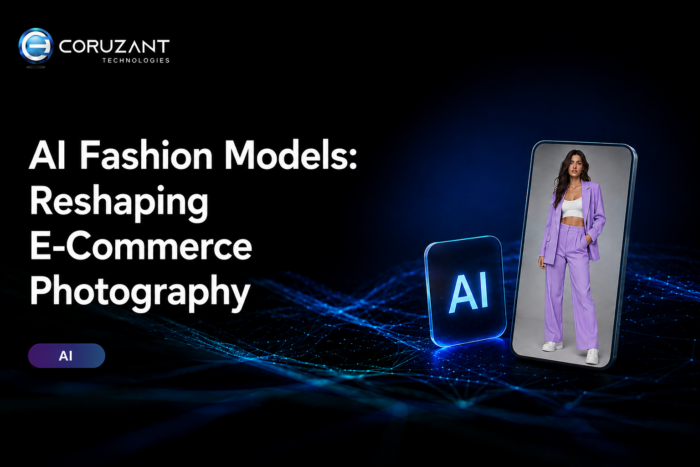
Fashion e-commerce has always had a production problem. Every garment needs to be shown on a human body before a customer will trust it enough to buy.
That requirement has historically meant model bookings, studios, and photography teams, an entire supply chain that exists solely to answer one question: what does this look like when someone wears it?
Generative AI is now answering that question without the supply chain. A new category of AI model generators has emerged over the past two years, and the underlying technology is worth understanding on its own terms, separate from any single product built on top of it.
Table of contents
How AI Fashion Models Actually Work
The technology behind AI-generated fashion models draws on the same diffusion model architecture that powers most modern image generation tools. What makes fashion-specific models different is the training data and the constraints applied during generation.
A general-purpose image generator has no concept of how fabric drapes, how a garment should fit a specific body type, or how lighting needs to be consistent across a full product catalogue. Fashion-focused models are trained specifically on clothing, body positioning, and studio lighting patterns. The output has to solve a narrower, more technical problem: place a real garment convincingly on a photorealistic human form, adjustable across skin tone, body type, and pose, without visible distortion in the fabric or proportions.
This is a harder technical problem than it sounds. Early versions of this technology, going back to 2022 and 2023, struggled badly with garment accuracy. Patterns would warp, textures would blur, and the technology was more useful for concept work than actual product photography.
The models used today have improved significantly on that baseline, largely due to better training data curation and more sophisticated garment-mapping techniques that preserve fabric texture and print accuracy during generation.
The Economics Driving Adoption
A traditional fashion photography shoot can cost several thousand dollars per day once models, photographers, studio rental, styling, and post-production are included. Costs vary significantly depending on the scale and production requirements.
AI generation inverts the cost structure. The marginal cost of generating an additional image approaches zero once the underlying model is trained and deployed.
This is the same economic logic that has driven AI adoption across other content-heavy industries, from marketing copy to video production, but fashion photography is one of the clearest cases because the output requirement (photorealistic humans) is one AI has gotten unusually good at.
Where the Technology Still Falls Short
It would be inaccurate to present this as a fully solved problem. Current AI fashion model tools still struggle with a handful of specific scenarios: complex draped fabrics like chiffon or silk in motion, garments with fine text or logo placement, and full-body shots involving unusual poses.
In production environments, some generated images still require manual touch-up or regeneration, particularly when garments contain intricate details, complex textures, or unusual poses.
There is also an evolving industry conversation about disclosure. As AI-generated model imagery becomes increasingly difficult to distinguish from traditional photography, questions about labeling and consumer expectations are becoming more important. Disclosure requirements now vary by jurisdiction and type of advertising, with some markets already introducing specific requirements for AI-generated people and synthetic performers.
What This Signals for Visual Content Generation Broadly
Fashion is an early and visible test case for a broader shift: AI models trained for narrow, high-precision visual tasks outperforming general-purpose generators on domain-specific output. The same pattern is playing out in architectural visualization, product mockups, and interior design rendering, all fields where photorealism and domain accuracy matter more than creative range.
Tools built specifically for this use case, such as AI fashion model generator, reflect this trend toward specialization rather than general-purpose AI image tools trying to serve every use case at once.
For an industry that has run on the same production model for decades, the shift is significant less because of the novelty of AI-generated imagery, and more because it changes who can afford to compete on visual content.
Small and independent brands, previously priced out of professional catalogue photography, now have access to output quality that was recently exclusive to companies with real production budgets.
Whether the technology continues improving at its current pace will determine how quickly it moves from a cost-saving alternative to the default method of fashion product photography.