Instead of watching an aircraft from the ground, an FPV pilot sees what the aircraft sees and responds with relatively low latency through a live video and control link. This immersive flight and imaging connection has transformed recreational flying, racing, freestyle performance, inspection work, and cinematic production.
An FPV Drone is an integrated system in which propulsion, stabilization, radio control, video capture, transmission, and human decision-making operate continuously. Understanding those parts helps pilots choose equipment wisely.
Key Takeaways
- FPV pilots experience an immersive flight by viewing live video feed, which enhances recreational flying and various applications.
- The flight controller acts as the brain of the FPV drone, processing commands and ensuring smooth maneuverability.
- Brushless motors and electronic speed controllers enable agile movements, while tuning settings affect performance and stability.
- Live video links utilize onboard cameras and transmitters, with analog and digital systems offering different benefits and tradeoffs.
- Building an FPV system requires careful selection of components and safety checks before flight to ensure reliability and compliance with regulations.
Table of contents
- What First-Person-View Flight and Imaging Actually Means
- The Flight and Imaging Controller as the Aircraft’s Brain
- Motors, Propellers, and Electronic Speed Controllers
- How the Live Video Link Works
- Radio Control and Command Reliability
- Batteries, Power Distribution, and Flight and Imaging Time
- Imaging Beyond the Piloting Flight and Imaging Feed
- Building a Safe and Coherent System
- Where Real-Time Flight and Imaging Technology Is Heading
What First-Person-View Flight and Imaging Actually Means
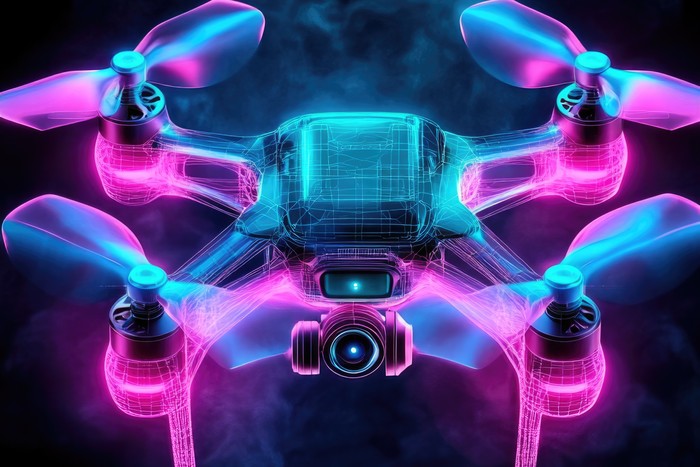
In ordinary visual-line-of-sight flying, the pilot judges attitude and direction by observing the aircraft externally. An FPV drone changes that relationship. A forward-facing onboard camera sends a live video feed to goggles, a screen, or another compatible receiver. The pilot therefore navigates from the aircraft’s viewpoint, much like sitting in a tiny cockpit.
The live feed prioritizes low delay, stable reception, and readable detail. A separate camera may record final footage, although some digital systems provide both a piloting image and usable onboard video. Beautiful imagery doesn’t help if transmission delay prevents precise reactions.
The Flight and Imaging Controller as the Aircraft’s Brain
At the center is the flight controller, a circuit board that processes commands and sensor data. Its gyroscope detects movement around the roll, pitch, and yaw axes. Some controllers also include accelerometers, barometers, magnetometers, or GPS connections.
Firmware interprets this information and calculates how motor speeds should change. In stabilized modes, the controller helps the craft return toward a level attitude. In acro mode, commonly used for racing and freestyle, stick inputs control rotational rates rather than automatically returning the aircraft to level. The aircraft continues at the chosen angle until the pilot corrects it, offering greater freedom and smoother control after sufficient practice.
Controller tuning shapes the experience. Proportional, integral, and derivative settings, called PID settings, govern how firmly the aircraft follows commands and rejects disturbances. Filters reduce vibration. Poor tuning can cause oscillation, excess motor heat, or unstable footage.
Motors, Propellers, and Electronic Speed Controllers
Most FPV quadcopters use four brushless motors. Each motor turns a propeller, generating thrust. By increasing or decreasing individual motor speeds, the flight and imaging controller makes the aircraft climb, descend, rotate, or tilt in any direction. This arrangement has few moving mechanical parts, yet it can produce remarkable agility.
Electronic speed controllers, or ESCs, translate flight-controller instructions into timed electrical power for the motors. Four-in-one boards package all channels together. Their firmware supports rapid communication protocols and useful telemetry.
Propeller diameter, pitch, blade count, motor size, battery voltage, and weight affect performance. High-pitch propellers may deliver aggressive acceleration but draw more current. Efficient combinations extend flight time; powerful combinations favor rapid movement or camera payloads.
How the Live Video Link Works
The onboard camera passes a continuous view to a video transmitter. It sends the signal to a receiver connected to the pilot’s goggles or monitor. Antenna design and placement can affect signal range, reception around obstacles, interference performance, and image stability.
Analog systems convert and transmit video with extremely low delay. Their picture can develop static, noise, or color loss as signal strength falls, but degradation is generally gradual. Pilots often value that visible warning because some useful information remains before reception disappears.
Digital systems encode the image before transmission and decode it at the receiver. They usually offer greater clarity, more readable detail, and an experience closer to high-definition viewing. The tradeoffs can include higher cost, proprietary compatibility, and different behavior near the edge of usable range. Some systems reduce resolution, add artifacts, or freeze when the connection weakens.
Latency is the time between the camera capturing an event and the pilot seeing it. Even a small delay affects precise high-speed turns. Total response also includes radio latency, controller processing, motor response, and human reaction.
Radio Control and Command Reliability
The handheld transmitter converts stick, switch, and dial positions into digital commands. Its radio module sends those commands to a receiver aboard the aircraft. The receiver then communicates with the flight and imaging controller, which performs the requested actions. Modern control links can deliver low latency, telemetry, and impressive range in very small hardware.
Reliability depends on more than advertised distance. Radio frequency, transmission power, antenna placement, obstacles, local interference, aircraft orientation, and regulatory limits all influence the connection in changing conditions.
Pilots should configure a failsafe before takeoff. If the control link is lost, the system must respond predictably, usually by disarming or using an appropriately configured recovery feature.
Batteries, Power Distribution, and Flight and Imaging Time
Lithium-polymer batteries remain common because they can release substantial current relative to their size. Cell count determines nominal voltage, while capacity, expressed in milliamp-hours, indicates stored charge. The discharge rating describes intended current capability, although real-world performance varies among manufacturers and battery conditions.
Higher voltage can allow motors to produce power efficiently, but every component must tolerate the selected battery. Voltage regulators provide suitable power to the flight controller, receiver, camera, and video transmitter. Capacitors help absorb electrical noise and voltage spikes that might disrupt electronics or contaminate the video feed.
Flight time depends on weight, speed, propeller efficiency, tune, wind, battery condition, and flying style. Aggressive freestyle may consume a pack within minutes, whereas an efficient long-range build can remain airborne much longer. Pilots should land before cells are excessively depleted and allow warm batteries to cool before charging.
Imaging Beyond the Piloting Flight and Imaging Feed
The FPV camera must handle rapid changes between bright sky and dark ground. Wide dynamic range helps preserve useful detail in both areas, while fast exposure adjustment prevents temporary blindness when direction changes. Lens field of view affects spatial awareness: wider views reveal more surroundings but introduce stronger distortion.
For finished productions, pilots often add an action camera or use a system with onboard high-quality recording. High frame rates support smooth motion and slow-motion sequences. Stabilization software can reduce unwanted rotation and vibration when supplied with clean footage or gyroscope data. Neutral-density filters control shutter speed in bright conditions, creating natural motion blur rather than a harsh, stuttering appearance.
Good cinematic results still depend on piloting. Gradual inputs, planned paths, coordinated turns, consistent altitude, and awareness of light create purposeful shots. Technology can stabilize imperfections, but it cannot fully replace composition or safe rehearsal.
Building a Safe and Coherent System
Every component must work electrically, mechanically, and digitally with the others. A motor and propeller combination should suit the frame and battery. The ESC must handle expected current. The receiver must match the pilot’s transmitter protocol, while goggles must support the selected video system. Firmware versions and wiring layouts also require confirmation.
Before each flight, pilots should inspect propellers, frame hardware, antennas, battery straps, solder joints, and camera mounts. A short hover can reveal unusual vibration, motor noise, or control behavior. Drone requirements vary by jurisdiction. In the United States, for example, recreational and commercial operations have specific visual-line-of-sight, airspace, registration, and operating requirements
Useful preparation includes:
- Practicing in a simulator before flying a powerful aircraft
- Learning arming, disarming, mode selection, and failsafe behavior
- Checking control direction and video reception without propellers fitted
- Inspecting batteries for swelling or damage and using a charger designed for the battery chemistry and configuration.
- Planning an emergency landing area before beginning the route
Read Next
A few related pieces worth your time:
- How Smart Buildings Collect and Use Data
- How Smart Charging Technology Is Transforming Portable Power
- Smart Technology Is Changing the Electric Mini Bike Experience
Where Real-Time Flight and Imaging Technology Is Heading
FPV development continues to improve image quality, link efficiency, sensor integration, and component reliability. Better cameras help pilots read difficult scenes, while refined radio protocols provide faster updates and clearer telemetry. Compact GPS units, onboard black-box logging, and increasingly capable firmware make aircraft easier to analyze and configure.
The essential appeal, however, remains direct human control. An FPV Drone turns radio signals, sensor measurements, electrical power, and live imagery into an immediate physical experience. When its parts are chosen thoughtfully and operated responsibly, the technology allows pilots to move a camera through space with unusual freedom, precision, and creative intention.