Restaurant technology is moving from a back-office convenience to a core planning and operating system for food businesses. AI, digital calculators, decision-support tools, and automation now help operators test ideas, plan kitchens, forecast demand, control waste, and make faster daily decisions. For independent restaurants, cloud kitchens, hotels, and multi-unit groups, the value is not “AI for its own sake”; it is clearer thinking, tighter execution, and more resilient restaurant operations.
Key Takeaways
- Restaurant technology is shifting to AI-driven systems that enhance planning and operations, fostering greater efficiency and resilience.
- AI helps operators use data for demand forecasting, inventory management, and staffing, improving overall operational efficiency.
- Digital tools like Horeca Store’s location analysis and recipe conversion reduce errors and enhance decision-making for restaurant entrepreneurs.
- Smart restaurant automation aims to streamline tasks, allowing staff to focus more on hospitality without sacrificing the guest experience.
- Emerging AI trends promise connected systems that integrate various operational functions, making restaurant management more efficient and data-driven.
Table of contents
- How does AI improve restaurant planning and operations?
- Restaurant technology creates a stronger planning foundation
- How can AI reduce waste, labor pressure, and avoidable costs?
- Digital calculators connect planning with real kitchen execution
- Restaurant automation works best when it protects the human experience
- Emerging trends in AI-powered restaurant operations
- Conclusion: technology should make restaurant decisions sharper
How does AI improve restaurant planning and operations?
AI improves restaurant planning and operations by turning scattered information into useful recommendations. Instead of relying only on instinct, operators can use data from sales patterns, weather, local demand, recipes, inventory, labor schedules, and guest behavior to guide decisions. The result is better ai operational efficiency: fewer blind spots, faster adjustments, and more consistent performance across planning, launch, and day-to-day service.
In restaurants, judgment remains essential because food quality, hospitality, brand positioning, and team culture are not purely mathematical. AI-powered restaurant tools work best when they support experienced operators, chefs, and managers with better forecasts and clearer options.
A restaurant founder, for example, might use digital tools to evaluate a location, estimate production needs, standardize recipes, and plan staffing before opening. Once the restaurant is live, the same logic extends into ordering, prep, scheduling, guest communication, and performance tracking.
Restaurant technology creates a stronger planning foundation
The biggest operational improvements often begin before the first service. Restaurant planning tools help teams move from concept to execution with fewer assumptions. They can clarify whether a location fits the target audience, whether the kitchen can support the menu, and whether recipes are scalable enough for real service conditions.
This is where practical, non-promotional tools have an important role. Horeca Store’s free digital tools are a useful example of how operators can apply structured thinking early: restaurant location analysis for site evaluation, a recipe conversion tool for scaling production, a pizza dough calculator for bakery and pizzeria planning, and broader digital kitchen tools for operational preparation. These tools do not need to be complex to be useful; they help entrepreneurs ask better questions before costs become fixed.
Location decisions become more data-aware
A restaurant location is not only about rent, visibility, or foot traffic. Operators also need to consider local demand, competition, accessibility, delivery radius, staffing availability, and concept fit. Restaurant location analysis supports this process by helping founders compare sites more systematically.
AI can add another layer by identifying patterns across demographic data, search behavior, delivery demand, local events, and competitor density. Even when the final decision remains human, the process becomes less reactive. A team can test whether a fast-casual concept, a premium dining room, or a delivery-focused kitchen is better suited to a specific area.
Menu planning becomes more realistic
A menu may look profitable on paper but fail operationally if the kitchen cannot execute it consistently. Digital calculators and recipe systems help operators understand ingredient quantities, portion sizes, production time, and preparation complexity. A recipe conversion tool is especially useful when a chef moves from small test batches to service-level production.
For example, a sauce developed for ten portions may need to be scaled to one hundred portions without losing consistency. Manual conversion increases the risk of errors, especially when measurements, yield loss, or preparation steps vary. The most valuable AI food service applications are operational.
In ai food service, the highest-value applications are usually practical rather than futuristic. Restaurants benefit most when AI helps solve recurring problems: over-ordering, understaffing, long ticket times, inconsistent prep, missed upsell opportunities, and poor visibility into performance.
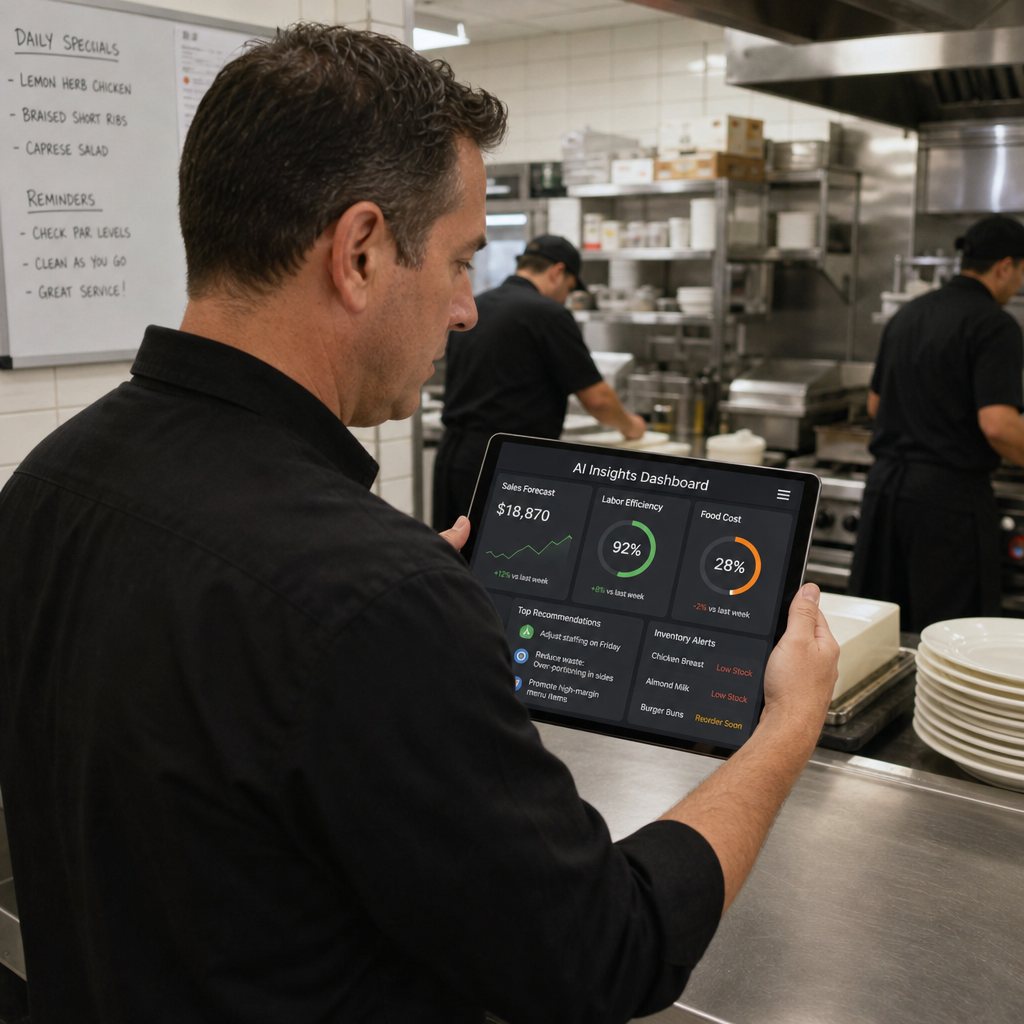
The most impactful restaurant ai tools tend to sit close to daily decisions. They do not simply produce reports; they recommend actions, flag exceptions, and help managers respond before small issues become expensive.
Key areas include:
- Demand forecasting: Predicting likely sales by daypart, season, weather, event activity, or historical trends.
- Inventory management: Tracking ingredient usage, identifying waste patterns, and improving purchasing decisions.
- Labor scheduling: Matching staffing levels to expected demand without overloading the team.
- Menu engineering: Comparing popularity, margin, preparation complexity, and guest preferences.
- Kitchen workflow: Improving prep sequences, ticket routing, and production timing.
- Guest experience: Personalizing offers, loyalty communication, reservation flow, and service recovery.
Each area improves a different part of the operating model. Together, they create a more connected restaurant management system.
How can AI reduce waste, labor pressure, and avoidable costs?
AI can reduce avoidable costs by helping restaurants forecast demand more accurately, order closer to actual need, schedule teams more precisely, and identify operational patterns that managers may miss during busy service. It is not a guaranteed cost-cutting button, but when data quality is strong and staff use the tools consistently, ai restaurant management can make cost control more proactive.
Waste is one of the clearest examples. A restaurant that regularly over-preps fresh ingredients loses money twice: first through purchasing, then through disposal. AI-supported forecasting can compare historical sales, reservations, weather, holidays, and local events to estimate production needs more accurately.
Labor planning follows similar logic. Managers often build schedules based on habit, last year’s numbers, or a cautious desire to avoid being short-staffed. AI can help forecast demand by hour, not just by day, so staffing decisions better match real service patterns.
Inventory becomes a live management system
Traditional inventory often happens after the fact. Teams count stock, compare invoices, and discover waste only once money has already been lost. AI-enabled inventory tools can make inventory more dynamic by connecting purchasing, recipes, sales, and actual usage.
This helps answer practical questions:
- Which ingredients are consistently over-ordered?
- Which menu items create the most trim waste?
- Which suppliers or product categories show price volatility?
- Which items should be prepped in smaller batches?
- Which menu changes would reduce complexity without weakening the concept?
For a small restaurant, this may begin with simple digital tracking and recipe costing. For a larger group, it may involve integrated purchasing systems, centralized reporting, and predictive ordering across multiple locations.
Kitchen workflow becomes easier to coordinate
Digital kitchen tools help teams organize prep, production, and service timing. In a busy kitchen, operational efficiency depends on sequencing: what must be prepped first, what can be held safely, what needs last-minute finishing, and which stations are likely to become bottlenecks.
AI can support kitchen workflow by analyzing ticket patterns, prep times, order combinations, and station load. A kitchen display system may route work more intelligently, while forecasting tools help managers prepare for a heavy lunch rush or delivery spike.
This is where smart commercial kitchen technology becomes especially relevant. Connected ovens, temperature monitoring, predictive maintenance, and energy management systems can help operators reduce downtime, protect food safety processes, and avoid unnecessary equipment strain.
Digital calculators connect planning with real kitchen execution
Not every useful restaurant technology system needs to be advanced AI. Some of the most valuable tools are calculators and decision-support resources that reduce manual errors. They create the foundation for more advanced restaurant automation by standardizing inputs and improving data discipline.
A pizza dough calculator, for example, can help a pizzeria estimate flour, water, yeast, salt, hydration, dough ball weight, and batch size more consistently. That matters because dough production affects purchasing, refrigeration space, prep timing, waste, and customer experience. A small miscalculation repeated daily can become a recurring operational problem.
A recipe conversion tool plays a similar role for restaurants, caterers, bakeries, and hotel kitchens. When recipes are scaled manually, ingredient ratios and yields can drift.
Practical uses for digital kitchen tools
Operators can use these tools throughout the restaurant lifecycle:
- Concept development: Test menu feasibility, production complexity, and ingredient needs before finalizing the offer.
- Launch preparation: Convert recipes, calculate batch sizes, and align prep plans with expected covers.
- Staff training: Give kitchen teams standardized quantities and repeatable procedures.
- Daily operations: Adjust production based on reservations, delivery demand, and sales trends.
- Menu review: Identify items that are operationally difficult, low-margin, or waste-heavy.
This progression matters because good data habits start early. A restaurant that standardizes recipes and production logic before opening will have cleaner information when it later adopts AI-powered forecasting, inventory, or scheduling tools.
Restaurant automation works best when it protects the human experience
Restaurant automation is often discussed as if it exists to remove people from the business. In practice, the better goal is to remove friction from repetitive, error-prone, or time-sensitive tasks. Automation should give managers and staff more time for hospitality, coaching, quality control, and guest interaction.
Examples include automated reservation confirmations, inventory alerts, reorder suggestions, digital prep lists, loyalty segmentation, invoice processing, and kitchen routing. These functions are not glamorous, but they reduce administrative load. The risk is over-automation. A restaurant can damage its guest experience if every interaction feels mechanical or if staff no longer understand the reasoning behind system recommendations.
What should restaurants consider before adopting AI tools?
Restaurants should begin with a specific operational problem, not with the technology itself. The best implementation path depends on restaurant size, data quality, existing systems, staff readiness, and the decision the tool is meant to improve. A small cafe, a pizzeria, a hotel kitchen, and a multi-location group will not need the same ai restaurant management setup.
A practical adoption plan includes:
- Define the pain point: Choose one measurable issue, such as waste, scheduling accuracy, slow ticket times, or inconsistent recipe scaling.
- Audit available data: Review sales history, inventory records, recipes, labor schedules, and supplier information.
- Start with simple tools: Use calculators, dashboards, or focused automation before moving into complex AI systems.
- Train staff early: Explain how the tool supports their work, what data they must enter, and how recommendations should be interpreted.
- Measure outcomes: Track whether the tool improves consistency, reduces manual work, or supports better decisions.
- Avoid isolated systems: Choose tools that can integrate with POS, inventory, accounting, or kitchen management platforms when needed.
For small restaurants, cloud-based tools and focused calculators may deliver the most immediate value. For multi-unit groups, the priority is often data architecture: consistent definitions, centralized reporting, and integrations that allow comparisons across locations.
Emerging trends in AI-powered restaurant operations
The next wave of restaurant technology is likely to be more connected, predictive, and context-aware. Instead of separate tools for ordering, scheduling, marketing, and kitchen production, operators are moving toward ecosystems that combine multiple data sources.
Generative AI is beginning to support tasks such as menu descriptions, training materials, guest communication, and performance summaries. Voice AI can help with reservations, drive-thru ordering, and phone inquiries. AI can also influence digital visibility. Search behavior is changing as guests use maps, review platforms, social media, and AI assistants to discover places to eat. Restaurants that maintain accurate menus, structured information, strong local presence, and consistent guest data will be better positioned for digital discovery.
AI-powered restaurant tools are becoming less like optional add-ons and more like decision infrastructure. The restaurants that benefit most will be those that combine technology with disciplined operations, thoughtful leadership, and a clear understanding of their guests.
Read Next
A few related pieces worth your time:
- Why Your Product Demo Looks Blurry at Launch—and How Tech Teams Fix It
- Create Cinematic Brand Commercials with Luma Dream Machine on Pollo AI
- How AI Is Changing Community-Led Growth in Big Businesses
Conclusion: technology should make restaurant decisions sharper
Restaurant technology is transforming how food businesses plan, launch, and operate, but its real value is practical rather than abstract. AI, calculators, data-driven decision tools, and automation help restaurants reduce guesswork, improve consistency, and respond faster to changing demand.
Start with clear planning tools, standardize recipes and production logic, use data to understand demand, then expand into AI systems that support inventory, labor, workflow, and guest engagement. When used well, smart commercial kitchen technology and AI do not replace the craft of hospitality; they give operators more control over the conditions that make great hospitality possible.