The Silent Enrollment Killer No One Talks About
A student lands on your university website at 11:42 PM. They’ve shortlisted three universities, and yours is one of them. They have questions about deadlines, scholarships, eligibility, and whether their profile qualifies for admission. So they fill out an inquiry form and wait for a response.
And then… nothing.
Twelve hours later, your admissions team replies with a thoughtful, informative email. But by then, it’s already too late. The student has committed elsewhere. Not because your university wasn’t good enough. Not because your program wasn’t competitive. But because another institution responded first.
This is the uncomfortable truth many universities are still struggling to acknowledge. Universities rarely lose students to competition alone. They lose them to delay. Today’s students expect answers instantly. In modern admissions, responsiveness is no longer a bonus it’s a deciding factor between student interest and actual enrollment. That’s exactly why AI student chatbots are becoming a critical part of the admissions journey.
Table of contents
- The Silent Enrollment Killer No One Talks About
- Why Traditional Admissions Systems Are Breaking
- What an AI Student Chatbot Actually Is
- Meet EDMO Student Copilot
- From Support Tool to Enrollment Engine
- How AI Chatbots Drive Enrollment Growth
- Human + AI: The Real Winning Model
- What a Modern AI Admissions Experience Looks Like
- Implementation Is Simpler Than Most Universities Think
- The Competitive Advantage Most Universities Are Missing
- Admissions Have Already Changed
Why Traditional Admissions Systems Are Breaking
Admissions teams today are dealing with more pressure than ever before. The number of applications, student inquiries, communication channels, and expectations has grown significantly, but the systems managing admissions haven’t evolved at the same pace.
- More applications
- More student inquiries
- More communication channels
- More expectations
Many universities still depend heavily on emails, phone calls, spreadsheets, and manual follow-ups. Meanwhile, admissions advisors are expected to manage hundreds, sometimes thousands of student conversations simultaneously. As inquiry volumes rise, response times slow down, follow-ups get missed, student engagement drops, and interested applicants move on to competitors.
Now add global demand into the equation. Students are no longer applying only from nearby regions. They’re reaching out from India, Nigeria, Brazil, the Middle East, and across the world, often in completely different time zones. A student exploring programs at midnight in their country doesn’t want to wait until your office opens the next morning. They expect answers immediately.
This expectation of instant support is reinforced by broader digital behavior trends in education. Research on AI chatbot adoption among university students shows strong acceptance of AI-driven conversational systems for learning and academic support, with studies reporting majority-level adoption/acceptance (often above 70% in surveyed populations), highlighting how normalized on-demand assistance has become in higher education environments. This matters because expectations shaped in learning environments increasingly carry over into admissions interactions, where students expect the same immediacy and autonomy.
The challenge isn’t that admissions teams are underperforming. The challenge is scale. And no amount of hiring can sustainably solve a problem that requires 24×7 responsiveness.
What an AI Student Chatbot Actually Is
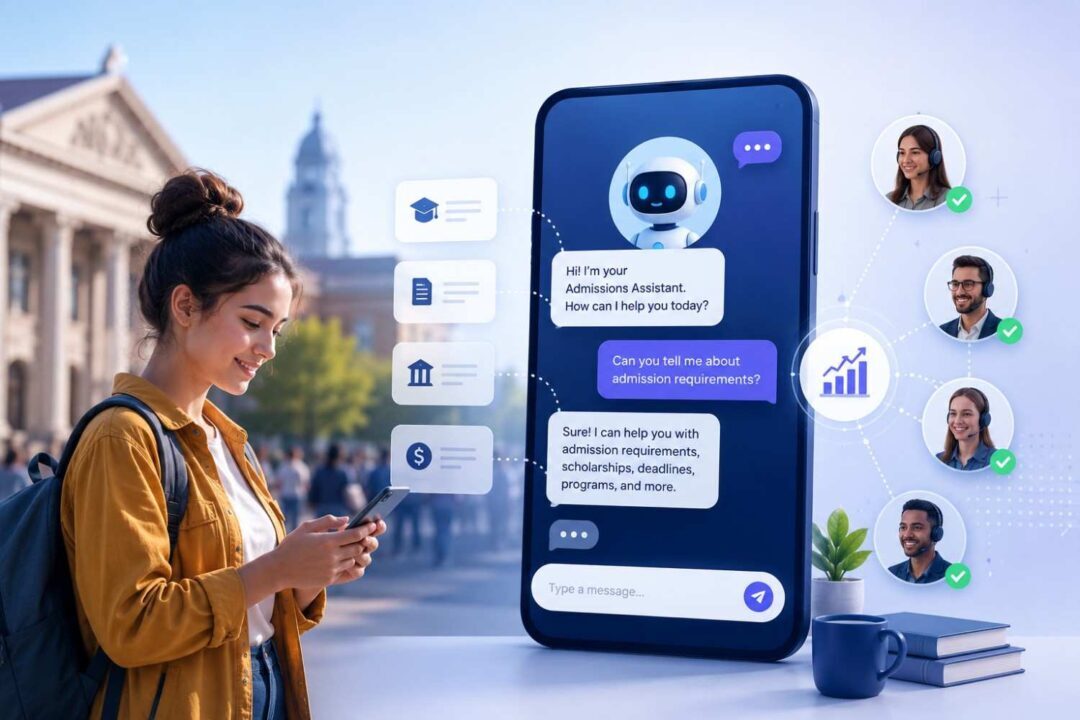
Let’s clear up a common misconception. An AI student chatbot is no longer just a pop-up FAQ widget. Modern AI student chatbots function as a conversational admissions layer that sits at the front of the student intake process.
They engage with students in real time across websites, messaging platforms, and voice channels, helping universities manage inquiries instantly and intelligently.
A modern AI student chatbot can:
- Respond instantly, 24×7
- Answer admissions, program, scholarship, and visa-related questions
- Understand student intent, not just keywords
- Capture and organize lead information
- Qualify students based on eligibility criteria
- Route high-intent students to advisors with full conversation context
In many ways, the chatbot becomes the university’s first admissions representative. More importantly, it becomes the student’s first impression of the institution.
Meet EDMO Student Copilot
This is exactly the kind of AI-powered experience many universities are now adopting through systems like EDMO Student Copilot. Unlike traditional chatbots that only handle basic FAQs, Student Copilot works as a 24×7 virtual admissions assistant across both chat and voice channels.
When a student reaches out, the system immediately responds to inquiries, answers questions conversationally, collects important student details, and guides students toward the next step in the admissions process.
Students can ask questions like:
- “Do I qualify for this program?”
- “What documents do I need?”
- “Can international students apply?”
- “Are scholarships available?”
Instead of waiting hours or even days for a reply, students receive instant, personalized responses.
The system can also identify high-intent applicants, evaluate eligibility, and connect students to the right admissions advisor with the full conversation history already attached. So when a human advisor joins the conversation, they already understand the student’s interests, questions, concerns, and readiness to apply.
The result is simple:
- Students get faster answers
- Advisors save time
- Universities reduce enrollment loss caused by delayed communication
From Support Tool to Enrollment Engine
For years, universities viewed chatbots primarily as support tools. Their role was limited to answering FAQs, helping students navigate websites, and reducing repetitive workloads.
- Answer FAQs
- Help students navigate websites
- Reduce repetitive workloads
Useful but limited.
That’s no longer the role AI plays in admissions. Today’s AI systems actively help universities move students from curiosity to enrollment, fundamentally changing the admissions experience.
Instead of reacting to questions, AI now guides students through the process. Instead of providing generic information, it creates personalized, conversational experiences. And instead of functioning like a passive support tool, AI actively helps institutions identify serious applicants and accelerate admissions decisions.
Modern AI systems understand context and intent. They can determine whether a student is casually exploring options, comparing universities, or ready to begin an application.
- Casually exploring options
- Comparing universities
- Ready to begin an application
Based on the conversation, the AI adjusts its responses accordingly.
And when a human advisor needs to step in, the transition is seamless. The advisor receives the full conversation history, allowing them to continue naturally without forcing the student to repeat information.
How AI Chatbots Drive Enrollment Growth
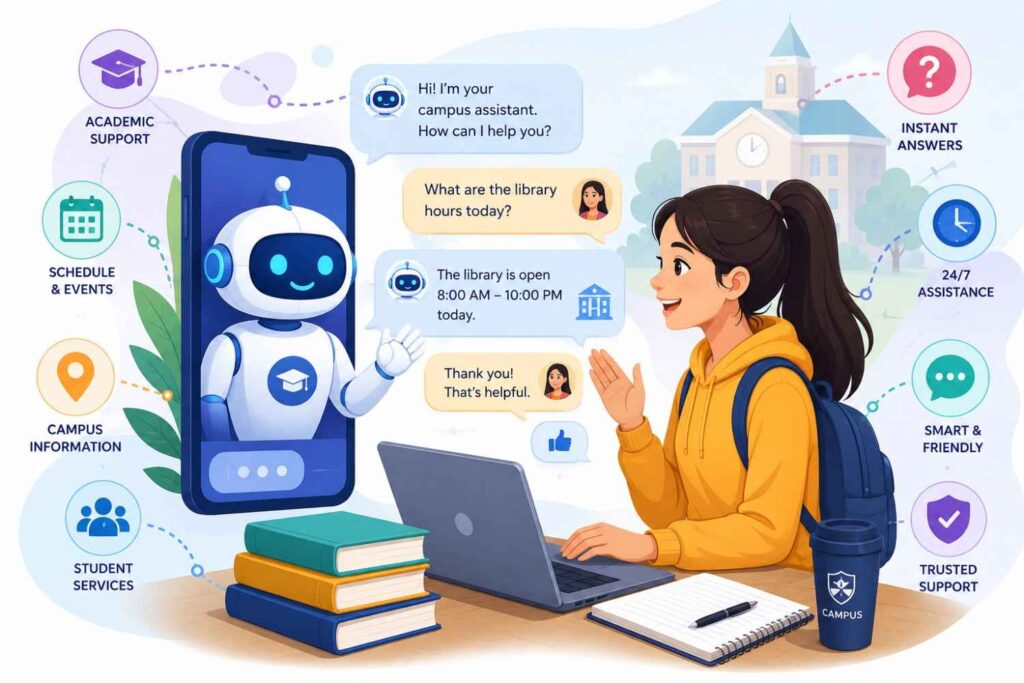
The impact of AI in admissions isn’t theoretical anymore. Universities are seeing measurable improvements across the entire enrollment funnel.
1. Instant Speed-to-Lead
The moment a student reaches out, they receive a response. Not hours later. Not the next business day. Immediately.
And in admissions, that first interaction often determines whether a student stays engaged or moves on to another institution.
2. Higher Conversion Rates
When students receive quick, relevant, and personalized answers, they stay engaged longer. The admissions process feels clearer and less overwhelming. What begins as casual browsing often turns into serious intent to apply because students receive the guidance they need in real time.
AI student chatbots reduce:
- Delays
- Confusion
- Communication gaps
- Endless back-and-forth emails
And that directly improves conversion rates.
3. Global Coverage Without Expanding Teams
Admissions offices cannot realistically operate around the clock, but AI systems can. AI chatbots ensure that every prospective student regardless of geography or time zone, receives immediate attention and consistent support.
This is especially valuable for universities targeting international student markets.
4. Reduced Mid-Funnel Drop-Off
One of the biggest challenges in admissions is losing students midway through the process. Many students begin applications but never complete them.
Often, the reason is surprisingly simple:
- They got stuck
- They had a question
- They couldn’t get an answer quickly enough
AI chatbots eliminate these dead ends by providing immediate support exactly when students need it.
Human + AI: The Real Winning Model
One of the biggest concerns around AI is whether it will replace admissions advisors. It won’t. In reality, it makes them more effective.
AI handles the repetitive, high-volume tasks that require speed:
- Answering common questions
- Collecting basic information
- Sorting and qualifying leads
- Managing initial engagement
Human advisors then focus on the areas where empathy, trust, and judgment matter most:
- Guiding important decisions
- Handling complex concerns
- Building long-term relationships with students and families
Instead of spending hours responding to repetitive inquiries, advisors can focus their energy on students who are genuinely ready to move forward.
AI doesn’t replace admissions teams. It removes the operational bottlenecks, slowing them down.
What a Modern AI Admissions Experience Looks Like
Imagine this scenario.
A student visits your university website and asks:
“Do I qualify for the MS in Data Science program?”
Instead of waiting for an email response, the AI chatbot replies instantly and asks a few follow-up questions:
- What’s your academic background?
- What’s your GPA?
- Have you taken any English proficiency exams?
Based on the student’s answers, the system provides a personalized response
“Yes, you meet the eligibility criteria. Here’s what you’ll need to apply.”
The chatbot then offers next steps:
“Would you like to speak with an advisor or start your application?”
If the student requests an advisor, the conversation is seamlessly transferred. But unlike traditional handoffs, the advisor already has access to:
- Student details
- Conversation history
- Questions asked
- Program interest
- Application readiness
The interaction continues naturally.
- No repetition
- No friction
- Just momentum
Implementation Is Simpler Than Most Universities Think
Many institutions assume implementing AI in admissions requires a complete technology overhaul. It doesn’t.
Modern AI student chatbot systems are designed to integrate with existing infrastructure, including:
- CRM systems
- Student information systems
- Communication platforms
- Admissions workflows
Universities don’t need to transform everything overnight. The smartest approach is gradual adoption:
- Add a chatbot to the website
- Expand to voice and messaging channels
- Automate more stages of the intake process over time
The goal isn’t disruption. It’s an improvement step by step.
The Competitive Advantage Most Universities Are Missing
Consider two universities. Both offer similar programs, have comparable rankings, and target the same students. But one responds instantly while the other responds the next day.
Who wins?
In today’s admissions environment, it’s rarely the “better” university that wins first. It’s the faster one. This is the shift many institutions are still underestimating:
Speed has become a competitive strategy. And AI is what enables that speed at scale.
Universities adopting AI early are already capturing high-intent students before competitors even enter the conversation. Meanwhile, slower institutions are losing opportunities they often never realize existed.
Admissions Have Already Changed
Many universities still talk about AI as if it’s the future of admissions. But the reality is much simpler:
The shift has already happened.
Today’s students expect:
- Instant responses
- Personalized interactions
- Conversational experiences instead of static forms
Universities that meet these expectations will attract and convert more students. Those that don’t will continue losing applicants to faster, more responsive competitors. The real question is no longer whether AI chatbots will become standard in admissions. It’s how quickly institutions will adapt. In modern admissions, the university that responds first is often the one that enrolls first.