
The e-commerce industry has entered an era where speed, creativity, and scalability determine who wins the market. Whether you’re selling on Shopify, Amazon, TikTok Shop, Etsy, or your own DTC website, the challenge is no longer simply finding great products, it’s producing enough high-quality marketing content to keep up with increasingly competitive digital channels.
Today’s consumers expect compelling product images, engaging short videos, authentic UGC (User-Generated Content), localized product listings, and personalized advertising. Meeting these expectations with traditional marketing workflows is becoming increasingly difficult.
Fortunately, artificial intelligence is changing the way e-commerce brands create, optimize, and distribute content. Instead of relying on disconnected software and lengthy production cycles, businesses can now build an AI-powered workflow that automates repetitive tasks, improves creative quality, and dramatically accelerates marketing execution.
In this guide, we’ll explore why traditional workflows are becoming obsolete, how AI is reshaping every stage of e-commerce marketing, and why integrated AI platforms like Crun AI are helping businesses achieve more with fewer resources.
Key Takeaways
- E-commerce success now relies on speed, creativity, and AI for content creation and distribution.
- Traditional marketing workflows struggle with content demands and multiple tool complexities.
- AI-powered workflows help automate tasks, enhance productivity, and enable faster campaign execution.
- Crun AI provides a unified platform for generating images, videos, and marketing copy, streamlining e-commerce operations.
- Businesses utilizing AI in their marketing can respond quickly to trends and maintain cost-effective production.
Table of contents
- Why Traditional E-commerce Marketing Workflows Are Breaking Down
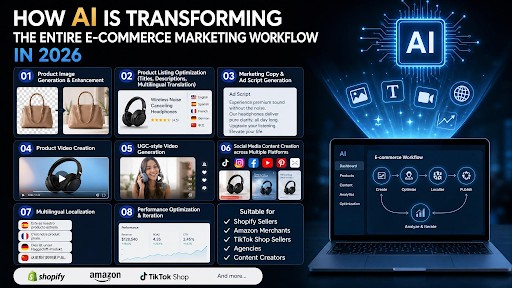
- How The Modern AI-Powered E-commerce Marketing Workflow Revolutionizes Productivity and Efficiency
- Product Image Generation and Enhancement
- Product Listing E-commerce Marketing Optimization (Titles, Descriptions, Multilingual Translation)
- Marketing Copy and Ad Script Generation
- Product Video Creation
- UGC-style Video Generation
- Social Media Content Creation across Multiple Platforms
- Multilingual Localization for E-commerce Marketing
- Performance Optimization and Iteration
- Benefits of an Integrated AI Workflow
- Why an All-in-One AI Platform Matters
- How Crun AI Supports the Entire Workflow
- FAQs
- Conclusion
Why Traditional E-commerce Marketing Workflows Are Breaking Down
Too Many Tools
Modern marketing teams often juggle dozens of specialized tools. One platform generates product images, another edits videos, another writes copy, while separate software handles translation, SEO optimization, and social media scheduling.
Constantly switching between applications introduces unnecessary complexity:
- Multiple subscriptions increase operating costs.
- Teams waste time transferring files between platforms.
- Brand consistency becomes difficult to maintain.
- Collaboration slows down due to fragmented workflows.
Instead of improving productivity, tool overload often creates bottlenecks.
Rising Content Demands
Consumers interact with brands across more channels than ever before.
A single product launch may require:
- Product images
- Lifestyle visuals
- Amazon listings
- Shopify product pages
- TikTok videos
- Instagram Reels
- Facebook ads
- Pinterest Pins
- Email campaigns
- YouTube Shorts
- Blog articles
Each asset requires unique formatting, messaging, and optimization.
Creating this volume of content manually is expensive and difficult to scale.
Increasing Advertising Costs
Paid advertising costs continue to rise across major platforms, making creative performance more important than ever.
To maximize return on ad spend (ROAS), marketers constantly test:
- Headlines
- Product images
- Video hooks
- Calls-to-action
- Landing pages
- Audience-specific creatives
Producing enough creative variations manually quickly becomes cost-prohibitive.
Need for Faster Campaign Execution
E-commerce trends evolve rapidly.
A viral TikTok trend today may disappear next week.
Holiday campaigns, flash sales, seasonal promotions, and influencer collaborations all demand fast turnaround times. Brands that take weeks to produce marketing assets often miss valuable opportunities.
AI dramatically shortens production cycles, allowing marketers to move from idea to campaign launch in hours instead of days.
How The Modern AI-Powered E-commerce Marketing Workflow Revolutionizes Productivity and Efficiency

Instead of treating AI as a standalone writing assistant or image generator, leading brands are integrating AI throughout the entire marketing workflow.
Product Image Generation and Enhancement
Professional product photography has traditionally required photographers, studios, lighting equipment, editing software, and significant budgets.
AI can now:
- Generate realistic product backgrounds
- Remove backgrounds instantly
- Improve image resolution
- Create lifestyle product photography
- Generate seasonal marketing visuals
- Produce multiple creative variations
This enables brands to launch campaigns much faster while reducing production costs.
Product Listing E-commerce Marketing Optimization (Titles, Descriptions, Multilingual Translation)
Optimized product listings directly impact visibility and conversions.
AI helps merchants generate:
- SEO-friendly titles
- Compelling product descriptions
- Feature-focused bullet points
- Keyword-rich metadata
- Category-specific content
- Multilingual listings
Instead of translating content word-for-word, modern AI adapts messaging to local audiences while preserving brand voice.
Marketing Copy and Ad Script Generation
Creating persuasive copy at scale has become one of AI’s strongest capabilities.
Marketing teams can rapidly generate:
- Google Ads
- Meta Ads
- TikTok Ads
- Email campaigns
- Landing pages
- Sales pages
- Promotional slogans
- Video scripts
AI also makes A/B testing easier by producing multiple variations optimized for different audiences.
Product Video Creation
Video dominates e-commerce engagement.
AI enables brands to transform static product images into dynamic promotional videos featuring:
- Camera movement
- Product highlights
- Animated transitions
- Motion graphics
- Professional storytelling
Instead of requiring a production crew, marketers can generate high-quality promotional videos within minutes.
UGC-style Video Generation
User-generated content consistently outperforms traditional advertising because it feels authentic and relatable.
AI now enables brands to create realistic UGC-style promotional videos that simulate customer testimonials, product demonstrations, and creator-style reviews.
These videos can significantly improve engagement while reducing influencer production costs.
Social Media Content Creation across Multiple Platforms
Every platform requires different creative formats.
AI helps marketers instantly adapt content for:
- TikTok
- YouTube Shorts
- X
Instead of redesigning every asset manually, AI automatically generates platform-specific variations.
Multilingual Localization for E-commerce Marketing
Global e-commerce requires more than simple translation.
AI-powered localization adjusts:
- Language
- Tone
- Cultural references
- Product descriptions
- Advertising copy
- Calls-to-action
This enables brands to enter international markets much faster while delivering more natural customer experiences.
Performance Optimization and Iteration
AI doesn’t stop after publishing content.
It can help marketers:
- Generate new creative variations
- Refresh underperforming ads
- Rewrite low-converting copy
- Optimize headlines
- Improve product listings
- Produce continuous A/B test variations
This creates a continuous optimization cycle that keeps campaigns competitive.
Benefits of an Integrated AI Workflow
Faster Time-to-Market
Campaigns that once required weeks can now be completed in hours, allowing brands to capitalize on trends before competitors.
Lower Production Costs
AI significantly reduces spending on photography, video production, copywriting, translation, and creative design while enabling smaller teams to accomplish more.
Higher Content Output for E-commerce Marketing
Instead of producing a handful of assets, marketers can generate dozens of image, copy, and video variations for every campaign, making large-scale testing practical.
Better Consistency Across Channels
Using one integrated workflow helps maintain a consistent visual identity, messaging style, and brand voice across websites, marketplaces, advertising platforms, and social media.
Easier Experimentation with Creatives
Successful marketing depends on testing. AI makes it affordable to experiment with different headlines, visuals, offers, and video concepts without dramatically increasing production costs.
Why an All-in-One AI Platform Matters
Challenges of Managing Multiple E-commerce Marketing AI Tools
Although many AI tools excel at individual tasks, combining numerous specialized applications introduces new challenges:
- Multiple subscriptions
- Different user interfaces
- Inconsistent outputs
- Duplicate workflows
- File compatibility issues
- Fragmented collaboration
- Higher overall costs
As teams scale, these inefficiencies become increasingly difficult to manage.
Advantages of a Unified Platform for Creators and Marketing Teams
An all-in-one AI platform streamlines the entire creative process by bringing image generation, video creation, writing, translation, and optimization into one workspace.
This approach offers several advantages:
- Reduced software costs
- Simplified collaboration
- Faster content production
- Consistent brand assets
- Centralized project management
- Access to the latest AI technologies without constantly switching platforms
The result is a more efficient, scalable marketing operation.
How Crun AI Supports the Entire Workflow
As AI models continue to evolve rapidly, marketers need a platform that provides flexibility without forcing them to manage dozens of individual services.
Access to Leading Image, Video, and Language Models for E-commerce Marketing
Crun AI brings together many of today’s leading AI models in a single platform, enabling users to choose the best model for each creative task, from generating product images and enhancing visuals to writing marketing copy and producing videos.
This flexibility allows teams to stay current as new AI capabilities emerge without constantly changing their workflows.
One Platform for Generating Product Images, Marketing Copy, Videos, UGC Content, and Optimized Listings
Instead of switching between multiple AI applications, users can complete their marketing workflow in one place.
With Crun AI, businesses can:
- Generate professional product images
- Enhance existing product photography
- Write SEO-friendly product listings
- Create multilingual content
- Produce marketing copy
- Generate advertising scripts
- Create promotional videos
- Produce UGC-style videos
- Build social media content for multiple platforms
By consolidating these capabilities, teams can accelerate production while maintaining quality and consistency.
Suitable for Shopify Sellers, Amazon Merchants, TikTok Shop Sellers, Agencies, and Content Creators
Whether you’re an independent entrepreneur or part of a large marketing team, Crun AI supports a wide range of use cases.
It is particularly valuable for:
- Shopify and WooCommerce store owners
- Amazon sellers
- TikTok Shop merchants
- Etsy businesses
- DTC brands
- Marketing agencies
- Content creators
- Cross-border e-commerce teams
Because the platform combines image, video, and language AI within a unified workflow, users can spend less time managing tools and more time growing their businesses.
FAQs
Is AI replacing e-commerce marketing teams?
No. AI automates repetitive and time-consuming tasks, allowing marketers to focus on strategy, creativity, branding, and customer engagement. The most successful teams use AI to augment human expertise rather than replace it.
What parts of e-commerce marketing can AI automate?
AI can assist with product image generation, image enhancement, product descriptions, SEO optimization, multilingual translation, advertising copy, video creation, UGC-style videos, social media posts, and creative testing.
Why is an integrated AI platform better than using multiple specialized tools?
An integrated platform reduces software costs, minimizes context switching, improves collaboration, maintains consistent branding, and significantly accelerates content production by keeping the entire workflow in one place.
Who can benefit from AI-powered e-commerce marketing workflows?
AI is valuable for Shopify sellers, Amazon merchants, TikTok Shop businesses, DTC brands, agencies, content creators, and enterprises managing large volumes of digital marketing assets.
How does Crun AI help e-commerce businesses?
Crun AI provides access to leading AI image, video, and language models through a single platform, enabling users to create product images, optimize listings, generate marketing copy, produce promotional and UGC-style videos, localize content, and streamline the entire e-commerce marketing workflow.
Conclusion
The future of e-commerce marketing is no longer defined by how many people are on your team, it is defined by how efficiently your team can create, test, and scale high-quality content.
Artificial intelligence is transforming every stage of the marketing workflow, from product imagery and listing optimization to video production, localization, and campaign iteration. Businesses that embrace AI-driven workflows can respond faster to market trends, reduce production costs, and deliver a consistent brand experience across every customer touchpoint.
Rather than piecing together a collection of disconnected tools, many forward-thinking brands are adopting integrated AI platforms that unify the entire creative process. By bringing leading image, video, and language models into one workspace, Crun AI helps e-commerce teams simplify operations, accelerate content creation, and scale their marketing efforts with confidence.
As competition continues to intensify in 2026 and beyond, an AI-powered workflow is no longer a competitive advantage, it’s becoming the foundation of modern e-commerce success.