Ata Ulaş Güler Podcast Transcript
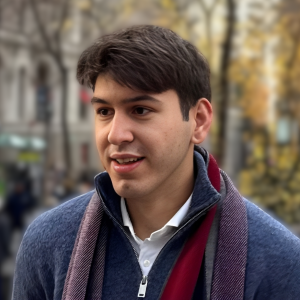
Ata Ulaş Güler joins host Brian Thomas on The Digital Executive Podcast.
Brian Thomas: Welcome to Coruzant Technologies, Home of The Digital Executive Podcast.
Do you work in emerging tech? Working on something innovative? Maybe an entrepreneur? Apply to be a guest at www.coruzant.com/brand.
Welcome to The Digital Executive. Today’s guest is Ata Ulas Güler. Ata Ulas Güler is the co-founder and COO of Noah Labs, where the team is building Sentinel, an air-gapped AI IDE purpose-built for regulated industries.
Ata leads business initiatives across growth, operations, and partnerships with a focus on legacy code, modernization in COBOL, Ada, Fortran, as well as multi-agent architectures designed for IL5 and NIST compliant environments. His work spans product strategy, go-to-market, and building the early relationships that position Noah Labs at the frontier of secure AI software development.
Alongside his work at Noah Labs, Ata brings experience from Lotus AI, where he is a senior consultant advising financial services and private equity clients, including Goldman Sachs portfolio companies, on AI strategy and value realization. Well, good afternoon, Ata. Welcome to the show.
Ata Ulaş Güler: Hi. Good afternoon, Ryan.
Brian Thomas: Nice to meet you, my friend. I really appreciate it. you’re navigating just a couple of time zones. You’re up in Palo Alto, California, I’m in Kansas City, so again, I won’t hold that against you. You know, Chiefs and the 49ers- … played some football in some past, crazy playoff games. But I appreciate you really making the time.
I know it’s hard sometimes. So, Ata, let’s jump into your first question. You’ve built your career at the intersection of engineering, AI strategy, and operations, now serving as the chief operating officer of Noah Labs. What experiences shaped your journey to where you are today?
Ata Ulaş Güler: Yeah. First of all, thank you so much for the opportunity.
Yeah, to answer the question, yeah, it’s kind of like a bit of a winding road, honestly. So I studied computer engineering at Purdue, with a concentration in, AI and machine learning, and I was just always drawn to the intersection of, like, just technical depth and, like, real world application. And I wasn’t just interested in, okay, like, building things.
I wanted to understand how they actually created value on these huge complex organizations. So that curiosity is basically what pulled me toward consulting pretty early on. And I joined, firm, Lotus AI, it’s London headquartered, while I was finishing my degree, and that experience was very, beneficial and formative.
And ways not, I mean, I didn’t fully appreciate at the time. So I was working, like, directly with private equity firms and financial institutions, and some of them were, like, Goldman Sachs portfolio companies. We helped them cut through, like the noise around AI and figure out what actually moves that needle, for their business.
And what I kept running into over and over was this massive gap between the AI, like what the industry was building and what these Goldman Sachs organizations actually needed. And the tools that were designed, most of the tools that they used, they were designed for a different world. oh, and I– we use this, in our startup, this kind of analogy, a world with, like, clean data, modern infrastructure, no regulatory constraints, basically.
And those clients, they lived in the opposite world. So by the time Murugappu, our CEO, brought me into the early conversations around Noah Labs, I had a, I had a good picture, right, of the problem, we were going after. I wasn’t coming in as this pure technologist or pure engineer from Purdue or pure businessperson.
I had, I had sat across the table from the customers we’re now selling to, and I kind of understood their pain, because of my prior, like, previous experience. And that background, I would say, is what shapes how I approach my role today as the COO. whether that’s GTM, right, go-to-market partnerships or the early pilots, we’re running with these prime companies or financial institutions mainly.
Brian Thomas: Yeah. Thank you. Really appreciate that. love the background. We always start these, podcasts out with kinda where you started and where you are today. And I liked, that your education was heavily immersed in AI and engineering, and you had an insatiable curiosity in this space, which obviously helped kinda lead you- Yeah
where you are today. So, in your experience in building AI systems, you found this gap, especially around security and compliance, and a– and again, big gap there. Still a gap there, but I’m glad what you’re doing today working with Noah Labs, which we’re gonna just dive in here to in a second. So at Noah Labs, you’re building Sentinel, an air-gapped AI IDE for regulated industries.
What problem did you see in traditional software development that led you to this innovation?
Ata Ulaş Güler: Yeah. So we, so we started with, code translation. I g- I guess the simplest way I can put it is, so the organizations with the most critical software in the world- Are also the ones that have been most completely, have been most completely ignored by the modern developer toolchain.
So, we started with code translation. Most of these, huge companies, they have a legacy code basis, COBOL, Fortran, C. and they are– they, they work with these code bases because one, yes, they work well, but they’re not equipped, they’re not memory safe. They’re very slow. and companies wanna modernize these code bases.
and most modern companies like, they use Cursor, Windsurf, GitHub, Copilot. These are incredible. but they– most of them assume you have internet access. They assume your code base is relatively modern or probably Python or TypeScript, right? They-they’ve been probably hosted on GitHub, probably a few hundred thousand lines at most.
So they assume your developers can just start using a cloud-connected tool without any security review. But these prime companies, let’s say, let’s take a government software team, for example. They might be maintaining a flight control system written in, let’s say, an old language, let me think, like Ada, for example, or a logistics platform or a financial institution, right?
Like, tho-those, companies that I mentioned with Lotus AI, like COBOL, very famous old legacy code base that nobody has touched in fifteen years because that, that one person, there’s this one person who understood, they retired, right? we, we wanted to focus on those codes and wanted to translate them with AI.
That’s how we started, Sentinel. Those companies wanna use AI, but they can’t because most of these tools connect to the internet. They connect to the cloud. they send data out of your computer. Sentinel mitigates that, and it does all of that offline without any internet connection. So that’s the gap we’re closing with Sentinel, basically.
and we built it from the ground up for those constraints. Like I said, it’s air-gapped by default. It’s optimized for these legacy languages, and it’s capable of holding an entire code base and context at once. I gu– I would say that that’s the problem we saw. And honestly, once you see it, it’s really hard to unsee because these regulated spaces, they’re very important for the economy.
The market is huge. and Murat, also our CEO, has had prior experience, in this space. So, that’s what we wanted to address. Yeah.
Brian Thomas: That’s awesome. Thank you. And I’ll just highlight a few things here. Obviously, the, the gap you’re, you’re looking to solve there, you used AI, you developed this, uh, code translation for these companies in the regulated space that are running legacy platforms and code bases like Fortran and COBOL, which I think is cool.
I have some experience back in the day, uh, with some of those, and I migrated- Yeah. …a lot of s- a lot of systems from those platforms. but yeah, doing it without internet is obviously a challenge, and you guys were able to solve that, obviously. And of course, in these very secure and regulated environments, you do need to have, top security.
And I know that’s why you also have this stuff air-gapped. So I appreciate you unpacking that. And Ata, your platform, Sentinel, is designed for IL Five and NIST-compliant environments. Right. Yes. How do you– how do strict compliance requirements shape the way AI tools are designed and deployed?
Ata Ulaş Güler: Yeah. they shape like everything, literally everything.
‘Cause I think the people outside of the space, regulated space, they underestimate just how deep those constraints go. It’s not like you can just take an existing AI IDE and just flip it, flip a switch to make it compliant, right? You have to rethink the entire architecture, the orchestrator, the, the, the AI, the models that you’re using.
So I just– I could talk about something as basic as like model inference. In a standard consumer AI tool, when you type a question, so that– but what… So, so what happens is, like that prompt, it leaves your machine, it goes to a data center somewhere, and then it get- it gets processed by a large model, and then you get a response.
Response comes back. So it’s the whole model. Now, in an IL Five environment, which most government agencies, most defense companies, most, like, most companies in these regulated spaces require, that data cannot leave the machine. Yeah, period. Like, you just can’t call out to OpenAI. You can’t call out to Anthropic.
You can’t call out to anyone. The model has to live on, locally, uh, on-premise or air-gapped. so those three terms we use. And that creates a whole cascade of technical challenges, right? Because the models that run locally tend to be smaller, and smaller models tend to perform, tend to perform worse.
So we’ve had to invest heavily in building and fine-tuning those custom models that are, optimized specifically for the languages and patterns you find in those code bases, government code bases. I mentioned in my previous response, but Ada, Fortran, COBOL, C. So languages that frontier models have very little training data on because most of them- Most of the open source code on the internet is Python and JavaScript.
Most of those models are not– They, they have not been trained with, these legacy code bases. and then beyond the model itself, you have things like audit trails, code attri-attribution, formal verification. And in, in these industries, regulated industries specifically. So if, if an AI writes a piece of code, and it ends up in a production system, you need to know exactly what, what the model did and why.
You need to be able to trace it. You need… Like the, the level of traceability is something consumer tools, like commercial tools weren’t built to provide, but it’s a baseline requirement for us for these IL Five plus, requirements. So in a lot of ways, compliance isn’t some, isn’t a constraint that slows us down.
It’s actually the core of what I would say differentiates Sentinel from everything else on the market, like CloudCode, Cursor, Windsurf. yeah.
Brian Thomas: Thank you. Really appreciate that. And I know it does take a lot. You’re, As you st-uh, started to say at the beginning there, a lot of times you have to redesign these environments from the ground up due to- Yeah
um, the regulatory requirements of IL Five and NIST. But you did spend a lot of time investing and developing for these, fine-tuned, highly complex environments. And of course, what I heard was important was that traceability, that auditing, guardrails, and y-it’s a totally different, game when you’re in these types of environments- Yeah
that have so much regulations.
Ata Ulaş Güler: yeah, totally different battlefields. Most tools, modern tools, they just don’t operate well. they’re very good models, but they’re mostly focused on the consumer side, commercial side. Yeah.
Brian Thomas: Exactly. Thank you so much. And Ata, as we look ahead to the future, how do you see secure AI development evolving over the next decade?
And what role will platforms like Sentinel play in shaping the future of software engineering in regulated industries?
Ata Ulaş Güler: Yeah. Yeah, I’m at, So I came to an event today, San Francisco. It’s, hosted by, Coda Capital, one of the big, venture capital firms here in San Francisco. And a lot of the, the portfolio companies here are just presenting their ideas, presenting their products, presenting like market research, where the AI is going, where the market is leading to.
I just genuinely, I’m like, I’ve just been impressed, constantly, and I think we’re genuinely at a pivotal moment. The last few years have just proven that AI can dramatically accelerate software development. it’s just no longer a hypothesis. It’s been sort of demonstrated But what we, I would say, I guess to tie it to Sentinel, we just haven’t figured out yet as an industry is how to bring those gains to the parts of the software world where the stakes are highest.
Defense systems, healthcare infrastructure, financial systems, energy, like critical government software. That’s where the work is still undone. And I would say over the next decade, I think you’re gonna see a real, real change. On one side, you’ll have a consumer and commercial AI actually ecosystem, which will keep moving incredibly fast, of course, and getting better and better for modern scene field development.
But on the other side, you’ll see a whole category of s- just secure compliance native, AI infrastructure, specifically for these regulated environments. And that category, that gap, like that… I’m sorry, that category that still, I mean, barely exists right now, that’s the space that Noah Labs is building into.
yeah, I would say that. And what I find really exciting, about where Sentinel fits is that we’re just not building an IDE by the way. Like we… Yes, uh, also, we’re not– we started with code translation, but now it evolved into a fully packaged IDE. Uh, it can do code generation, formal verification. we have fifteen features, and, so, uh, code translation is just one of them.
But our future vision is to build ASOs, autonomous software operators, no human intervention, AI agents for these regulated spaces. and I, I’m sure you know, that the market is becoming agentic. Everything is turning into agents right now, and we wanna, we wanna, we want to bring those agents to these regulated spaces, air-gapped, offline, optimized agent space to put. Yes.
Brian Thomas: Thank you. I appreciate that. You talked about a couple things here that really resonated with me. You see the future expanding and advancing to a point where, compliance-native AI development is commonplace, which I think is pretty cool. And then you talked about those, ASOs, autonomous software operators, and you’re absolutely right.
Agentic AI has been probably the, the top keyword listed out on the internet for the past eighteen months, and it’s only getting- Yeah … busier as we look at agentic systems and, and where they’re going today. So I appreciate that. And Ata, it was such a pleasure having you on today, and I look forward to speaking with you real soon.
Ata Ulaş Güler: Yeah. The pleasure was mine. Thank you so much, Brian. I appreciate it.
Brian Thomas: Bye for now.
Ata Ulaş Güler Podcast Transcript. Listen to the audio on the guest’s Podcast Page.